
Equity Ownership vs. Fixed-Income Allocation: Calibrating Growth and Stability
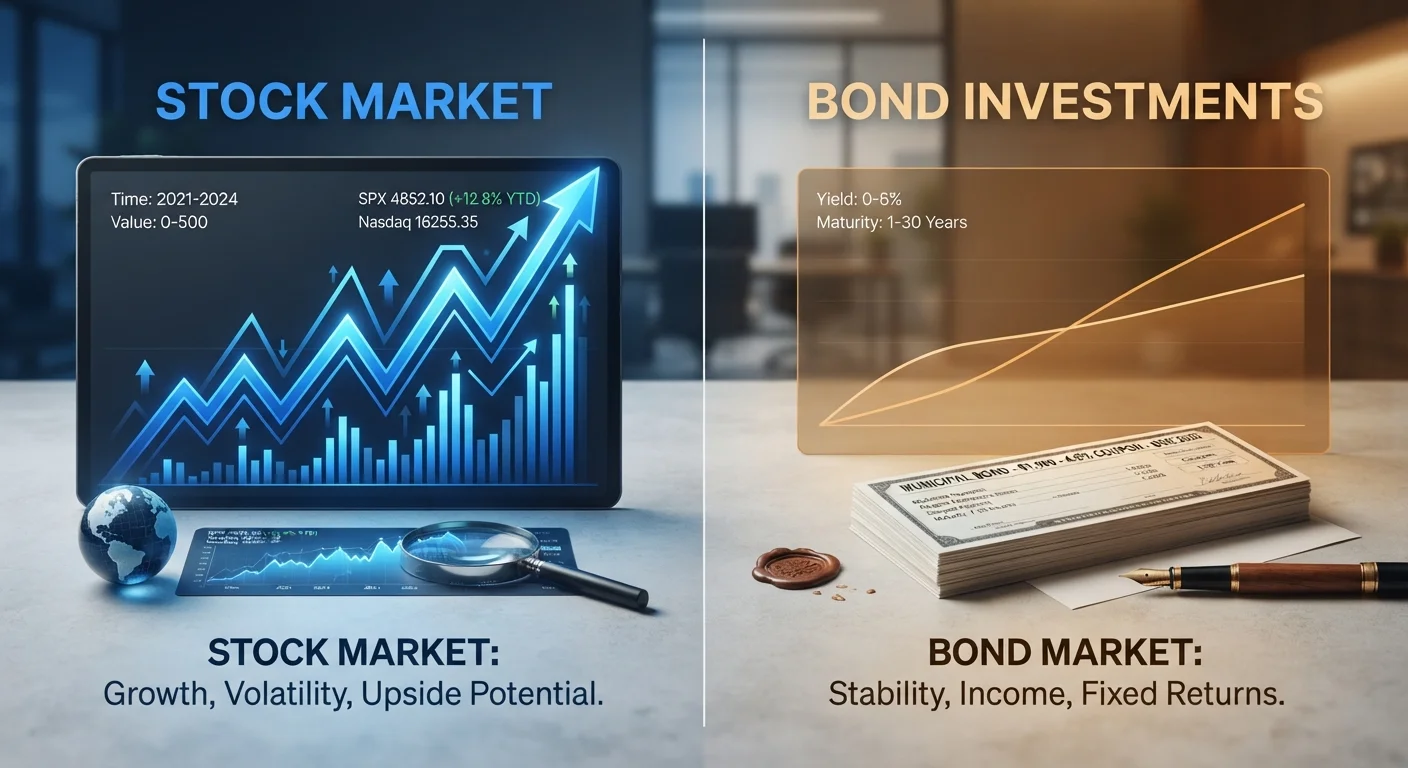
Photo credit: NewBizBuzz.net | Financial Insights For All
In this article
Stocks and bonds play different roles in a portfolio. Understand the trade-offs in growth potential and volatility between the two.
Key Takeaways
- Equities offer higher long-term return potential but carry substantially greater short-term volatility and downside risk.
- Fixed-income instruments generate predictable interest payments and generally hold value better during equity market downturns.
- The optimal equity-to-bond ratio depends on an investor's time horizon, risk tolerance, and income needs.
- Equities and investment-grade bonds have historically shown a low or negative correlation during market stress, providing diversification benefits.
- Neither asset class alone is sufficient — the interplay between the two shapes overall portfolio risk and return.
What Each Asset Class Actually Does
Equity ownership means holding a fractional claim on a company's future earnings and assets. As the company grows, so does the value of that claim — but if it contracts or fails, shareholders absorb losses. Returns come from two sources: price appreciation and dividends. Neither is guaranteed. For a deeper exploration of what drives equity returns and how they fit into a broader strategy, see equities as an asset class.
Fixed-income allocation involves lending capital to a government, municipality, or corporation in exchange for regular interest payments (the coupon) and return of principal at maturity. The income stream is contractually defined. The primary risks — credit risk and interest rate risk — are different in character from equity risk, and they interact with the broader portfolio differently. How bonds actually interact with equities is more nuanced than simply labelling them "safe."
| Criterion | Equity Ownership | Fixed-Income Allocation |
|---|---|---|
| Primary return source | Price appreciation + dividends | Interest (coupon) payments + principal return |
| Long-run return potential | Higher (historically 6–7% real) | Lower (historically 2–4% real) |
| Volatility | High; significant drawdowns possible | Generally lower; duration-dependent |
| Inflation protection | Moderate; earnings can grow with prices | Limited; fixed coupons lose real value |
| Behaviour in recessions | Typically declines sharply | Government bonds often gain; credit bonds vary |
| Income predictability | Variable; dividends can be cut | High; contractual coupon payments |
| Primary risk factors | Business risk, market sentiment, concentration | Interest rate risk, credit risk, inflation |
| Ideal time horizon | 10+ years to ride out volatility | Flexible; matches to liability or income need |
The Return and Volatility Trade-Off
The historical record is consistent: equities have delivered higher average annualised returns than investment-grade bonds over multi-decade periods. The S&P 500's long-run real (inflation-adjusted) return has averaged roughly 6–7% annually. Investment-grade bonds have typically returned 2–4% in real terms. That gap compounds dramatically over time.
The cost is volatility. Equity markets have historically experienced drawdowns of 20% or more during recessions and financial crises. Bonds, particularly government bonds, tend to hold or gain value during those same periods, acting as a portfolio buffer. This inverse relationship — while not guaranteed and not universal — underpins much of modern asset allocation theory.
~6–7%
Historical real annual equity return (long-run)
Based on long-run US large-cap equity data; past performance does not guarantee future results.
~2–4%
Historical real annual investment-grade bond return
Long-run estimate for US investment-grade fixed income; returns vary by duration and credit quality.
−0.3 to −0.5
Typical equity–bond return correlation during stress
During equity market downturns, US Treasuries have historically shown negative correlation with stocks, providing portfolio ballast.
Critically, volatility is not merely a psychological discomfort. It has a mathematical cost: sequence-of-returns risk means that a severe drawdown early in a retirement withdrawal period can permanently impair a portfolio's longevity, even if markets eventually recover.
Calibrating the Mix: Allocation Frameworks
No universal allocation ratio suits every investor. Several well-established frameworks can guide the thinking:
- Age-based rules of thumb: Traditional guidance once suggested holding a bond percentage equal to one's age (so a 40-year-old holds 40% bonds). Modern variants adjust this downward given longer lifespans and low-yield environments.
- Risk tolerance-driven models: Aggressive portfolios (e.g., 80–90% equity) prioritise growth and accept sharp drawdowns. Conservative portfolios (e.g., 30–40% equity) prioritise stability and income.
- Goal-based segmentation: Capital earmarked for spending within five years may be better held in fixed income; capital with a 20-year horizon can typically absorb equity volatility.
The relationship between these two asset classes across different economic environments is explored in depth in our guide on how asset classes behave across the economic cycle. For a broader view of how to structure a portfolio around both growth and protection, diversification across asset classes provides a practical framework.
Allocation Is Not Set-and-Forget
As markets move, an initial 70/30 equity-bond split can drift meaningfully — becoming 80/20 after a strong equity rally, for example. Periodic rebalancing restores the intended risk profile by trimming outperforming assets and adding to underperforming ones. The appropriate rebalancing frequency depends on transaction costs, tax implications, and the investor's sensitivity to drift. A licensed financial adviser can help determine the right cadence for a given situation.
Key Risks Investors Often Underestimate
Equity investors often underestimate concentration risk — the danger of being too exposed to a single sector, geography, or factor — and behavioural risk, the tendency to sell during downturns and lock in losses. Diversification within equities, across geographies and sectors, mitigates the former. A written investment policy statement can help address the latter.
Fixed-income investors frequently underestimate interest rate risk. When rates rise, existing bond prices fall — an inverse relationship that can produce meaningful capital losses, particularly in long-duration bonds. Inflation risk is equally significant: fixed coupon payments lose purchasing power when inflation runs high, eroding real returns. Investors who treat bonds as inherently "safe" without accounting for these dynamics may find themselves surprised.
The classic stocks vs. bonds trade-off is ultimately a trade-off between types of risk, not a choice between risk and safety.
This article is for general informational and educational purposes only and does not constitute personalised financial, investment, tax, or legal advice. All investments carry risk, including the potential loss of principal. Past performance does not guarantee future results. Consult a qualified financial adviser before making decisions based on your individual circumstances.

Author
Wealth Management Editorial Team
Wealth Management Editorial Team is the collective byline for our editorial team and contributor network. Articles published under this byline or an editorial pen name are researched, written, and reviewed according to our editorial standards for clarity, consistency, and independence before publication.
View all articles →