
Approaches to Wealth Growth Across Different Life Stages
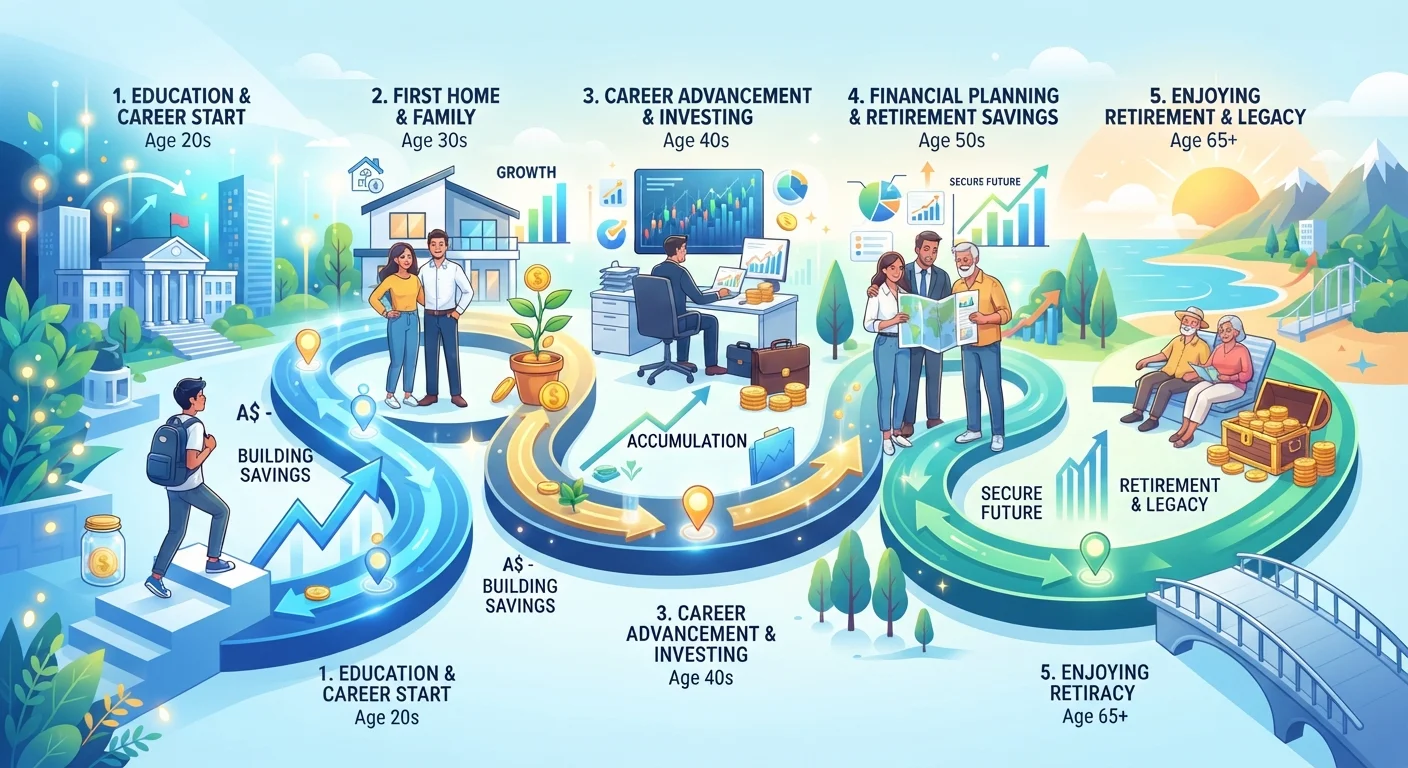
Photo credit: NewBizBuzz.net | Financial Insights For All
In this article
From early career to pre-retirement, wealth-building priorities shift. Explore how strategy should evolve across each major financial stage.
Key Takeaways
- Wealth-building priorities shift significantly from your 20s through your 60s and beyond.
- Early career years offer the most powerful compounding runway — starting early has outsized long-term impact.
- Mid-career is the optimal time to diversify assets, accelerate savings, and stress-test your financial plan.
- Pre-retirement focus should shift toward capital preservation, income sequencing, and tax-efficient drawdown.
- No single strategy fits all stages — aligning approach to life stage is itself a core wealth management skill.
Why Life Stage Should Shape Your Wealth Strategy
Wealth growth is not a static discipline. The strategies that build net worth effectively at 28 can be counterproductive at 58. Income levels, time horizons, tax situations, risk capacity, and financial obligations all shift across the decades — and your approach to wealth accumulation needs to shift with them.
This is not simply about becoming more conservative as you age. It is about aligning your tools, priorities, and risk posture to what each stage of life demands and permits. Understanding those shifting dynamics is one of the more consequential decisions finance-savvy adults can make. For a deeper look at how asset class selection changes with time, see our companion piece on asset allocation across life stages.
The five stages below represent broadly recognised financial phases. Individual timelines vary — a late-career professional returning to education, a business founder exiting early, or someone inheriting wealth mid-life will have different inflection points. Use these as frameworks, not rigid prescriptions.
Review Your Strategy at Every Major Milestone
Life events — a job change, marriage, divorce, the birth of a child, or an inheritance — can alter your financial situation faster than the calendar does. Build a habit of reviewing your wealth strategy whenever a significant change occurs, not only on a fixed annual schedule. A qualified financial adviser can help you stress-test your plan against new realities and adjust course before small misalignments become costly ones.
Five Wealth-Building Approaches by Life Stage
Early Career (20s–early 30s): Establish the Foundation
The defining advantage of early career years is time. Compound growth — the mechanism by which returns generate their own returns — is most powerful over long durations. Even modest contributions made consistently in your 20s can dwarf larger contributions made a decade later. Our explainer on why compounding makes time the most powerful variable details the mathematics behind this dynamic.
Core priorities at this stage typically include:
- Building an emergency fund covering three to six months of essential expenses — a liquidity buffer that prevents wealth destruction when the unexpected hits. See The Role of Emergency Funds in a Long-Term Wealth Strategy for context on why this matters beyond short-term safety.
- Maximising employer-sponsored retirement contributions, particularly where employer matching is available.
- Eliminating high-cost debt, which effectively offers a guaranteed return equal to the interest rate avoided.
- Establishing a diversified, growth-oriented portfolio appropriate to a long time horizon.
Time is the most valuable asset in early career wealth building — compounding rewards early starters disproportionately.
Mid-Career (mid-30s–40s): Accelerate and Diversify
Rising incomes, growing responsibilities, and increasing financial complexity define the mid-career phase. This is often the most productive accumulation window — income is typically higher, debt may be falling, and the investment runway remains substantial.
Key strategic shifts at this stage include:
- Increasing savings rates in line with income growth, rather than allowing lifestyle inflation to absorb every pay rise.
- Diversifying across asset classes and account types to reduce concentration risk and improve tax efficiency.
- Revisiting insurance coverage as dependants, mortgages, and earning power expand. Our guide on mapping insurance needs across life stages provides a structured overview.
- Beginning to model long-term goals — college funding, business ownership, early retirement — with realistic projections.
For a clear-eyed comparison of active accumulation versus passive income strategies at this stage, see Active Wealth Accumulation vs. Passive Income Strategies.
Mid-career is the prime accumulation window — raising your savings rate here compounds powerfully over the decades ahead.
Late Career (50s): Optimise and Protect
As retirement moves from abstract to concrete, the emphasis shifts from pure accumulation toward optimisation and protection. The goal is not simply to grow wealth but to grow it in ways that preserve optionality and minimise unnecessary risk.
- Tax efficiency becomes critical: decisions about Roth conversions, asset location, and deferred compensation can have lasting impact on net wealth at retirement.
- Catch-up contribution limits available to those aged 50 and over in US retirement accounts represent a meaningful opportunity that many overlook.
- Portfolio risk should be reviewed against actual retirement timelines, not assumed rules of thumb. The risk and return balance across life stages evolves materially here.
- Early estate planning — beneficiary designations, power of attorney, and basic legacy structures — becomes a sensible priority rather than a deferred task.
In your 50s, tax optimisation and risk calibration often deliver more value than chasing higher nominal returns.
Pre-Retirement (early 60s): Sequence and Structure Income
The transition from accumulation to distribution introduces a distinct set of risks, most notably sequence-of-returns risk — the danger that poor market performance in the early years of retirement can permanently impair a portfolio's longevity, even if long-term average returns look reasonable.
Strategic considerations at this phase include:
- Building a cash or near-cash buffer covering one to two years of income needs to avoid forced selling during downturns.
- Mapping Social Security claiming decisions against health, longevity expectations, and spousal income needs — delaying benefits increases monthly payments but requires bridging income.
- Structuring a clear drawdown sequence across taxable, tax-deferred, and tax-free accounts to manage lifetime tax exposure.
- Reviewing the wealth protection strategies appropriate to this stage, including annuity options and longevity planning.
Sequence-of-returns risk is a pre-retirement blind spot — structuring an income buffer reduces the damage of early drawdown losses.
Retirement and Legacy (mid-60s onward): Preserve, Distribute, Transfer
Active accumulation gives way to sustainable distribution and intentional legacy planning. The financial objectives shift: sustaining purchasing power, managing healthcare costs, and transferring remaining wealth efficiently to heirs or causes.
- Inflation protection remains relevant — a 20- to 30-year retirement horizon means purchasing power erosion is a genuine risk, not a distant concern.
- Required Minimum Distributions (RMDs) from tax-deferred retirement accounts create mandatory taxable income from age 73 (under current US rules) that benefits from advance planning.
- Estate planning tools — trusts, gifting strategies, charitable vehicles — become operational rather than preparatory. The Wealth Transfer hub outlines the core frameworks for passing assets efficiently and intentionally.
- Healthcare and long-term care costs represent the largest unplanned expense risk for retirees and warrant dedicated financial planning attention.
Retirement is not the end of wealth strategy — sustainable distribution and intentional legacy planning define this phase.
These Stages Are Frameworks, Not Formulas
Life rarely unfolds on a predictable schedule. Someone who starts investing at 35, sells a business at 45, or faces an unexpected health event at 55 will need to adapt these frameworks to their specific context. The underlying principles — time horizon awareness, diversification, tax efficiency, and risk alignment — apply broadly, but their application is always personal. Work with a licensed financial professional to tailor any strategy to your individual circumstances.
Building a Strategy That Evolves With You
The most durable wealth-building plans are not rigid blueprints — they are adaptive frameworks reviewed regularly as circumstances change. Major life events such as marriage, a new child, a business exit, or a career transition can render an existing strategy obsolete. Our guide on wealth transfer strategies after major life changes outlines what to reassess and when.
Periodic self-assessment matters at every stage. The Wealth Growth Audit checklist provides a structured way to review your savings rate, asset allocation, and tax efficiency as your situation evolves. For a comprehensive end-to-end reference, Building and Compounding Personal Wealth covers the full spectrum of growth strategies in one place.
This article is for general informational and educational purposes only. It does not constitute personalised financial, investment, tax, or legal advice. Individual circumstances vary significantly — consult a qualified financial adviser, tax professional, or attorney before making decisions based on your own situation.

Author
Wealth Management Editorial Team
Wealth Management Editorial Team is the collective byline for our editorial team and contributor network. Articles published under this byline or an editorial pen name are researched, written, and reviewed according to our editorial standards for clarity, consistency, and independence before publication.
View all articles →