
Diversification Across Asset Classes: What a Balanced Growth Portfolio Actually Looks Like
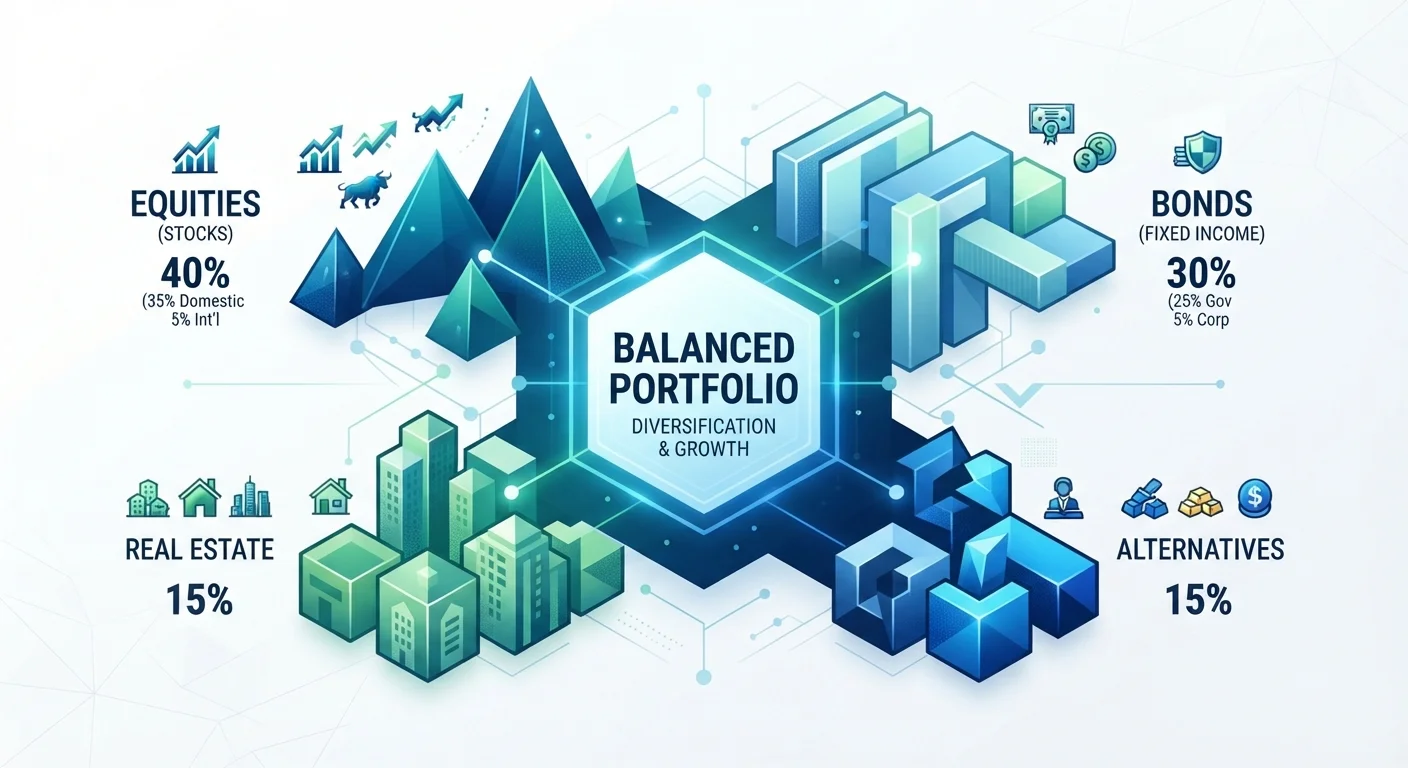
Photo credit: NewBizBuzz.net | Financial Insights For All
In this article
Explore how spreading capital across equities, fixed income, real assets, and alternatives can reduce risk while supporting long-term growth.
Key Takeaways
- True diversification requires spreading capital across asset classes with different return drivers, not just different tickers.
- Equities, fixed income, real assets, and alternatives each play a distinct role in a balanced growth portfolio.
- Correlation between asset classes — not just individual volatility — determines how effective diversification actually is.
- A portfolio's asset allocation should reflect an investor's time horizon, risk tolerance, and liquidity needs.
- Regular rebalancing is essential to maintain intended allocation as market movements cause drift over time.
- Past performance of any asset class does not guarantee future results; all investing involves risk.
Why Asset Class Diversification Goes Beyond Holding More Stocks
Many investors assume that owning dozens of stocks — or a handful of equity mutual funds — constitutes a diversified portfolio. It does not. Holding fifty technology-sector equities provides broad exposure within one asset class but leaves the portfolio highly vulnerable to a single type of economic shock: a sector rotation, rising interest rates, or a contraction in growth expectations can compress all of them simultaneously.
Genuine diversification means assembling assets whose prices are driven by different underlying forces. Asset classes such as equities, fixed income, real assets, and alternatives respond distinctly to the same macroeconomic events — and that divergence is the source of diversification's protective value.
The statistical measure that matters most here is correlation. When two assets have a correlation close to +1, they move in lockstep, providing no diversification benefit. Assets with low or negative correlations to each other can dampen overall portfolio volatility even if each individual asset is volatile on its own. Understanding this principle is the foundation of building a portfolio that is genuinely balanced, not just superficially varied.
Common Diversification Misconceptions
Holding many funds or ETFs does not automatically produce a well-diversified portfolio. Multiple funds tracking similar indices can create significant overlap, concentrating risk rather than spreading it. Misconceptions about diversification outlines several widely held beliefs that do not hold up under scrutiny — worth reviewing before assuming your portfolio is truly balanced.
The Core Building Blocks of a Balanced Growth Portfolio
A practical balanced growth portfolio typically draws from four broad categories, each serving a distinct function:
- Equities provide the primary engine of long-term capital growth. Public equities — domestic and international — expose investors to corporate earnings and economic expansion. Within equities, diversification across geographies, market capitalizations, and sectors further reduces concentration. See how equities compare to fixed income for a deeper look at calibrating growth and stability.
- Fixed income (bonds) serves as a stabilizer and income source. High-quality government and investment-grade corporate bonds have historically provided ballast when equity markets fall sharply — though this relationship is not guaranteed during inflationary periods when both asset classes may decline together.
- Real assets — including real estate (often accessed via REITs), commodities, and infrastructure — tend to hold their value or appreciate during inflationary environments, providing a hedge that neither stocks nor bonds reliably offer.
- Alternatives encompass a wide range: private equity, hedge funds, commodities, and more recently, digital assets. Their primary appeal is a potentially low correlation to public market returns. For a comprehensive overview, see alternative asset classes explained.
~90%
Portfolio returns explained by asset allocation
Research including the landmark Brinson, Hood, and Beebower study (1986, updated 1991) found that asset allocation policy explains the vast majority of a portfolio's return variability over time — underscoring the primacy of class-level decisions over individual security selection.
0.0
Ideal inter-asset correlation for diversification
In portfolio theory, combining assets with a correlation of zero or below provides the strongest diversification benefit; while perfect zero correlation is rare in practice, it illustrates why pairing assets with distinct return drivers is central to portfolio construction.
60/40
Traditional balanced portfolio benchmark split
The 60% equity / 40% bond split has served as a baseline reference point for balanced portfolios for decades, though practitioners increasingly debate its adequacy in modern, higher-inflation market environments.
What Allocation Percentages Actually Look Like in Practice
There is no single allocation that suits every investor. A balanced growth portfolio for a 35-year-old with a 30-year horizon will look meaningfully different from one designed for someone approaching retirement. That said, a commonly discussed illustrative framework for a growth-oriented investor with a long time horizon might apportion roughly 50–65% to equities (domestic and international), 20–30% to fixed income, 10–15% to real assets, and 5–10% to alternatives.
These figures are illustrative, not prescriptive. Individual circumstances — including income stability, liquidity needs, tax situation, and risk tolerance — should drive any actual allocation decision. Consulting a licensed financial adviser is strongly recommended before making material changes to portfolio construction.
It is also worth noting that diversification across geographies matters within equities. A portfolio concentrated entirely in US large-cap stocks, while internally diversified by sector, still carries significant country-specific and currency risk. International developed-market and emerging-market exposure can broaden that foundation. Diversification as a defensive tool explores how geographic and currency diversification further strengthens a portfolio's structure.
Check Correlations, Not Just Asset Names
Before assuming two holdings diversify each other, look at how they have historically moved relative to one another — particularly during market stress periods. Assets that appear different on paper (such as high-yield bonds and equities) can become highly correlated during broad sell-offs, reducing the diversification benefit precisely when it is most needed.
Maintaining Balance: The Role of Rebalancing and Ongoing Review
Building a balanced allocation is not a one-time event. Market movements continuously alter the composition of a portfolio — equities that outperform will grow to represent a larger share, inadvertently increasing risk beyond the intended target. Without periodic attention, a portfolio designed as 60% equity / 40% other assets could drift to 75% equity over a sustained bull market, exposing the investor to far more downside than originally intended.
Portfolio rebalancing — the process of selling overweight assets and adding to underweight ones — restores the intended risk profile. The frequency and method of rebalancing involves real trade-offs: more frequent rebalancing captures drift efficiently but may trigger taxable events and transaction costs.
Additionally, an investor's own circumstances change over time. A balanced growth portfolio that made sense at age 40 may need to shift toward capital preservation as retirement approaches. Life events — inheritance, business exit, change in income — may also warrant a structural review of the portfolio's objectives.
For those incorporating dividend-generating equities as part of their growth strategy, the dividend growth strategy offers a complementary lens on compounding income within an equity allocation. And for investors exploring digital assets as a diversifying element, digital asset portfolio construction provides a structured framework for that allocation.
This article is intended for general informational and educational purposes only and does not constitute personalized financial, investment, tax, or legal advice. All investing involves risk, including the potential loss of principal. Past performance does not guarantee future results. Please consult a qualified financial adviser before making decisions about your own portfolio.
Frequently Asked Questions

Author
Wealth Management Editorial Team
Wealth Management Editorial Team is the collective byline for our editorial team and contributor network. Articles published under this byline or an editorial pen name are researched, written, and reviewed according to our editorial standards for clarity, consistency, and independence before publication.
View all articles →