
Equities as an Asset Class: Return Potential, Volatility, and Portfolio Role
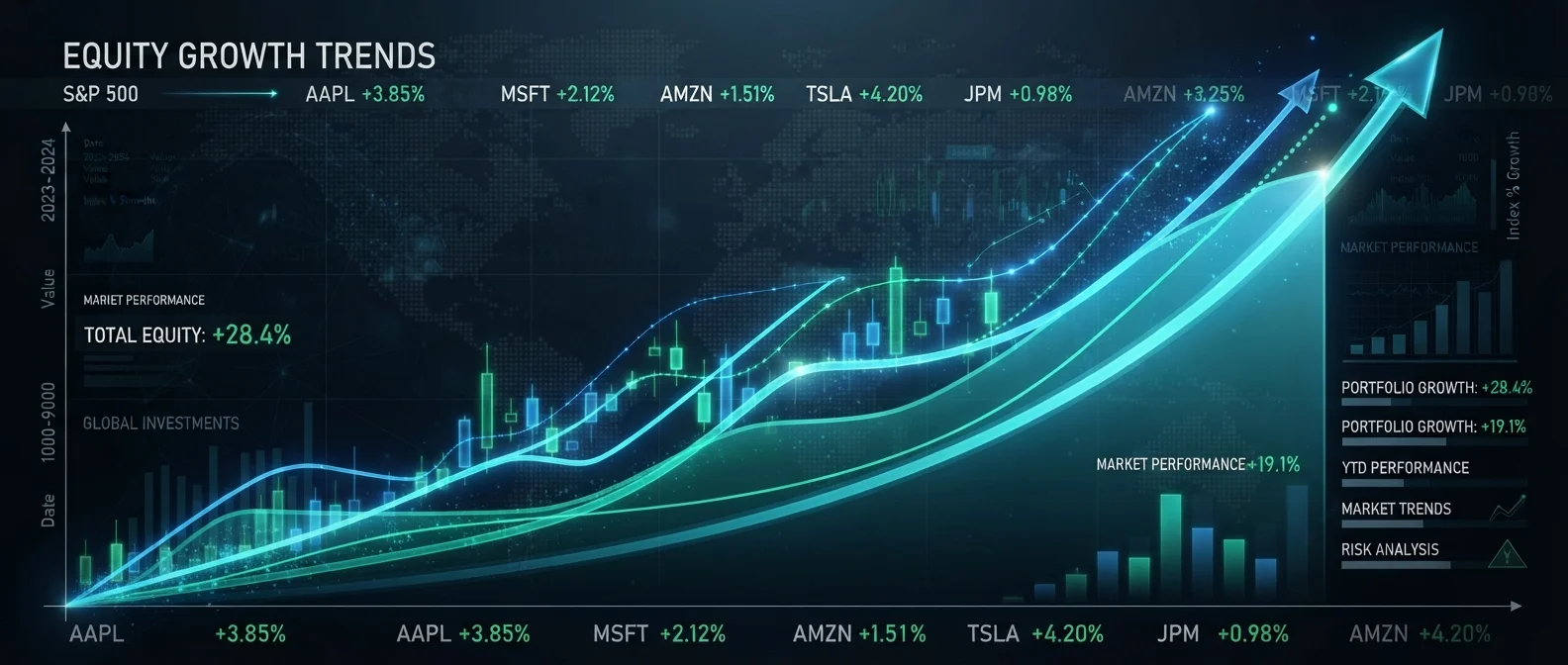
Photo credit: NewBizBuzz.net | Financial Insights For All
In this article
Stocks sit at the heart of most growth-oriented portfolios. This guide explains what drives equity returns and the risks that come with them.
Key Takeaways
- Equities represent ownership stakes in companies and carry both growth potential and real loss risk.
- Equity returns come from capital appreciation, dividends, and earnings reinvestment over time.
- Stocks have historically outperformed bonds and cash over long horizons, but with significant short-term volatility.
- Equity allocation should reflect an investor's time horizon, risk tolerance, and portfolio objectives.
- Diversification across sectors, geographies, and market capitalizations can reduce concentration risk.
- Past equity performance does not guarantee future results; all equity investing involves risk of loss.
What Equities Actually Are
An equity is a fractional ownership stake in a company. When a corporation issues shares — through an initial public offering or subsequent offerings — it is dividing ownership into transferable units. Each share entitles the holder to a proportional claim on the company's assets and earnings, though that claim is subordinate to creditors and bondholders in the event of liquidation.
This ownership structure is what distinguishes equities from debt instruments. Bondholders are creditors who receive promised interest payments; shareholders are owners who participate in the company's upside — and absorb its downside. That fundamental distinction drives nearly every difference in risk and return between the two asset classes. For a deeper comparison, see how equities and bonds trade off against each other.
Equities exist across a wide spectrum: large-cap domestic corporations, small-cap growth companies, international developed-market stocks, and emerging-market equities each carry distinct risk and return characteristics. Understanding this internal diversity is as important as understanding equities as a category.
The Sources of Equity Returns
Equity returns flow from three interconnected sources: capital appreciation, dividends, and the compounding effect of earnings reinvestment.
- Capital appreciation occurs when a company's market price rises, reflecting improved earnings expectations, multiple expansion, or broader market sentiment.
- Dividends are periodic cash distributions from after-tax profits. Historically, dividend reinvestment has accounted for a substantial portion of total equity returns over multi-decade periods.
- Earnings reinvestment compounds value when management allocates retained profits into projects that generate returns above the cost of capital.
These drivers are ultimately anchored in corporate earnings growth. Over long time horizons, equity market returns broadly track the growth of underlying corporate profits, which itself reflects economic expansion, productivity gains, and innovation. Investors seeking to understand how equities compare with real assets should also consult how stocks, bonds, and real estate risk profiles actually differ.
~10%
US large-cap equities annualized nominal return
The broad US equity market has delivered approximately 10% annualized nominal returns over rolling 20-year periods historically, though results vary significantly by start date.
~30–40%
Contribution of dividends to long-run total returns
Academic research on long-run US equity returns has found that dividend reinvestment has historically contributed roughly one-third or more of total equity returns over multi-decade periods.
−38%
S&P 500 annual return in 2008
The 2008 financial crisis produced one of the steepest calendar-year drawdowns in US equity market history, illustrating the magnitude of short-term loss risk equities carry.
Understanding Equity Volatility
Volatility — typically measured by the standard deviation of returns — is the defining characteristic that separates equities from more stable asset classes. US large-cap equities have historically experienced annual return swings ranging from losses exceeding 30% to gains above 40%, even within the same secular bull market.
This volatility stems from the open-ended nature of equity claims. Unlike a bond with a fixed coupon, a share's value is the present discounted value of all future cash flows — a figure that fluctuates continuously as interest rates, earnings expectations, and investor sentiment shift.
Distinguish between volatility and risk of permanent loss. A 20% drawdown in a diversified equity index is painful but historically recoverable; permanent impairment typically requires concentration in a failed business.
Conflating temporary price declines with permanent loss leads many investors to sell at the worst moment, locking in losses that time would otherwise have reversed.
Before increasing equity exposure, verify your actual cash reserve covers at least 12–18 months of planned withdrawals. Forced selling during drawdowns is the most common source of realized equity loss.
The sequence-of-returns risk is most acute when investors must liquidate positions at depressed prices to meet income needs — a structural hazard that liquidity planning directly addresses.
Short-term volatility, while psychologically challenging, is distinct from permanent capital loss. Investors with sufficiently long time horizons have historically recovered from drawdowns, though there is no guarantee this pattern will persist. The key variable is whether an investor can remain invested through a downturn without being forced to sell — which is why liquidity needs and time horizon should define equity allocation decisions. For context on how equities compare with higher-volatility alternatives, see how crypto's risk-return profile compares.
How Equities Fit Into a Portfolio
In portfolio construction, equities serve as the primary engine of long-run growth. Their higher expected return over time — relative to bonds and cash — reflects compensation for bearing greater short-term uncertainty. This principle is central to the risk and return framework that underlies modern portfolio theory.
The appropriate equity allocation for any investor depends on three variables: time horizon (longer horizons allow more time to recover from drawdowns), risk tolerance (the psychological and financial capacity to endure losses), and income needs (portfolios funding near-term withdrawals require stability that equities may not provide).
Fixed income plays a complementary role — providing income, dampening volatility, and serving as a rebalancing source during equity downturns. See how bonds interact with equities in a stock-heavy portfolio for a detailed examination. For investors calibrating growth against stability, equity versus fixed-income allocation trade-offs offers a structured framework.
Rebalance to Maintain Your Target Allocation
Equity outperformance gradually shifts portfolio weight toward stocks, increasing risk beyond your intended level. Periodic rebalancing — selling appreciated equity positions and adding to underweight asset classes — systematically enforces discipline and can improve risk-adjusted outcomes over time. Consult a financial adviser to determine a rebalancing approach suited to your tax situation and investment policy.
Key Risks Every Equity Investor Should Know
Investing in equities involves several distinct categories of risk that investors should understand before building a position:
- Market risk
- Broad economic downturns or sentiment shifts can depress equity prices across all sectors simultaneously, limiting the protection diversification provides within equities alone.
- Concentration risk
- Overweighting a single stock, sector, or geography amplifies the impact of localized adverse events on overall portfolio value.
- Valuation risk
- Equities purchased at elevated price-to-earnings multiples may generate lower forward returns even if underlying business fundamentals remain sound. Understanding valuation is explored in depth in our guide to measuring equity worth.
- Liquidity risk
- While large-cap stocks are highly liquid, smaller-cap or international equities may carry bid-ask spreads or trading volume constraints that affect execution.
Equities Carry Real Loss Risk
Equity prices can decline sharply and remain depressed for extended periods. During the 2000–2002 dot-com bust and the 2008–2009 financial crisis, US equity markets lost roughly 50% of their value from peak to trough. Investors close to retirement or with short time horizons should carefully assess whether their equity allocation matches their capacity to absorb such drawdowns without lasting financial harm.
Practical Considerations for US Investors
US investors building equity exposure face a range of structural choices that affect both cost and outcome. Broad index strategies — which seek to track a market index rather than beat it — have historically generated competitive after-cost returns for many investors, reflecting the difficulty of consistently identifying outperforming securities. Active strategies may offer differentiated exposure but typically carry higher fees and tax drag in taxable accounts.
Tax efficiency matters considerably in equity investing. Long-term capital gains (on positions held more than one year) are taxed at preferential rates under current US federal tax law, making holding period discipline an important consideration. Dividend taxation, qualified versus non-qualified status, and account type (taxable vs. tax-advantaged) all interact with equity returns in ways worth reviewing with a qualified tax professional.
Geographic diversification — including developed international and emerging-market allocations — can reduce dependence on the US economic cycle, though it introduces currency risk and country-specific governance considerations. For structured approaches to equity investing, the investing strategies hub provides further guidance on building and managing a stock portfolio.
This article is for general informational and educational purposes only and does not constitute personalized financial, investment, tax, or legal advice. All investing involves risk, including the potential loss of principal. Past performance does not guarantee future results. Consult a qualified financial adviser, accountant, or attorney before making decisions based on your individual circumstances.

Author
Investing Fundamentals Editorial Team
Investing Fundamentals Editorial Team is the collective byline for our editorial team and contributor network. Articles published under this byline or an editorial pen name are researched, written, and reviewed according to our editorial standards for clarity, consistency, and independence before publication.
View all articles →