
Asset Allocation Across Life Stages: How Time Horizon Changes the Equation
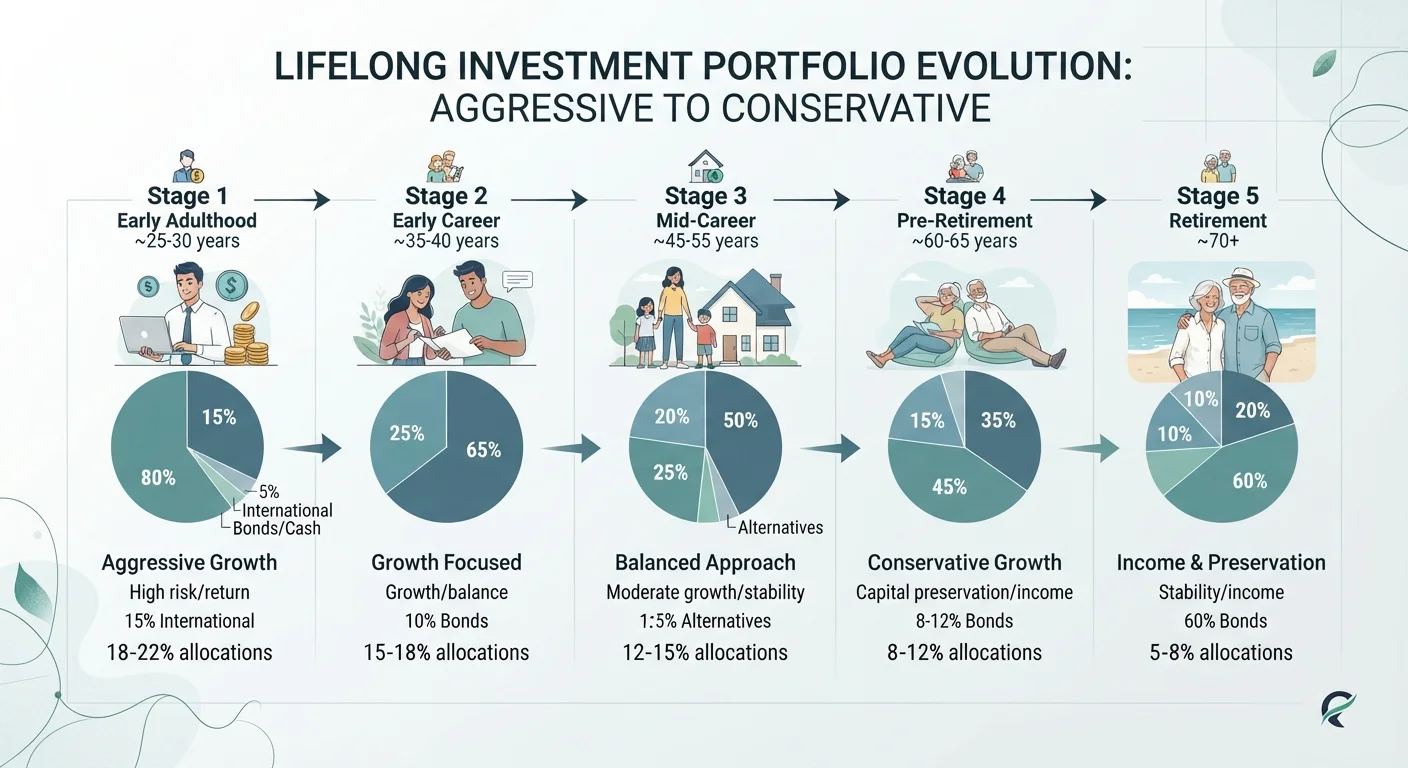
Photo credit: NewBizBuzz.net | Financial Insights For All
In this article
The right mix of asset classes at 30 looks very different from the right mix at 60. Here's how and why the balance generally shifts over time.
Key Takeaways
- Longer time horizons generally support higher equity allocations because short-term volatility can be absorbed over time.
- As retirement approaches, gradually shifting toward income-generating and capital-preserving assets reduces sequence-of-returns risk.
- Life-stage allocation is a framework, not a formula — individual risk tolerance, income stability, and goals all matter.
- Regular rebalancing is essential to ensure your actual allocation stays aligned with your target as markets move.
- Tax-advantaged account choices interact directly with allocation decisions and deserve coordinated planning.
Why Life Stage Is the Starting Point for Allocation Decisions
Asset allocation — the division of a portfolio across equities, fixed income, cash, and alternatives — is the primary driver of long-run portfolio risk and return, according to foundational research in portfolio theory. But no single allocation is right for all investors. The most consequential variable distinguishing one investor's appropriate mix from another's is time horizon: how long the money has to work before it needs to be spent.
A 30-year-old saving for retirement 35 years away can, in principle, ride out multiple market cycles. A 62-year-old planning to begin drawing down in three years cannot afford the same exposure to short-term volatility. The math, the psychology, and the consequences are all different — and the allocation should reflect that.
This guide walks through a structured, step-by-step process for thinking about allocation across life stages. It is framed as general financial education. Individual circumstances vary enormously, and readers should consult a licensed financial adviser before making decisions. You'll need the right tools and baseline knowledge before starting:
What you will need
Personal balance sheet
Clarifies net worth, existing asset mix, and liabilities — the foundation for deciding where allocation adjustments are needed.
Retirement income calculator
Estimates how much your portfolio needs to generate in retirement, informing how conservative your eventual allocation should become.
Tax-advantaged account summary (401(k), IRA, Roth IRA)
Knowing which accounts hold which assets lets you optimize asset location alongside asset allocation.
Risk tolerance questionnaire
Establishes your emotional and financial capacity for loss, which should anchor any allocation decision alongside time horizon.
Portfolio tracking spreadsheet or software
Monitors actual vs. target allocation over time and flags when rebalancing is due.
The Step-by-Step Framework for Life-Stage Allocation
This Is Education, Not Personalized Advice
The frameworks described here are general in nature and intended for educational purposes only. They do not account for your specific financial situation, tax circumstances, or goals. Consult a licensed financial adviser before making allocation decisions.
Establish your current time horizon and financial milestone map
Before adjusting any allocation, define how many years separate you from each major financial goal — retirement, a home purchase, funding education, or another target. Time horizon is the single most powerful variable in allocation design. As explored in our guide on how time horizon changes risk and reward, a longer runway allows volatility to average out; a shorter one does not.
Map each goal to a specific year, then rank them by priority and size. This prevents the common error of applying a single allocation logic to money that serves very different timelines.
Benchmark your current allocation against your life stage
Pull together your holdings across all accounts and calculate your current equity-to-fixed-income-to-cash split. Compare this against a life-stage benchmark appropriate to your time horizon. While no universal rule applies to everyone, broad financial planning literature frequently references heuristics such as holding a larger equity percentage in early career years and reducing it incrementally as retirement nears — though such rules of thumb are starting points, not prescriptions.
Investors in their 20s and early 30s, with decades before retirement, can typically absorb more short-term volatility in exchange for higher long-run expected growth. Those within 10 years of retirement generally benefit from a more defensive tilt. See how risk and return priorities shift across life stages for a fuller breakdown of that progression.
Set a target allocation aligned with your stage, goals, and risk tolerance
Using your time horizon analysis, set a written target allocation — specifying target percentages for equities (domestic and international), fixed income (government, corporate, duration mix), cash equivalents, and any alternative exposures. Your target should reflect both your objective capacity for risk (time horizon, income stability, liquidity needs) and your subjective tolerance for watching portfolio value decline without panic-selling.
This is where strategic versus tactical asset allocation becomes relevant: a strategic allocation sets a long-term target you maintain through market cycles; a tactical overlay adjusts it based on specific market views. Most individual investors are best served starting with a clear strategic target before layering any tactical adjustments.
Integrate account type and tax location into your allocation plan
Where you hold assets matters as much as what you hold. Tax-inefficient assets — such as taxable bond funds that generate ordinary income — are generally better suited to tax-deferred accounts like traditional IRAs or 401(k)s. Growth-oriented equities, especially those held long-term, may be more efficient in taxable brokerage accounts where long-term capital gains rates apply, or in Roth accounts where qualified withdrawals are tax-free.
Decisions about Roth conversions versus traditional IRA contributions can directly affect how you distribute assets across account types. Coordinating allocation with account structure is a meaningful source of after-tax return improvement that doesn't require taking additional investment risk.
Build a rebalancing discipline to maintain your target over time
Markets will drift your portfolio away from its target — often substantially over multi-year periods. A sustained equity bull market can leave a nominally "balanced" portfolio significantly overweight stocks, increasing risk without a conscious decision to do so. Portfolio drift is systematic, not exceptional.
Establish either a calendar-based rebalancing schedule (annually or semi-annually) or a threshold-based trigger (rebalance when any asset class deviates more than a set percentage from target). The mechanics, costs, and tax implications of each approach are covered in depth in rebalancing timing, triggers, and tradeoffs.
Schedule periodic allocation reviews tied to life events and age milestones
A target allocation set at 35 should not still be in place, unchanged, at 55. Build annual or biennial allocation reviews into your financial calendar, and trigger an additional review after any major life event: marriage, divorce, job change, inheritance, or a significant shift in health status.
As part of your broader financial picture, wealth-building strategy naturally evolves across life stages — and your allocation should track that evolution deliberately rather than by default. Similarly, insurance needs shift across life stages in parallel with investment priorities, and a comprehensive review should address both together.
Sequence-of-Returns Risk Is Real
Large portfolio losses in the years immediately before or after retirement can permanently impair your financial security, even if long-term average returns look acceptable. This is why reducing equity concentration as retirement nears is widely recommended — not because stocks are inherently bad, but because the timing of losses matters enormously late in the accumulation phase.
Automate Allocation Shifts Where Possible
Target-date funds automatically adjust their equity-to-bond ratio as a stated retirement year approaches — a useful structural tool for investors who want a systematic glide path without manual intervention. Understanding how any such fund's glide path works before relying on it is worthwhile, since different funds use meaningfully different approaches.
For investors considering exposure to newer asset classes, sizing a crypto position responsibly is a useful reference for thinking through position sizing within a broader allocation framework. The core principle — that any single asset's weight should reflect its risk contribution to the overall portfolio — applies regardless of asset class.
For a broader framework on building and balancing a portfolio, and on strategies for compounding wealth over time, explore the related pillar content linked throughout this guide.
This article is intended for general informational and educational purposes only. It does not constitute personalized financial, investment, tax, or legal advice. All investments carry risk, including the possible loss of principal. Past performance does not guarantee future results. Consult a qualified financial professional before making any investment decisions.

Author
Investing Fundamentals Editorial Team
Investing Fundamentals Editorial Team is the collective byline for our editorial team and contributor network. Articles published under this byline or an editorial pen name are researched, written, and reviewed according to our editorial standards for clarity, consistency, and independence before publication.
View all articles →