
Actual Cash Value vs. Replacement Cost: Why the Gap Can Be Enormous
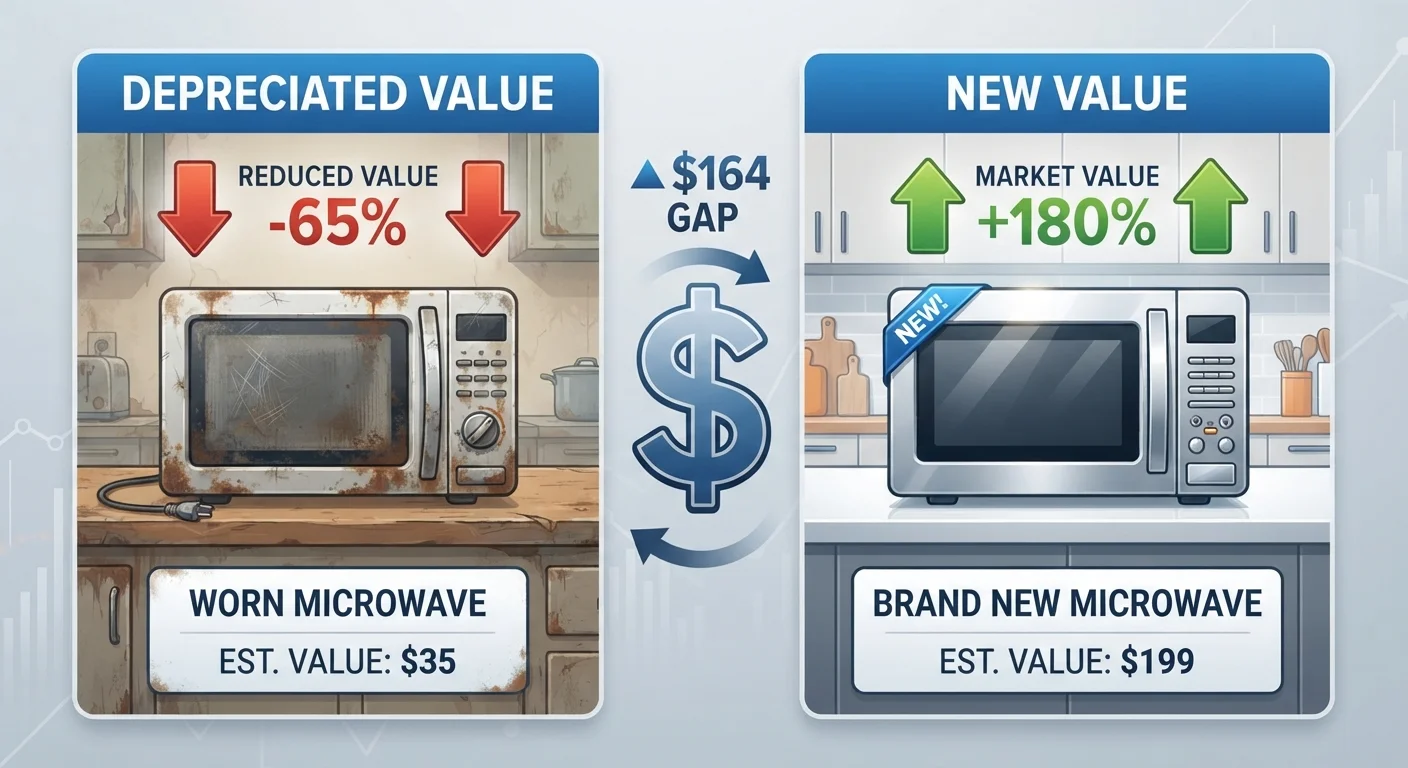
Photo credit: NewBizBuzz.net | Financial Insights For All
In this article
Two valuation methods. One major financial difference. Learn how insurers calculate payouts — and which approach protects you more fully.
Key Takeaways
- ACV pays what your property was worth at the time of loss, after subtracting depreciation.
- RCV pays what it actually costs to repair or replace the damaged property with a comparable new item.
- The gap between ACV and RCV can run into tens of thousands of dollars for older homes or belongings.
- RCV policies carry higher premiums, but dramatically reduce out-of-pocket costs after a major claim.
- Your policy's valuation method is one of the most consequential choices in your coverage — check your declarations page.
- Always consult a licensed insurance professional to determine which valuation approach fits your financial situation.
How Each Valuation Method Works
When you file a property insurance claim, your payout hinges on a single question buried in your policy: how does your insurer calculate the value of what you lost? Two methods dominate the market — Actual Cash Value (ACV) and Replacement Cost Value (RCV) — and the difference between them is not semantic. It can mean the difference between full recovery and a five-figure shortfall.
Actual Cash Value is calculated as the item's replacement cost minus accumulated depreciation. Depreciation accounts for age, wear and tear, and obsolescence. A roof that cost $15,000 to install twelve years ago, with a 20-year expected lifespan, may have depreciated by roughly 60% — leaving an ACV payout around $6,000, even if a new roof costs $20,000 today.
Replacement Cost Value pays what it actually costs — at current market prices — to repair or replace the damaged property with a comparable new item or material, without deducting for depreciation. Using the same roof example, an RCV policy would pay toward the full $20,000 replacement, minus your deductible.
| Criterion | Actual Cash Value (ACV) | Replacement Cost Value (RCV) |
|---|---|---|
| Payout basis | Depreciated value at time of loss | Current cost to repair or replace |
| Depreciation deducted? | Yes — subtracted from payout | No — paid at today's prices |
| Premium cost | Generally lower | Generally higher |
| Out-of-pocket risk after loss | Higher — policyholder covers gap | Lower — insurer covers full replacement |
| Best suited for | Lower-value or rapidly depreciating property | Homes, structures, and high-value belongings |
| Inflation exposure | Higher — depreciation compounds rising costs | Lower — current market prices apply |
For a deeper look at how insurers approach property valuation across multiple policy types, see how each valuation approach affects your payout.
Why the Gap Grows So Large
The financial distance between ACV and RCV widens as property ages. Insurers apply depreciation schedules — often based on IRS guidelines or industry tables — that can be aggressive. Carpeting, appliances, HVAC systems, and roofing materials all depreciate on fixed timelines regardless of their actual condition.
20–40%
Typical depreciation reduction on a 10-year-old roof claim
Depreciation schedules vary by insurer and material type, but significant reductions on aged building components are common across the industry.
~60%
US homeowners with potentially inadequate dwelling coverage
CoreLogic has consistently reported that a large share of US homes are underinsured relative to current rebuild costs, a gap worsened by construction inflation.
Consider a homeowner who suffers a kitchen fire. The 10-year-old cabinetry, appliances, and flooring may have a replacement cost of $35,000 at today's prices. Under ACV, after applying typical depreciation rates, the insurer might pay $14,000–$18,000. The remaining $17,000–$21,000 comes out of the homeowner's pocket. This is not an edge case — it's the predictable arithmetic of depreciation applied to real property.
Inflation compounds the problem. Construction labor and material costs have risen sharply in recent years. A home that was adequately insured five years ago may be materially underinsured today if its coverage limit has not kept pace with rising rebuild costs. RCV policies don't solve the coverage-limit problem, but they do ensure that whatever limit you carry pays out at current prices, not depreciated ones.
Understanding how insurers assess risk and set premiums in the first place can add important context here — learn how insurers evaluate risk when calculating your premium.
Making the Right Choice for Your Financial Plan
Choosing between ACV and RCV is ultimately a question of risk tolerance and financial resilience — concepts that should be familiar to anyone managing a broader wealth strategy. RCV premiums are typically higher, sometimes meaningfully so, but they function like a more complete financial backstop. ACV premiums are lower, but the policyholder is effectively self-insuring the depreciation gap.
The Two-Step RCV Payout Process
Many RCV policies pay in two stages. First, the insurer releases the ACV amount once the claim is approved. Second, after you complete repairs and submit documentation, the insurer pays the remaining depreciation holdback. This means you may need to front some costs before receiving the full payout. Confirm your policy's specific claim payment process with your insurer before a loss occurs.
One practical check: pull your current policy's declarations page and locate the valuation method. Many policyholders have never confirmed which method applies to their home, personal property, or both — and discover the answer only when they file a claim.
It's also worth noting that some RCV policies operate in two steps: the insurer pays ACV upfront, then releases the depreciation holdback once repairs are completed and documented. Understanding this timing matters for cash-flow planning after a loss — a dynamic not unlike the divergence between reported earnings and actual cash on hand that separates net income from cash flow in financial reporting.
If you're weighing whether to self-insure any portion of this risk — for example, by carrying ACV coverage and banking the premium difference — explore when self-insurance is a sound strategy and when it isn't before making that decision.
This article is for general informational and educational purposes only. It does not constitute personalised insurance, financial, or legal advice. Coverage terms, exclusions, depreciation schedules, and eligibility vary by insurer, policy, and state. Read your actual policy documents carefully and consult a licensed insurance agent or adviser to evaluate the options appropriate for your situation.

Author
Insurance Explained Editorial Team
Insurance Explained Editorial Team is the collective byline for our editorial team and contributor network. Articles published under this byline or an editorial pen name are researched, written, and reviewed according to our editorial standards for clarity, consistency, and independence before publication.
View all articles →