
How Each Asset Class Tends to Behave at Different Points in the Economic Cycle
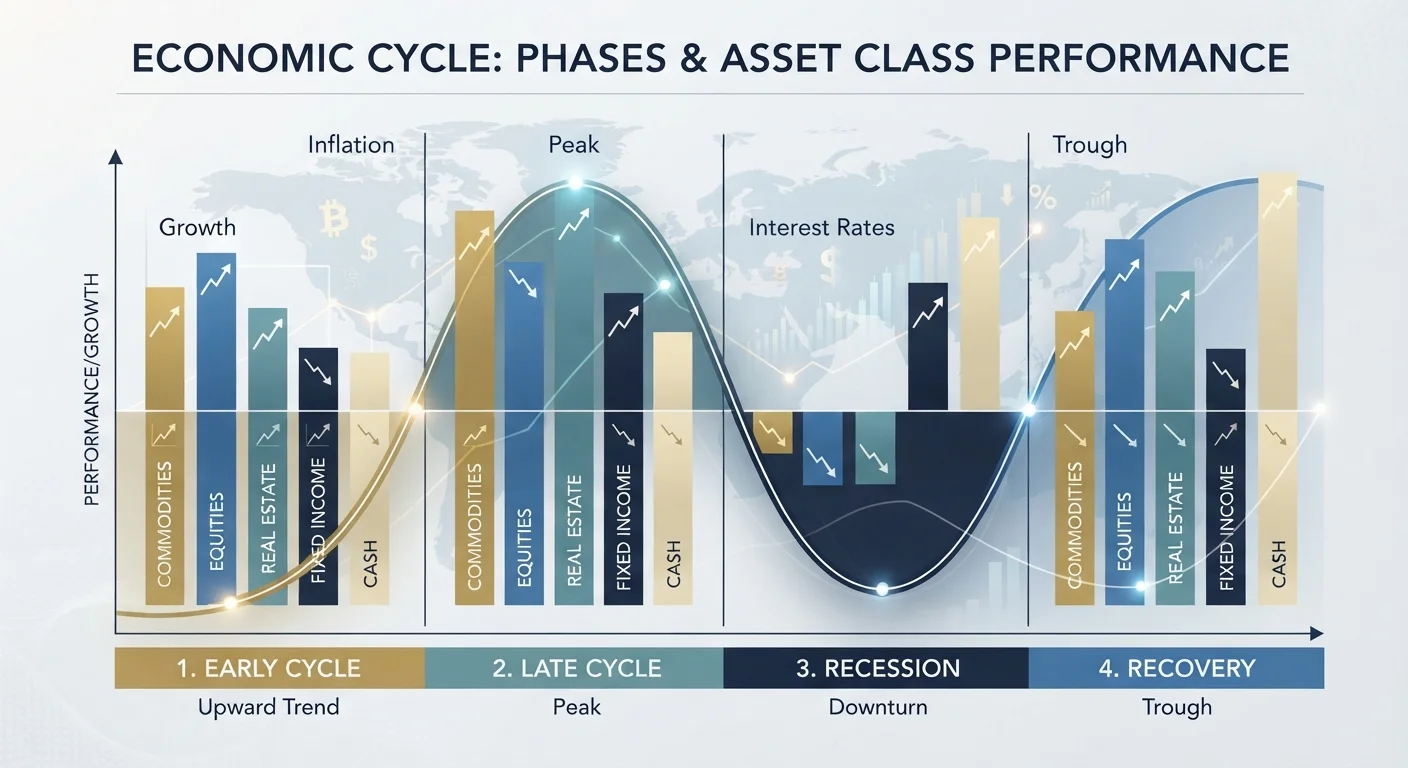
Photo credit: NewBizBuzz.net | Financial Insights For All
In this article
Equities, bonds, commodities, and real estate don't all move in lockstep with the economy. Understanding their typical patterns can inform allocation thinking.
The Economic Cycle and Why Asset Classes Respond Differently
The economy moves through recurring phases — expansion, peak, contraction, and trough — and each phase tends to create distinct conditions for corporate earnings, interest rates, inflation, and investor risk appetite. Because different asset classes draw their returns from different sources, they rarely all move in the same direction at the same time.
Equities are claims on corporate profits; bonds are contractual interest streams; commodities reflect supply-demand dynamics in physical markets; real estate income is tied to rent and property values. These structural differences explain why the correlation between asset classes shifts as economic conditions change — a dynamic explored in depth in how correlations behave during crises.
The patterns described here are tendencies observed over long historical periods, not reliable forecasts. Economic phases rarely announce themselves clearly, and markets often reprice assets in anticipation of shifts before they fully arrive. For a grounding in what each asset class actually is, see the major asset classes every investor should understand.
| Economic cycle phases | Expansion, Peak, Contraction, Trough |
| Asset classes covered | Equities, Bonds, Commodities, Real Estate, Cash |
| Equities' typical sweet spot | Early-to-mid expansion (General historical pattern; not a guarantee of future performance) |
| Bonds' rate sensitivity | Inverse relationship — prices rise when interest rates fall |
| Commodities' inflation link | Often correlated with rising price levels in late-cycle expansions (Historical tendency; varies by commodity and period) |
| Cash role in downturns | Capital preservation and deployment optionality |
Equities and Bonds: Opposing Rhythms
Equities tend to perform best during the early-to-mid expansion phase, when GDP growth is accelerating, corporate earnings are rising, and credit conditions are loose. Historically, equity markets often begin rallying before a recession ends — they are forward-looking instruments, pricing expected earnings rather than current ones. During contractions, equities typically face meaningful drawdowns as earnings expectations fall and risk appetite retreats.
Investment-grade bonds often display a roughly inverse pattern. As economic growth slows and central banks ease monetary policy by cutting interest rates, existing bonds with fixed coupons become more valuable — prices rise as yields fall. Bonds have historically offered a partial buffer during equity downturns, though this relationship is not constant. In inflationary environments, for example, both equities and bonds can decline simultaneously, as investors saw in certain historical periods when rising prices prompted aggressive rate hikes. For a detailed comparison of how growth and stability trade off between these two classes, see equity ownership vs. fixed-income allocation.
~18 months
Average lead time equity markets price in cycle turns
Research on US equity market history suggests stocks often begin repricing recession and recovery expectations well before GDP data confirms the shift — though the timing varies considerably.
Negative
Bond-equity correlation during inflationary rate hikes
Historical episodes of simultaneous equity and bond declines — sometimes called 'correlation breakdown' — tend to coincide with periods of sustained inflationary pressure and central bank tightening.
Understanding which sectors within equities tend to lead at different cycle stages adds further granularity — a concept known as sector rotation.
Commodities, Real Estate, and Cash: Cyclical Roles
Commodities — including energy, metals, and agricultural goods — often perform best during the late expansion phase, when demand is strong and supply constraints push prices higher. They also tend to be sensitive to inflation: when the general price level rises, raw material prices frequently rise with it, which is why commodities are sometimes considered an inflation hedge. However, they are volatile and offer no income stream, making them a specialized allocation rather than a core one. Learn more in alternative assets: commodities, private equity, hedge funds, and beyond.
Real estate — whether held directly or through REITs — tends to benefit from expansion-phase income growth and rising rents. However, real estate is sensitive to interest rates: higher borrowing costs can suppress property values and reduce the attractiveness of leveraged purchases. REITs, as publicly traded instruments, can behave more like equities in stressed markets than physical property typically does. Physical property vs. REITs explores these distinctions in detail.
Cash and cash equivalents preserve capital during contractions and offer optionality — the ability to deploy capital when valuations fall. During rate-rising cycles, short-term instruments can offer competitive yields. Their main cost is opportunity cost during strong bull markets. See cash and cash equivalents: the asset class that's easy to overlook for a fuller discussion.
Economic cycle
The recurring pattern of expansion, peak, contraction, and trough that characterizes GDP growth over time. Asset prices often respond to transitions between these phases.
Yield
The income return on an investment, typically expressed as an annual percentage. For bonds, yield and price move in opposite directions — when yields rise, bond prices fall.
Inflation hedge
An asset expected to maintain or increase its real value when the general price level rises. Commodities and real assets are commonly cited as potential hedges, though their effectiveness varies.
Drawdown
The peak-to-trough decline in an asset's value over a given period. It is a standard measure of downside risk and volatility.
REIT
A Real Estate Investment Trust — a publicly traded or private vehicle that pools capital to own income-producing real estate. REITs must distribute most taxable income to shareholders.
For investors building a framework around these dynamics, the choice between a static long-term target and an actively shifting mix is explored in strategic vs. tactical asset allocation. Macro-level economic indicators that signal cycle transitions are covered in economic indicators every stock investor should know.
This article is for general informational and educational purposes only. It does not constitute personalized investment, financial, tax, or legal advice. Past performance of any asset class does not guarantee future results. All investments carry risk, including the potential loss of principal. Readers should consult a qualified financial adviser before making decisions suited to their individual circumstances.

Author
Investing Fundamentals Editorial Team
Investing Fundamentals Editorial Team is the collective byline for our editorial team and contributor network. Articles published under this byline or an editorial pen name are researched, written, and reviewed according to our editorial standards for clarity, consistency, and independence before publication.
View all articles →