
Capital Gains: Short-Term vs. Long-Term Tax Treatment
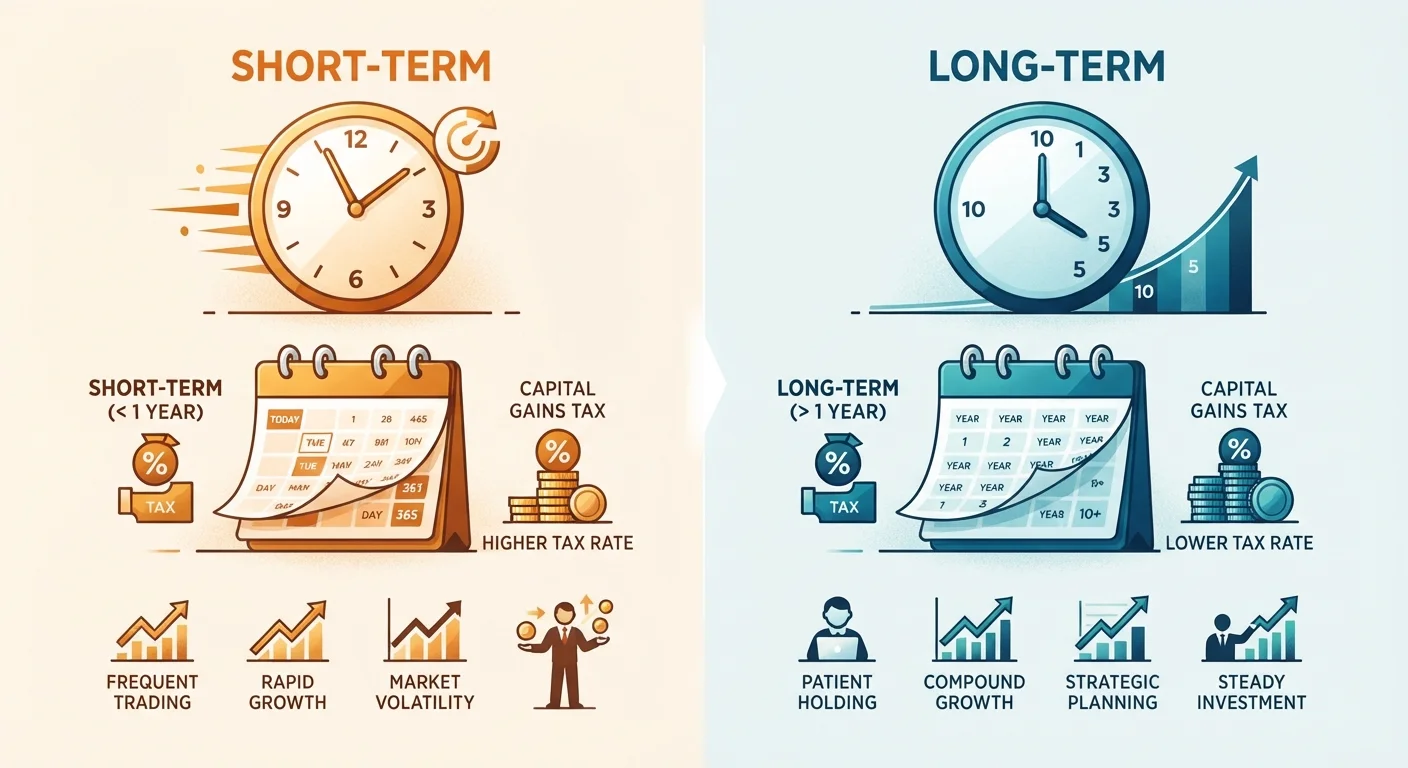
Photo credit: NewBizBuzz.net | Financial Insights For All
In this article
A clear reference on how holding periods determine the tax rate applied to investment gains, with examples of how timing affects net returns.
Key Takeaways
- Selling an asset held one year or less triggers short-term capital gains taxed at ordinary income rates, up to 37%.
- Assets held longer than one year qualify for long-term rates of 0%, 15%, or 20%, depending on taxable income.
- The holding period begins the day after acquisition and ends on the sale date — one day can shift the tax bracket.
- High-income taxpayers may also owe the 3.8% Net Investment Income Tax on capital gains regardless of holding period.
- Strategic timing of asset sales is one of the most accessible — and legal — levers for reducing your tax liability.
- Consulting a qualified tax professional is essential before making holding-period decisions based on your specific circumstances.
How the IRS Defines the Holding Period
The distinction between short-term and long-term capital gains rests entirely on how long you owned the asset before selling it. Under current IRS rules, an asset held for one year or less generates a short-term capital gain (or loss) when sold at a profit. An asset held for more than one year — meaning at least one year and one day — produces a long-term capital gain.
The holding period begins the day after you acquire the asset and ends on the date of sale. This precise counting matters: selling on day 365 instead of day 366 can push a gain into the short-term category and increase your tax bill meaningfully. For unfamiliar terms like adjusted basis (the cost used to calculate your gain), see our investor tax glossary for clear definitions.
Inherited and Gifted Assets: Special Holding Rules
Inherited assets generally receive a stepped-up basis to fair market value at the date of death and are automatically treated as long-term, regardless of how long the decedent owned them. Gifted assets carry over the donor's original basis and holding period, which can be advantageous or create complexity. These exceptions underscore why accurate recordkeeping — and professional guidance — are critical.
Tax Rates: The Core Difference
Short-term capital gains are taxed as ordinary income — the same rates applied to wages. For the 2024 tax year, federal marginal rates run from 10% to 37% depending on filing status and taxable income. A single filer earning $150,000 who sells a stock held nine months at a $20,000 profit could owe as much as $4,400 in federal tax on that gain alone.
Long-term capital gains receive preferential rates: 0%, 15%, or 20% at the federal level. For 2024, the 0% rate applies to single filers with taxable income up to approximately $47,025; the 15% rate covers most middle- and upper-middle-income filers; and the 20% rate applies above roughly $518,900 (single). On the same $20,000 gain, a filer in the 15% long-term bracket owes $3,000 — a $1,400 saving simply by holding longer.
| Criterion | Short-Term Capital Gains | Long-Term Capital Gains |
|---|---|---|
| Holding period | One year or less | More than one year |
| Federal tax rates (2024) | 10%–37% (ordinary income) | 0%, 15%, or 20% |
| NIIT applicability | Yes, for high earners | Yes, for high earners |
| State tax treatment | Ordinary income in most states | Varies; many states tax as ordinary income |
| Loss netting order | Offset short-term gains first | Offset long-term gains first |
| Primary planning lever | Loss harvesting, liquidity management | Holding-period extension, tax deferral |
Additionally, taxpayers whose modified adjusted gross income exceeds $200,000 (single) or $250,000 (married filing jointly) may owe an additional 3.8% Net Investment Income Tax (NIIT) on the lesser of net investment income or the amount by which income exceeds the threshold. This applies to both short- and long-term gains.
Timing, Strategy, and Real-World Considerations
Tax-aware investors integrate holding-period discipline into portfolio decisions — not as an afterthought at year-end, but as part of an ongoing strategy. A few practical principles:
- Track acquisition dates meticulously. Brokerage platforms generally report this, but errors occur. Confirm lot-level data before executing any sale.
- Weigh tax savings against investment risk. Holding a deteriorating position purely to cross the one-year threshold may cost more in lost value than you save in taxes.
- Use loss harvesting strategically. Short-term losses offset short-term gains first, then long-term gains. Long-term losses offset long-term gains first. Sequencing matters.
- Consider state taxes. Many states tax capital gains as ordinary income regardless of holding period, which changes the net benefit calculation significantly.
These principles sit within a broader framework of tax-efficient investing. Our guide on tax-efficient wealth growth covers complementary strategies including account sequencing and asset location. If you hold digital assets, note that the same short-term/long-term framework applies — explored further in our piece on crypto tax concepts.
20%
Maximum federal long-term capital gains rate
The IRS sets the top long-term rate at 20% for the highest income bracket, compared to a 37% top ordinary income rate for short-term gains.
3.8%
Net Investment Income Tax surcharge
High-income taxpayers — above $200,000 single or $250,000 married filing jointly — may owe this additional IRS surcharge on top of capital gains taxes.
For a broader look at common misconceptions around these rules, including how gain thresholds are often misunderstood, see tax myths that cost investors money.
This article is for general informational purposes only and does not constitute personalized tax, investment, or legal advice. Tax rules are subject to change, and individual circumstances vary. Consult a qualified tax professional or financial adviser before making decisions based on capital gains treatment.

Author
Accounting & Tax Editorial Team
Accounting & Tax Editorial Team is the collective byline for our editorial team and contributor network. Articles published under this byline or an editorial pen name are researched, written, and reviewed according to our editorial standards for clarity, consistency, and independence before publication.
View all articles →