
Low Risk vs. High Risk Investments: What Changes Beyond the Potential Upside
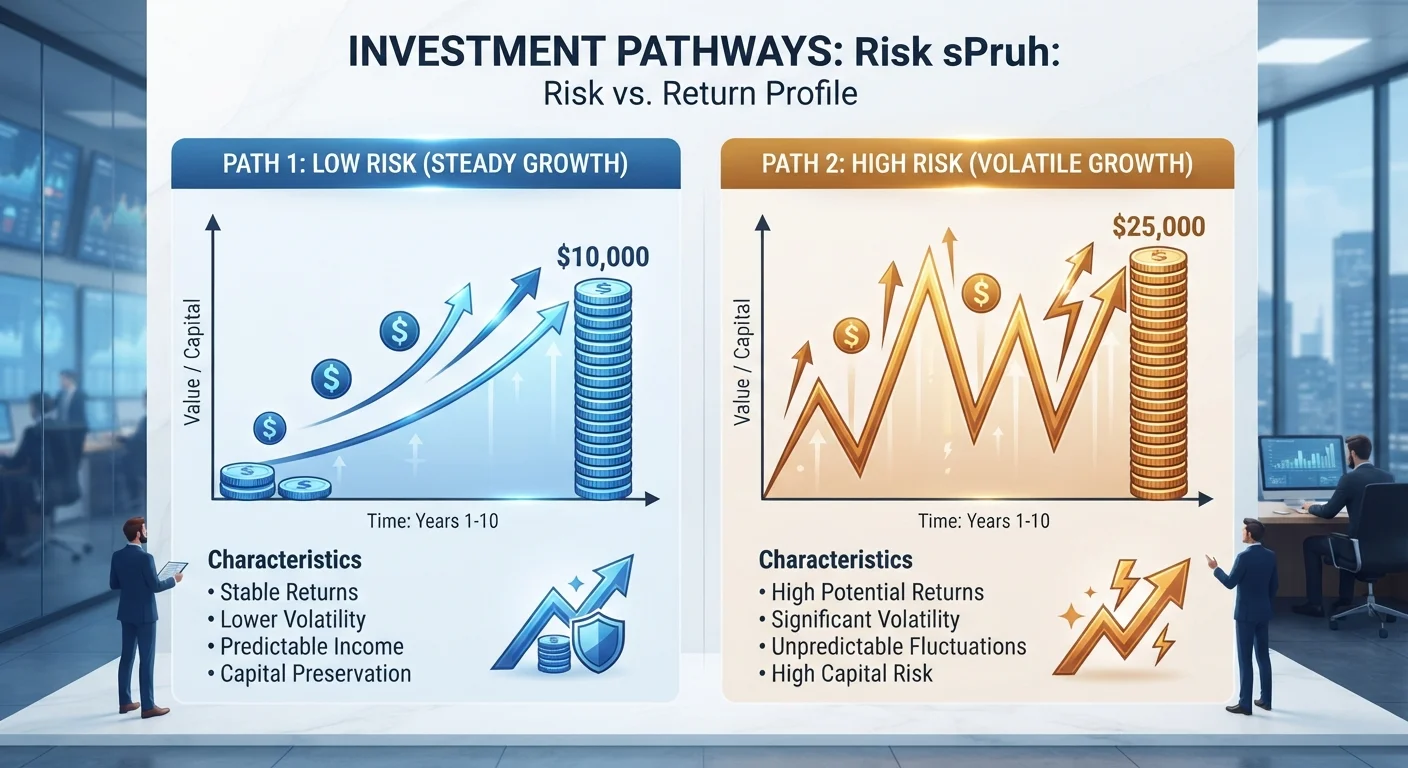
Photo credit: NewBizBuzz.net | Financial Insights For All
In this article
The differences between low and high-risk investments go beyond expected returns. Compare liquidity, volatility, and time considerations.
Key Takeaways
- Low-risk investments generally offer stability and liquidity, but at the cost of lower long-term growth potential.
- High-risk investments introduce volatility, potential capital loss, and longer required time horizons alongside upside potential.
- Liquidity — how quickly you can convert an asset to cash — varies dramatically between risk categories.
- Your time horizon is one of the most important factors in determining what level of risk is appropriate for your situation.
- Risk and volatility are related but distinct concepts; understanding the difference leads to better portfolio decisions.
The Dimensions of Risk That Most Investors Overlook
When investors compare low- and high-risk investments, the conversation almost always centers on potential returns. That framing misses the fuller picture. The differences between these two categories extend across at least four dimensions: volatility, liquidity, time horizon requirements, and the nature of potential loss. Each of these dimensions reshapes how an investment actually behaves inside a real portfolio.
Understanding the fundamental risk-return tradeoff is a starting point — but the mechanics of how risk manifests day-to-day are equally important for making sound allocation decisions.
| Low-Risk Investments | High-Risk Investments | |
|---|---|---|
| Price Volatility | Low; narrow, predictable price bands | High; large swings over short periods |
| Typical Liquidity | High; capital accessible quickly | Varies; illiquid assets can lock capital for years |
| Required Time Horizon | Short to medium term appropriate | Longer horizons needed to absorb drawdowns |
| Primary Loss Risk | Inflation and purchasing power erosion | Capital loss through price decline |
| Return Potential | Modest; may trail inflation over time | Higher; but not guaranteed and with more variability |
| Behavioral Demand on Investor | Lower; fewer extreme price moves to endure | Higher; requires discipline during steep drawdowns |
Volatility and the Behavior of Prices Under Stress
Volatility measures how widely and rapidly an asset's price fluctuates over time. Low-risk investments — such as short-duration government bonds or FDIC-insured savings instruments — tend to exhibit narrow price bands. Their values may still shift with interest rate changes, but those movements are generally predictable and moderate.
High-risk assets — equities in emerging markets, small-cap stocks, or digital assets — can experience price swings of 20%, 30%, or more within a single year, sometimes within weeks. This is not merely uncomfortable; it has real behavioral consequences. Research in behavioral finance consistently shows that steep drawdowns prompt emotional selling at precisely the wrong moment, locking in losses that a longer-held position might have recovered.
It is worth noting that volatility is not identical to risk. A highly volatile asset held over a sufficiently long time horizon may carry less permanent-loss risk than a seemingly stable asset that slowly erodes purchasing power. This distinction matters enormously in portfolio construction.
Separate Volatility Tolerance from Risk Capacity
Many investors conflate how much volatility they can emotionally handle with how much risk their financial situation can actually absorb. These are different assessments. Your risk capacity is determined by your time horizon, income stability, and liquidity needs — not by how you feel watching a portfolio drop 15%. Building this distinction into your planning leads to more durable allocation decisions.
Liquidity: How Quickly Can You Access Your Capital?
Liquidity — the ease with which an asset can be converted to cash without materially affecting its price — is one of the most practically significant differences between risk categories, yet it receives less attention than return projections.
Low-risk instruments like Treasury bills or money market funds offer near-immediate liquidity. You can access your capital within days, often hours, without meaningful loss of value. This makes them suitable as emergency reserves or for capital earmarked for near-term obligations.
High-risk investments vary widely on liquidity. Publicly traded equities are liquid in normal market conditions, but thinner markets — particularly in crypto — can impose severe costs when exiting a position. Private equity, venture investments, and real estate are illiquid by nature, sometimes locking capital for years. Investors who underestimate this dimension often find themselves forced to sell at inopportune times.
Time Horizon and Its Role in Shifting the Risk Equation
Time is arguably the most powerful variable in investment risk management. A 30-year runway transforms the profile of a volatile asset class: short-term drawdowns become noise within a long upward trajectory, and compounding has time to generate meaningful wealth accumulation. Conversely, a 3-year investor holding high-volatility assets faces a real possibility of needing to liquidate during a downturn.
How time horizon reshapes the risk-reward tradeoff is explored in depth elsewhere on this site — but the core principle is clear: the longer your timeline, the more capacity you generally have to absorb short-term volatility in exchange for higher long-term growth potential.
Low-risk investments, meanwhile, are not entirely free of time-related risk. Over long periods, assets generating returns below the rate of inflation produce a quiet, steady erosion of purchasing power — a form of loss that does not appear on a monthly statement but compounds meaningfully over decades. This is sometimes called inflation risk or purchasing power risk.
~3%
Average US inflation rate, long-run historical
Federal Reserve data suggests long-run US inflation has averaged around 3%, meaning low-yield assets must clear this bar just to preserve purchasing power.
~10%
Long-run annualized US large-cap equity return
The S&P 500 has historically delivered roughly 10% annualized nominal returns over long periods, though individual years vary enormously and past returns do not predict future results.
Constructing a Portfolio Across the Risk Spectrum
Understanding these dimensions — volatility, liquidity, time horizon, and loss type — allows investors to make more deliberate allocation decisions rather than simply chasing returns or reflexively avoiding discomfort. Building and balancing a portfolio effectively requires mapping each holding's characteristics to your actual financial circumstances and goals.
Risk-adjusted return measures, such as the Sharpe ratio, help compare investments on more equal footing by accounting for the volatility required to generate a given level of return. This framing makes it easier to evaluate whether the extra risk of a high-volatility asset is actually being compensated with proportionally higher returns.
Risk profile classifications — conservative, moderate, and aggressive — are useful shorthand, but they are most valuable when grounded in a genuine assessment of your time horizon, income stability, liquidity needs, and psychological capacity to endure drawdowns without panic-selling.
This article is for general informational and educational purposes only and does not constitute personalized financial, investment, tax, or legal advice. All investing involves risk, including the possible loss of principal. Past performance does not guarantee future results. Consult a qualified financial adviser before making decisions about your own investments.

Author
Investing Fundamentals Editorial Team
Investing Fundamentals Editorial Team is the collective byline for our editorial team and contributor network. Articles published under this byline or an editorial pen name are researched, written, and reviewed according to our editorial standards for clarity, consistency, and independence before publication.
View all articles →