
From Conservative to Aggressive: What Investment Risk Profiles Actually Mean
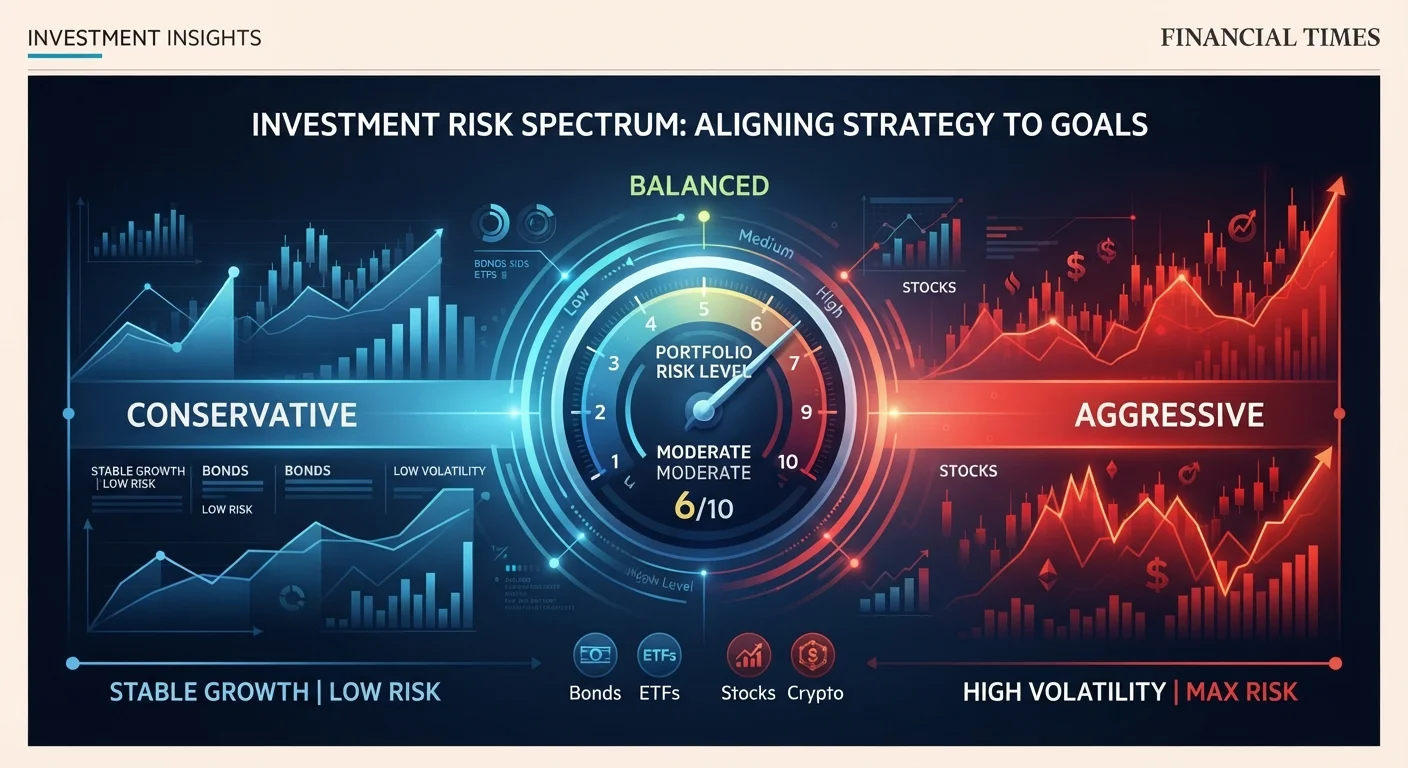
Photo credit: NewBizBuzz.net | Financial Insights For All
In this article
Risk profiles are more than labels. Learn what conservative, moderate, and aggressive classifications really reveal about a portfolio.
Key Takeaways
- Risk profiles combine emotional tolerance and financial capacity — both matter for sound portfolio construction.
- Conservative, moderate, and aggressive are not fixed labels; they reflect a spectrum with gradations in between.
- Time horizon is one of the most influential factors determining an appropriate risk profile.
- A mismatch between your risk profile and your portfolio can lead to panic selling or inadequate growth.
- Risk profiles should be reassessed periodically as life circumstances and markets evolve.
The Spectrum: What Conservative, Moderate, and Aggressive Really Mean
The terms conservative, moderate, and aggressive are used widely — but they describe meaningfully different portfolio behaviors, not just different attitudes toward risk. Understanding what each classification implies in practice is essential for anyone building or reviewing a portfolio. For a deeper look at how individual asset classes map to these risk levels, see how stocks, bonds, and real estate risk profiles differ.
Conservative
A conservative profile emphasizes capital preservation. Investors here are primarily concerned with not losing what they have, often because they are near or in retirement, have a short investment horizon, or have limited financial reserves. Portfolios tend to hold a substantial allocation to bonds, Treasury securities, money market funds, and other lower-volatility instruments. Growth potential is modest, but so is the risk of significant loss during market downturns.
Moderate
A moderate profile seeks a balance between growth and stability. Investors accept some volatility in exchange for better long-term returns, but they are not comfortable riding out severe drawdowns. Portfolios typically blend equities and fixed income — often in rough proportions such as 50/50 or 60/40 — and may include real estate investment trusts (REITs) or other diversifying asset classes. The goal is participation in market gains with a meaningful cushion against sharp losses.
Aggressive
An aggressive profile prioritizes long-term capital growth over short-term stability. Investors here accept that their portfolio may fall substantially in value during market corrections and are prepared to hold through extended downturns. Portfolios are heavily weighted toward equities, including small-cap stocks, international and emerging market funds, and potentially alternative assets. This approach requires both a long time horizon and genuine psychological resilience — not just theoretical willingness to accept losses.
Labels Vary by Institution
Different brokerage firms and advisory platforms use varying terminology for risk profile categories — some use five tiers (very conservative to very aggressive), others use three. What matters is the underlying asset allocation and investment behavior the classification produces, not the label itself. Always examine the specific portfolio construction behind a given category rather than relying on the name alone.
What Risk Profiles Are Actually Measuring
A risk profile is not simply a personality test. It attempts to quantify two distinct but related dimensions: risk tolerance and risk capacity. Tolerance is subjective — it reflects how an investor feels when their portfolio declines. Capacity is objective — it reflects how much loss an investor's financial situation can actually absorb without derailing their goals.
A 35-year-old with a stable income, no debt, and a 30-year investment horizon may have high risk capacity even if their risk tolerance is moderate. Conversely, a high-earning investor close to retirement may feel psychologically comfortable with volatility but have limited capacity to recover from a major drawdown before they need to draw on funds.
60/40
Classic moderate portfolio equity-bond split
The 60% equity, 40% bond allocation has historically served as a benchmark moderate portfolio, though appropriate ratios vary widely by individual circumstances and market conditions.
~1.5%
Average annual 'behavior gap' in investor returns
Research by financial analysts, including work associated with Morningstar's investor return studies, has estimated that investor behavior — including poorly timed buying and selling — can reduce actual returns relative to fund returns by roughly 1–2 percentage points annually.
30+ years
Time horizon that typically supports an aggressive profile
Financial planning frameworks generally indicate that investors with multi-decade horizons have greater capacity to weather volatility, though individual circumstances always apply.
Advisers often use structured questionnaires to assess both dimensions, covering factors like investment timeline, income stability, existing assets, and reactions to hypothetical loss scenarios. The output informs recommended asset allocation ranges. For a broader view of how historical data has characterized different asset classes by risk, see asset classes ranked by risk profile.
Why Mismatches Are Costly — and How to Avoid Them
A portfolio misaligned with an investor's true risk profile creates two distinct failure modes. The first is over-conservatism: holding too little in growth assets means a portfolio may fail to outpace inflation or fund long-term goals. The second — and often more damaging — is over-aggressiveness: holding more volatility than an investor can emotionally sustain leads to panic selling during downturns, locking in losses and missing subsequent recoveries.
Test Your Real Tolerance With a Scenario
Rather than relying solely on a questionnaire, consider how you actually responded to the last significant market decline you experienced. If you felt compelled to sell or checked your account daily with anxiety, your behavioral risk tolerance may be lower than your stated profile suggests. Aligning your portfolio to your actual — not aspirational — tolerance reduces the probability of costly reactive decisions.
Research consistently shows that investor behavior, not investment selection alone, is a primary driver of underperformance relative to benchmark returns. A portfolio that matches an investor's actual profile — not their aspirational one — is far more likely to be held through difficult periods.
It is also worth noting that risk profiles are not static. Major life changes, shifts in income, changes to financial obligations, or new investment goals can all alter both tolerance and capacity. Portfolio construction fundamentals outline how to structure and rebalance holdings as circumstances evolve. Periodic reassessment — often annually or after significant life events — is a standard practice in sound portfolio management.
For investors exploring higher-risk segments of the market, understanding the specific characteristics of each asset class is critical. Low-risk vs. high-risk investments differ in more ways than expected return alone — liquidity, volatility structure, and recovery time all differ meaningfully. Similarly, assets like digital currencies introduce volatility patterns distinct from traditional equities; crypto's risk-return profile warrants separate consideration before inclusion in any portfolio.
This article is for general informational and educational purposes only and does not constitute personalized financial, investment, or legal advice. Investment decisions should be made in consultation with a qualified, licensed financial adviser who can assess your individual circumstances. Past performance of any asset class does not guarantee future results, and all investing involves risk, including possible loss of principal.
Frequently Asked Questions

Author
Investing Fundamentals Editorial Team
Investing Fundamentals Editorial Team is the collective byline for our editorial team and contributor network. Articles published under this byline or an editorial pen name are researched, written, and reviewed according to our editorial standards for clarity, consistency, and independence before publication.
View all articles →