
How Time Horizon Changes the Entire Equation of Risk and Reward
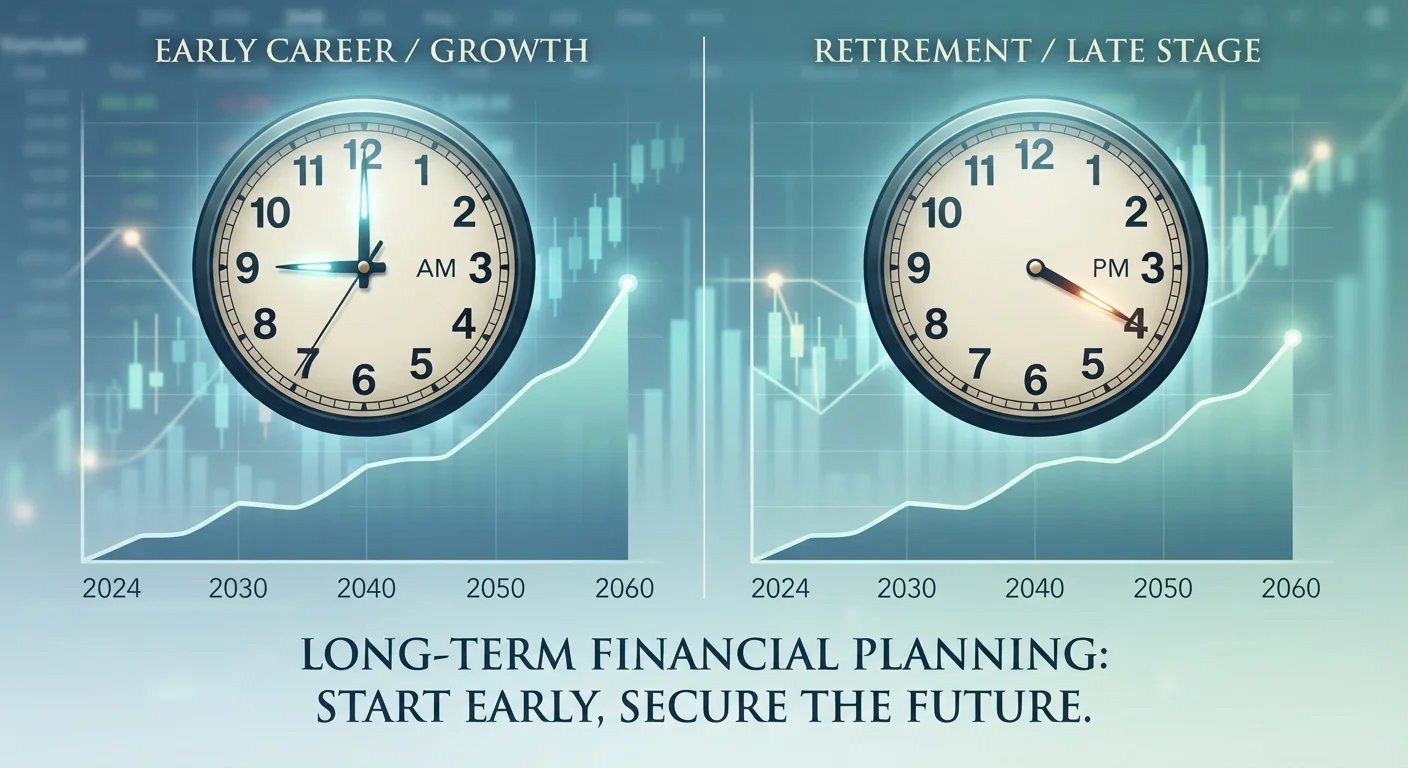
Photo credit: NewBizBuzz.net | Financial Insights For All
In this article
A 30-year investor and a 3-year investor face fundamentally different risk realities. Explore how time reshapes the risk-return tradeoff.
Key Takeaways
- Time horizon is the single most important factor determining how much portfolio risk is appropriate.
- Longer horizons allow investors to weather volatility without permanently impairing their capital.
- Short-term investors face sequence-of-returns risk that long-term investors can largely ignore.
- Matching asset allocation to time horizon prevents both under-investing and over-exposing capital.
- Time horizon typically shortens as investors age, requiring gradual rebalancing toward stability.
Why Time Is the Variable That Changes Everything
Two investors might have identical net worths, identical return goals, and even similar views on the economy — yet they should hold fundamentally different portfolios. The differentiating factor is time. How long before the money must be used determines almost everything about what level of risk is rational to accept.
This isn't a soft guideline. It's rooted in how markets actually behave over different periods. Short-term price swings that are irrelevant to a 30-year investor can be financially devastating to someone who needs funds within two years. Understanding why this is true — and how to apply it — is one of the most high-leverage skills in personal finance. See how risk and return interact at the foundational level for context on why this tradeoff exists in the first place.
~10%
Average annualized US equity return over long periods
Based on long-run historical data for broad US equity market indices; actual results vary by period and are not guaranteed.
1 in 3
Chance of a down year in US equities historically
Roughly one-third of calendar years have historically produced negative returns in US stock markets, underscoring short-term risk.
20+ years
Horizon typically needed to ride out major bear markets
Analysis of historical market cycles suggests portfolios held through multiple full cycles tend to recover and grow beyond prior peaks.
The Long-Horizon Investor: Volatility as a Feature, Not a Bug
For an investor with a 20- to 30-year runway, short-term market volatility is largely noise. Historically, extended holding periods in diversified equity portfolios have tended to smooth out the peaks and troughs that cause so much anxiety in the short run. A market correction that drops a portfolio by 30% in year three still has two decades to recover and grow.
This is why long-horizon investors can rationally tilt toward growth-oriented, higher-volatility assets. The risk being accepted is real — portfolio values will fluctuate, sometimes sharply — but the time available converts that volatility from a threat into an opportunity. Buying into market weakness, continuing contributions, and allowing compounding to work over time are strategies only available to those who don't need the money soon.
It's worth being precise here: volatility and risk are related but not identical. Conflating volatility with risk leads to costly decisions, particularly for long-horizon investors who may sell prematurely out of short-term fear.
Separate Your Capital by Goal, Not Just Account
Consider mentally — and where possible, structurally — separating capital by when it will be needed. Money earmarked for retirement decades away can tolerate an aggressive posture; funds needed within three years generally should not. Mixing goals into a single undifferentiated bucket often leads to inappropriate risk levels for at least one of those goals.
The Short-Horizon Investor: When Stability Earns Its Place
A 3-year horizon changes the calculus entirely. If funds are needed — for a home purchase, tuition, or an early retirement — within a short window, a severe market drawdown at the wrong moment can permanently impair the goal. There may simply not be enough time to recover.
This is the logic behind capital preservation: for near-term needs, the priority shifts from maximizing growth to protecting purchasing power. Short-duration bonds, high-yield savings vehicles, and cash equivalents earn their place not because they are exciting, but because they are appropriate. The expected return is lower — but so is the probability of needing to sell at a loss to meet an obligation.
Sequence-of-returns risk is especially relevant here. Poor performance in the early years before a withdrawal event can cause disproportionate damage that higher returns later cannot fully repair. This is a structural asymmetry that time horizon directly controls.
Aligning Portfolio Construction to Your Horizon
Effective portfolio construction starts with an honest assessment of when each pool of capital will be needed. Many investors have multiple simultaneous horizons: a short-term emergency fund, a medium-term goal like a property purchase, and a long-term retirement account. Each pool warrants a distinct allocation strategy.
As a general framework: longer horizons support higher equity exposure; medium horizons often call for a balanced blend; near-term needs are best served by stable, liquid instruments. This isn't static — as time passes and horizons shorten, allocations should be revisited and gradually adjusted. How the risk-return balance shifts across life stages explores this progression in detail.
Investors who hold a single undifferentiated portfolio for all goals frequently end up either too conservative for their long-term capital or too aggressive for their near-term needs. Segmenting by horizon resolves both problems.
Tax-Advantaged Accounts and Time Horizon
Retirement accounts like 401(k)s and IRAs are purpose-built for long time horizons, which is partly why they restrict early withdrawals. The tax structure reinforces patient, long-term investing. If you are weighing account types, understanding Roth vs. traditional contribution timing can help clarify how tax treatment interacts with your horizon and income trajectory.
This article is for general informational and educational purposes only and does not constitute personalized investment, financial, tax, or legal advice. Investment decisions carry inherent risks, and past performance does not guarantee future results. Consult a qualified financial adviser before making decisions specific to your situation.
Frequently Asked Questions

Author
Investing Fundamentals Editorial Team
Investing Fundamentals Editorial Team is the collective byline for our editorial team and contributor network. Articles published under this byline or an editorial pen name are researched, written, and reviewed according to our editorial standards for clarity, consistency, and independence before publication.
View all articles →