
Interest-Only vs. Repayment Mortgages: Structural Trade-offs Borrowers Face
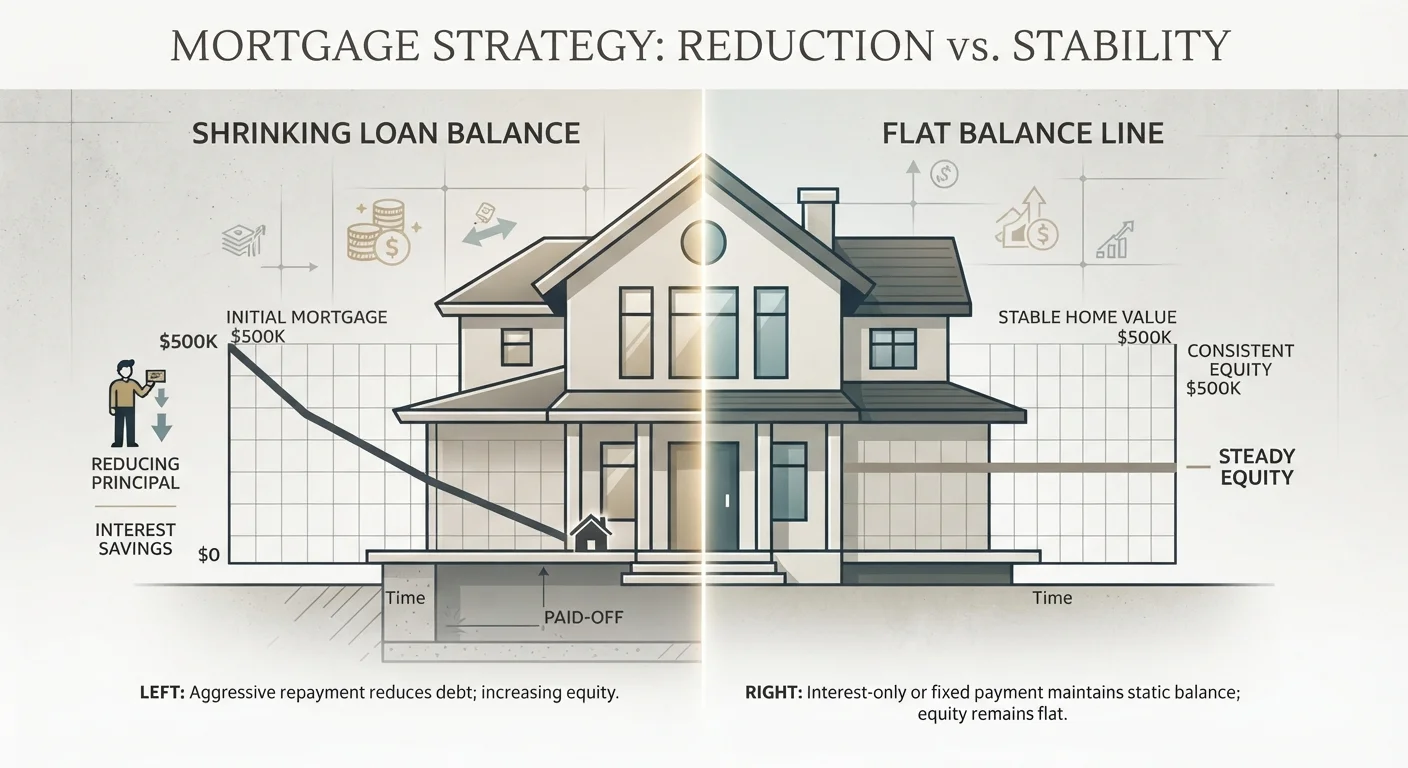
Photo credit: NewBizBuzz.net | Financial Insights For All
In this article
Compare interest-only and capital-repayment mortgage structures side by side, including risk profiles and long-term equity implications.
Key Takeaways
- Repayment mortgages reduce the outstanding loan balance with every payment, building equity throughout the term.
- Interest-only mortgages carry lower monthly payments but leave the full principal due at maturity.
- Lenders impose stricter eligibility criteria on interest-only products, typically requiring a credible repayment vehicle.
- Total interest paid over the life of a loan is significantly higher on an interest-only structure.
- Each structure suits a distinct borrower profile; neither is universally superior.
How Each Structure Works
At its core, a mortgage is a secured loan repaid over a fixed term — but the method of repayment varies significantly between the two dominant structures. Understanding how amortisation schedules function is foundational to grasping why these two products behave so differently over time.
Repayment mortgages (also called capital-and-interest mortgages) blend interest charges with a portion of principal reduction in every scheduled payment. Early in the term, interest dominates the payment split; as the balance falls, more of each payment chips away at the capital. By the final scheduled payment, the loan is fully extinguished and the borrower holds unencumbered title.
Interest-only mortgages require the borrower to service only the interest accruing on the outstanding balance during the mortgage term. The principal remains static throughout. At term end, the full original loan amount becomes immediately due — typically satisfied by selling the property, refinancing into a repayment product, or drawing on a designated investment vehicle (such as an ISA or pension lump sum).
| Repayment Mortgage | Interest-Only Mortgage | |
|---|---|---|
| Monthly payment | Higher (principal + interest) | Lower (interest only) |
| Balance at term end | Fully cleared | Full original principal due |
| Equity accumulation | Grows with each payment | Dependent on property appreciation |
| Total interest paid | Lower over full term | Significantly higher over full term |
| End-of-term risk | Low — loan extinguished | High — lump-sum repayment required |
| Lender eligibility criteria | Standard affordability test | Stricter; repayment vehicle required |
| Typical LTV limit | Up to 95% (product-dependent) | Often capped at 75% |
| Best suited to | Most owner-occupiers | Investors with repayment strategy |
Risk Profiles and Equity Implications
The equity trajectory for each structure diverges from day one. Under a repayment mortgage, equity — defined as the property's market value minus the outstanding loan — grows through two compounding forces: principal reduction and any property value appreciation. This dual mechanism provides a meaningful buffer against negative equity during market downturns.
Interest-only borrowers accumulate no equity through their payments. Any equity gain depends entirely on property price appreciation, which is neither guaranteed nor linear. Should values stagnate or fall, the borrower reaches maturity still owing the original sum against a potentially impaired asset. This concentration of repayment risk is the central structural vulnerability of the interest-only model.
Interest-Only Maturity Risk Is Real
Borrowers who reach the end of an interest-only term without a sufficient repayment vehicle face forced sale or default. Regulators have flagged this as a systemic concern, particularly for borrowers who relied on endowment policies that underperformed. Anyone considering interest-only should stress-test their repayment strategy against conservative return assumptions — and revisit it periodically throughout the mortgage term.
For borrowers considering how rate type interacts with repayment structure, see how fixed-rate and adjustable-rate mortgages behave over time — the choice of rate structure compounds or mitigates these equity dynamics.
~£40,000+
Additional lifetime interest on interest-only vs repayment
Illustrative estimate on a £300,000 mortgage at 4.5% over 25 years, assuming no principal reduction on the interest-only product.
75%
Typical maximum LTV for interest-only products
Many UK lenders impose an LTV cap around 75% on interest-only mortgages, compared with higher thresholds on standard repayment products.
Lender Requirements and Eligibility
Lenders apply markedly different underwriting standards to each product. Repayment mortgages are the standard residential offering; affordability assessments focus on whether stressed monthly payments remain serviceable against verified income.
Interest-only applications face additional scrutiny. Most lenders require borrowers to demonstrate a credible, documented repayment vehicle — an investment portfolio, endowment policy, or confirmed proceeds from a future property sale. Loan-to-value (LTV) caps on interest-only products tend to be lower, often restricted to 75% or below, reflecting the elevated end-of-term risk. Minimum income thresholds further narrow the eligible pool.
Regulatory attention to interest-only lending has intensified since the post-2008 mortgage market review, with lenders required to demonstrate the plausibility of repayment strategies at origination. Borrowers whose repayment vehicles underperform face mid-term pressure to convert to repayment, potentially at less favourable rates. Those weighing broader borrowing structures may also find value in reviewing how secured loan mechanics differ from unsecured borrowing.
Total Cost and Cash-Flow Considerations
Monthly payment differentials can be substantial — an interest-only borrower on a £300,000 loan at 4.5% pays roughly £1,125 per month against a repayment borrower's approximately £1,520 over a 25-year term. That gap creates genuine cash-flow headroom, but it comes at a steep long-term cost: interest-only borrowers pay interest on the full principal for the entire term, while repayment borrowers' interest charges decline with each payment.
Cumulative interest over 25 years can be tens of thousands of pounds higher on an interest-only product, even at identical rates. Borrowers who intend to use the monthly saving to fund a disciplined investment strategy must achieve after-tax returns that outperform the mortgage rate — a credible but uncertain proposition. For those exploring strategies that accelerate debt elimination, overpayment and lump-sum strategies can meaningfully reduce total interest on a repayment mortgage without refinancing.
Consider a Part-and-Part Approach
Some lenders permit a split mortgage structure — part repayment, part interest-only — on the same property. This allows borrowers to manage monthly outgoings while ensuring a portion of the debt is systematically reduced. It does not eliminate end-of-term risk on the interest-only portion but may suit borrowers navigating near-term cash-flow constraints while maintaining some equity progress.
Rate structure interacts with repayment method to shape overall cost. Understanding fixed versus variable rate dynamics alongside repayment type gives borrowers a complete picture of long-term exposure. Similarly, discount points can alter the cost calculus further for those optimising the lifetime cost of either structure.
This article provides general financial information for educational purposes only and does not constitute personalised mortgage, financial, or legal advice. Mortgage eligibility, product availability, and regulatory requirements vary. Readers should consult a licensed mortgage adviser or financial professional before making any borrowing decisions specific to their circumstances.

Author
Credit & Lending Editorial Team
Credit & Lending Editorial Team is the collective byline for our editorial team and contributor network. Articles published under this byline or an editorial pen name are researched, written, and reviewed according to our editorial standards for clarity, consistency, and independence before publication.
View all articles →