
Fixed-Rate vs. Adjustable-Rate Mortgages: Choosing the Right Structure for Your Situation
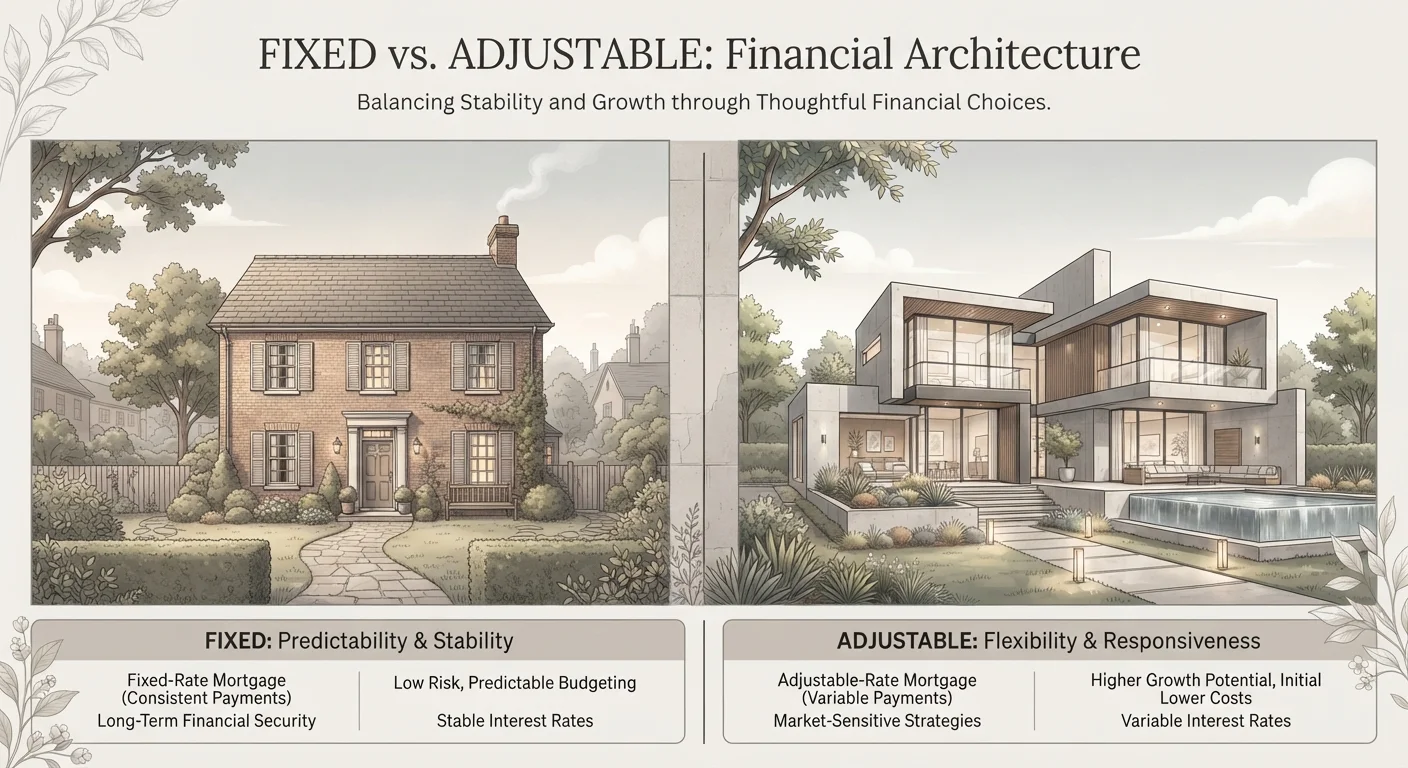
Photo credit: NewBizBuzz.net | Financial Insights For All
In this article
A clear comparison of fixed and adjustable-rate mortgages, including how each behaves over time and what conditions suit each type.
Key Takeaways
- Fixed-rate mortgages lock in an interest rate for the entire loan term, eliminating payment uncertainty.
- ARMs typically offer a lower initial rate that adjusts periodically based on a benchmark index plus a margin.
- The right structure depends heavily on your time horizon, rate environment, and risk tolerance.
- Rate caps on ARMs limit how much your payment can rise in a single period or over the loan's life.
- Refinancing is always an option but carries closing costs and is not guaranteed to be available.
How Each Structure Works
A fixed-rate mortgage carries an interest rate that remains constant from the first payment to the last. Whether you hold a 15-year or 30-year term, your principal-and-interest payment never changes. This predictability makes budgeting straightforward and insulates borrowers from interest-rate market movements. For a deeper look at how each loan component — principal, interest, escrow — interacts, see our mortgage anatomy breakdown.
An adjustable-rate mortgage (ARM) operates in two distinct phases. The initial fixed period — commonly three, five, seven, or ten years — holds the rate steady, often below prevailing fixed-rate levels. After that period ends, the rate adjusts at defined intervals (typically annually) based on a reference benchmark index, such as the Secured Overnight Financing Rate (SOFR), plus a lender-set margin. The result is a payment that can rise or fall depending on where rates move. ARMs are described using shorthand like "5/1" — five years fixed, then annual adjustments — or "7/6," meaning seven years fixed, then adjustments every six months.
| Criterion | Fixed-Rate Mortgage | Adjustable-Rate Mortgage (ARM) |
|---|---|---|
| Interest rate | Constant for loan term | Fixed initially, then periodic adjustments |
| Payment predictability | Fully predictable | Varies after initial period |
| Typical initial rate | Higher than ARM teaser rate | Lower during fixed period |
| Rate risk | None — locked in at closing | Rate can rise at each adjustment |
| Rate upside if market falls | None without refinancing | Payment may decrease at reset |
| Common terms | 15-year, 30-year | 3/1, 5/1, 7/1, 10/1 and variants |
| Best ownership horizon | Long-term (7+ years) | Shorter-term (under 7 years) |
| Budgeting simplicity | Straightforward | Requires scenario planning |
Understanding how payments shift over time is essential for evaluating either structure. Amortisation schedules reveal why early payments are heavily weighted toward interest regardless of mortgage type.
Rate Caps, Floors, and the Risk Profile of ARMs
ARMs include contractual rate caps designed to limit exposure. Three cap figures typically govern an ARM: the initial adjustment cap (maximum increase at first reset), the periodic cap (maximum change per subsequent adjustment), and the lifetime cap (total allowable increase over the loan's life). A common structure is 2/2/5 — no more than 2% at first adjustment, 2% per period thereafter, and 5% total above the starting rate.
2/2/5
Most common ARM cap structure
Per Freddie Mac guidelines, a 2/2/5 cap structure is widely used in conventional ARM products, limiting per-adjustment and lifetime rate increases.
~1–1.5%
Typical ARM initial rate discount vs. 30-yr fixed
Historically, ARM initial rates have carried a discount relative to 30-year fixed rates, though the spread varies with market conditions.
These caps matter because they define your worst-case payment scenario, not your expected one. Borrowers should stress-test their budget against the lifetime cap before committing. For context on how variable-rate structures compare across broader borrowing products, this rate structure overview covers the wider landscape.
Fixed-rate mortgages carry no equivalent risk — but they also offer no upside if market rates fall after closing. The trade-off is symmetrical: you give up potential savings in exchange for absolute certainty.
Comparing the Two Structures: Key Criteria
The decision between fixed and adjustable rarely comes down to a single factor. Rate environment, ownership timeline, income trajectory, and personal risk tolerance all interact. It is also worth distinguishing between the nominal interest rate and the APR, which includes fees and better reflects total borrowing cost — a topic explored in detail in why your mortgage rate differs from your APR.
Refinancing Is Not a Safety Net
Some borrowers choose an ARM intending to refinance before the rate adjusts. While refinancing is a valid strategy, it is not guaranteed — it depends on your credit profile, home equity, lender availability, and prevailing rates at that time. Closing costs also reduce the financial benefit. Plan for the possibility that refinancing may not be available or favourable when needed.
Borrowers who want structural alternatives beyond rate type may also benefit from reviewing interest-only versus repayment mortgage trade-offs, which addresses a separate but related structural decision.
This article is for general informational purposes only and does not constitute personalised financial, mortgage, or legal advice. Mortgage products, rates, and terms vary by lender and are subject to borrower qualification. Consult a licensed mortgage professional or financial adviser before making decisions specific to your circumstances.

Author
Credit & Lending Editorial Team
Credit & Lending Editorial Team is the collective byline for our editorial team and contributor network. Articles published under this byline or an editorial pen name are researched, written, and reviewed according to our editorial standards for clarity, consistency, and independence before publication.
View all articles →