
Amortisation Schedules: How Your Payments Shift Over the Life of a Loan
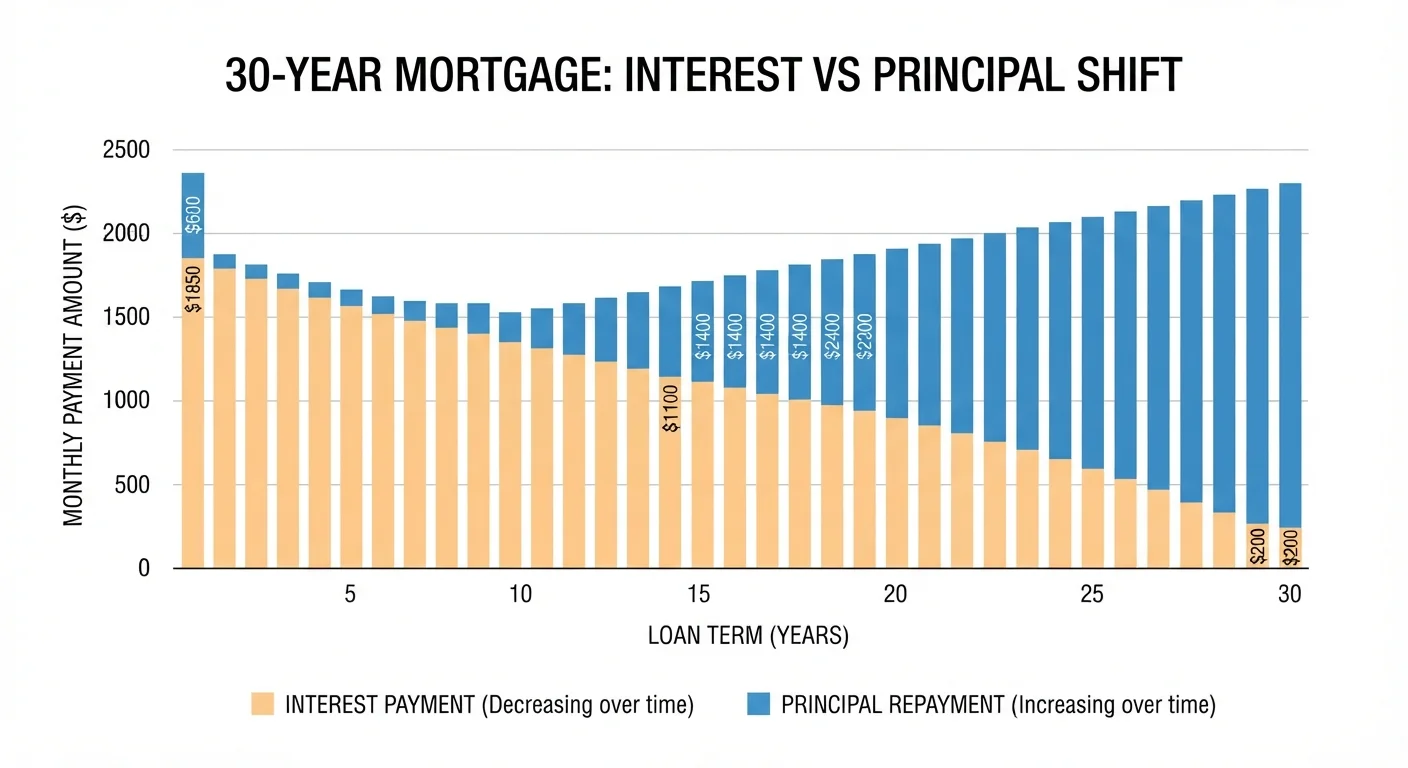
Photo credit: NewBizBuzz.net | Financial Insights For All
In this article
Early mortgage payments are mostly interest. Learn why that is, how amortisation works, and what it means for building equity.
Key Takeaways
- On a standard 30-year mortgage, the majority of early payments go toward interest, not principal.
- The monthly payment amount stays constant, but its composition shifts continuously throughout the loan term.
- Equity builds slowly at first, then accelerates significantly in the later years of the loan.
- Extra principal payments early in the loan can substantially reduce total interest paid over the life of the mortgage.
- Understanding amortisation helps borrowers evaluate refinancing, prepayment, and equity-access decisions more accurately.
The Mechanics Behind Every Mortgage Payment
When you make a mortgage payment, it doesn't split evenly between interest and principal. Instead, the allocation is calculated fresh each period based on your remaining balance. The formula is straightforward: multiply the outstanding principal by your periodic interest rate (your annual rate divided by 12) to determine that month's interest charge. The remainder of your fixed payment then reduces the principal.
Because the balance is largest on day one, the interest charge is also at its peak in those first payments. On a $400,000 mortgage at 7% interest over 30 years, the first payment of roughly $2,661 would direct approximately $2,333 toward interest and only about $328 toward principal. That ratio shifts incrementally with every payment — never dramatically month to month, but substantially over years.
This structure isn't arbitrary. It reflects the lender's actual cost of providing capital over time, and it's consistent with how amortisation functions across most instalment loans, from auto loans to personal loans.
~88%
Share of first payment going to interest
On a $400,000 mortgage at 7% over 30 years, approximately 88% of the first monthly payment covers interest charges rather than reducing principal.
Year 21
Approximate crossover point on a 30-year loan
At a 7% fixed rate, borrowers typically reach the point where more than half of each monthly payment reduces principal around year 21 of a 30-year term.
$321,000+
Total interest on a $400K, 30-year loan at 7%
Over the full term of a $400,000 mortgage at 7%, total interest paid can exceed the original loan principal — illustrating the long-run cost of front-loaded amortisation.
Why Equity Builds Slowly Early On
One of the most consequential implications of amortisation is its effect on home equity accumulation. In the early years of a mortgage, each payment retires only a modest slice of principal. This means that even after several years of on-time payments, a borrower may have paid hundreds of thousands of dollars in total but reduced their loan balance by a comparatively small amount.
Consider a borrower ten years into a 30-year mortgage: they've completed one-third of their payments but have typically paid off far less than one-third of the principal. The exact figure depends on the interest rate, but this front-loading of interest is an inherent feature of standard amortisation — not a penalty or lender tactic.
This dynamic has direct implications for homeowners considering a cash-out refinance, home equity line of credit, or a sale shortly after purchase. Equity available for these purposes may be less than intuited if the loan is still in its early years.
Request Your Amortisation Schedule Upfront
Before closing on any mortgage, ask your lender for a complete amortisation schedule. Review how the interest-to-principal split evolves year by year, and identify the crossover point where principal payments begin to dominate. This one document can fundamentally change how you think about the true cost of the loan and the value of early prepayments.
How the Schedule Shifts Over Time
The transition from interest-heavy to principal-heavy payments is gradual and continuous. On a 30-year fixed mortgage, borrowers cross the inflection point — where more than half of each payment goes to principal — somewhere around the 20-year mark, depending on the rate. Beyond that point, the pace of equity building accelerates noticeably.
This acceleration in the final decade is one reason why borrowers who refinance frequently, resetting their loan term each time, may find themselves perpetually in the interest-heavy phase of amortisation. Each new loan restarts the clock. Understanding this dynamic is essential context when evaluating whether to refinance. The trade-off between upfront costs and long-term savings becomes especially relevant here.
The rate environment also matters. At higher interest rates, a greater share of each payment goes to interest, and the crossover point arrives later. At lower rates, the schedule is comparatively more favorable to early principal reduction. Borrowers evaluating fixed-rate versus adjustable-rate structures should factor this into their long-term projections.
Practical Implications for Borrowers
Understanding amortisation isn't purely academic — it informs several real financial decisions. First, it reframes the value of extra principal payments. Because interest accrues on the remaining balance, reducing that balance early has a compounding benefit: every dollar applied to principal today saves interest on that dollar for every remaining month of the loan. Structured prepayment strategies can meaningfully reduce total interest paid without requiring a full refinance.
Second, amortisation affects decisions about how long to stay in a property. Borrowers who sell after a short holding period may discover that their loan payoff amount is only marginally lower than the original balance — particularly relevant in flat or declining markets where appreciation hasn't supplemented equity growth.
Finally, comparing total interest cost across loan products requires looking beyond the monthly payment. A 15-year mortgage carries a higher monthly payment than a 30-year loan but builds equity substantially faster and accumulates far less total interest. The broader debt management framework for any household should account for these structural differences when evaluating home financing options.
“Most borrowers focus on the monthly payment when choosing a mortgage. The wiser focus is on the amortisation structure — because that determines how much of what you pay actually builds your net worth.”
— Credit & Lending Editorial Team, Finance and Mortgage Analysis Division
This article is for general informational and educational purposes only and does not constitute personalised financial, mortgage, tax, or legal advice. Loan structures, rates, and terms vary by lender and borrower profile. Consult a qualified financial adviser or licensed mortgage professional before making decisions about your own mortgage or borrowing arrangements.
Frequently Asked Questions

Author
Credit & Lending Editorial Team
Credit & Lending Editorial Team is the collective byline for our editorial team and contributor network. Articles published under this byline or an editorial pen name are researched, written, and reviewed according to our editorial standards for clarity, consistency, and independence before publication.
View all articles →