
Why Your Mortgage Rate Is Not the Same as Your APR
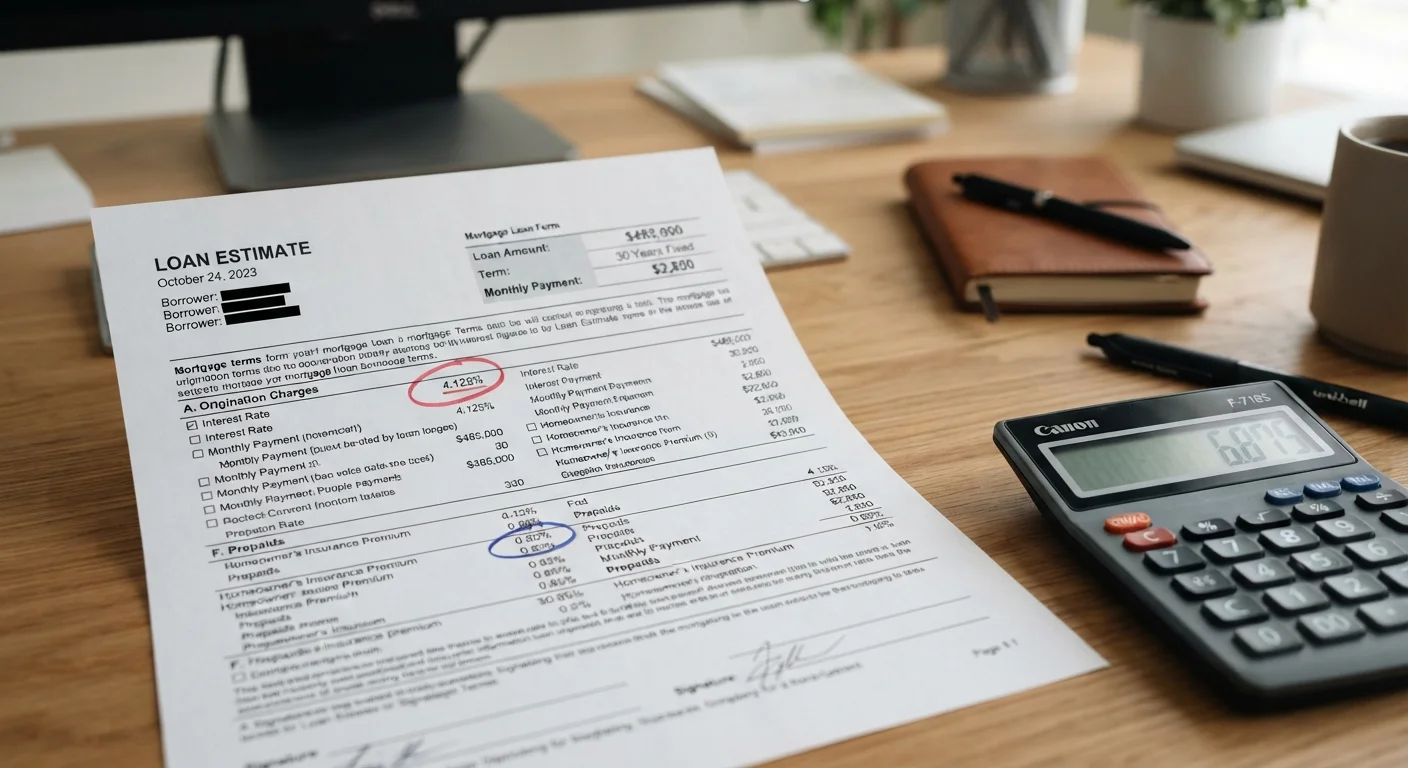
Photo credit: NewBizBuzz.net | Financial Insights For All
In this article
Interest rate and APR look similar but measure different things. Here's what each figure tells you and why both matter.
Key Takeaways
- The interest rate determines your monthly principal-and-interest payment; APR reflects the loan's broader annual cost.
- APR includes most upfront fees — origination charges, discount points, mortgage broker fees — spread over the loan term.
- A lower rate with high fees can produce a higher APR than a slightly higher rate with fewer fees.
- APR is most useful when comparing loans with similar terms and structures from different lenders.
- APR loses accuracy as a comparison tool if you sell or refinance before the loan's full term.
- Always review the Loan Estimate form to see both figures and the itemized fees that separate them.
Two Numbers on the Same Loan Document
When you receive a Loan Estimate, you will notice two distinct percentage figures: the interest rate and the Annual Percentage Rate. They look alike, they're close in value, and lenders are legally required to show both — yet they measure fundamentally different things. Conflating them is one of the most common errors borrowers make when evaluating mortgage offers.
The interest rate is straightforward: it is the annual percentage charged on the outstanding loan balance and is the direct input into your monthly principal-and-interest payment. The APR, by contrast, is an engineered composite figure. It incorporates the interest rate plus most of the upfront financing costs associated with the loan, then expresses that combined burden as an annualized rate, as if those fees were additional interest spread over the loan term. For a deeper primer on the terminology involved, see our loan terminology reference.
0.10%–0.50%
Typical rate-to-APR spread on a conventional mortgage
The spread varies based on origination fee load, points paid, and loan size; larger loans with fixed fees tend to show smaller spreads proportionally.
3 days
Time lenders must provide a Loan Estimate after application
Under the TRID rule enforced by the CFPB, lenders are legally required to deliver the standardized Loan Estimate within three business days of receiving a completed application.
What Gets Folded Into APR
The gap between your interest rate and your APR is not arbitrary — it is the mathematical footprint of your loan's fee structure. Common costs that increase APR above the stated rate include:
- Origination fees: Lender charges for processing and underwriting the loan.
- Discount points: Prepaid interest you may pay upfront to reduce the rate.
- Mortgage broker compensation: If a broker arranged the loan, their fee is typically included.
- Certain prepaid finance charges: Depending on how a lender categorizes them under TILA rules.
Costs that are generally not included in APR — appraisal fees, title insurance, recording fees, and property taxes — are third-party expenses rather than direct financing costs. This exclusion means APR does not capture the complete cash outlay at closing, only the financing-related portion. See our guide to mortgage anatomy for a breakdown of every cost category in a home loan.
Compare APRs Only on Like-for-Like Loans
APR is most useful as a comparison tool when loan type, term length, and down payment are identical across offers. Mixing a 15-year and 30-year loan's APRs, or comparing a fixed-rate to an ARM using APR alone, will produce misleading conclusions. Request itemized fee schedules from each lender and evaluate the rate, APR, and fee breakdown together.
How to Use Both Figures Strategically
The interest rate and APR each answer a different question. The rate tells you what your monthly obligation will be — useful for budgeting. The APR tells you which of two loans is more expensive over its full life, assuming you hold it to maturity — useful for lender comparison.
The caveat on APR is significant. Because it amortizes fixed upfront fees across the entire loan term, it implicitly assumes you never sell, refinance, or pay off the mortgage early. If you hold a 30-year loan for only seven years, those front-loaded fees are effectively concentrated over a shorter window, making the actual cost higher than the disclosed APR implied. This is why a low-rate, high-fee loan can look attractive on APR if you plan to stay long-term, but become costly if you exit early. The inverse also applies — a higher-rate, low-fee structure may produce a better outcome for short-horizon borrowers.
Loan structure compounds this dynamic. Fixed-rate vs. adjustable-rate mortgages carry different APR implications because the rate — and therefore the interest cost — can change on adjustable products. APR for ARMs is calculated based on initial assumptions and may not reflect what you actually pay if rates shift.
Reading the Loan Estimate With Both Metrics in Mind
The Loan Estimate form, standardized by the Consumer Financial Protection Bureau (CFPB), displays both the interest rate and APR prominently on page one, with itemized fees accessible on subsequent pages. Reviewing those pages together is the only reliable way to understand what is driving the spread between rate and APR for any given offer.
When comparing multiple offers, align them on the same loan type, term, and down payment before treating APR as the deciding factor. A 30-year fixed loan's APR is not meaningfully comparable to a 15-year fixed loan's APR, even from the same lender, because the fee amortization period differs. Understanding how your payment evolves over time is equally important — our guide to amortization schedules explains why early payments are interest-heavy and what that means for long-term equity building.
This article is for general informational purposes only and does not constitute personalized financial, mortgage, legal, or tax advice. Mortgage products, rates, fees, and regulations vary by lender and borrower circumstances. Consult a licensed mortgage professional or financial adviser before making borrowing decisions.
APR Disclosure Is Mandated by Federal Law
The Truth in Lending Act (TILA) requires lenders to disclose APR on all consumer credit products, including mortgages. This federal standard exists specifically to give borrowers a consistent basis for comparison. However, because lenders have some discretion in categorizing certain fees as 'finance charges,' APR figures are not always perfectly comparable across institutions. Always review the full Loan Estimate fee schedule alongside the headline APR.
Frequently Asked Questions

Author
Credit & Lending Editorial Team
Credit & Lending Editorial Team is the collective byline for our editorial team and contributor network. Articles published under this byline or an editorial pen name are researched, written, and reviewed according to our editorial standards for clarity, consistency, and independence before publication.
View all articles →