
Risk and Return Across Life Stages: How the Right Balance Shifts Over Time
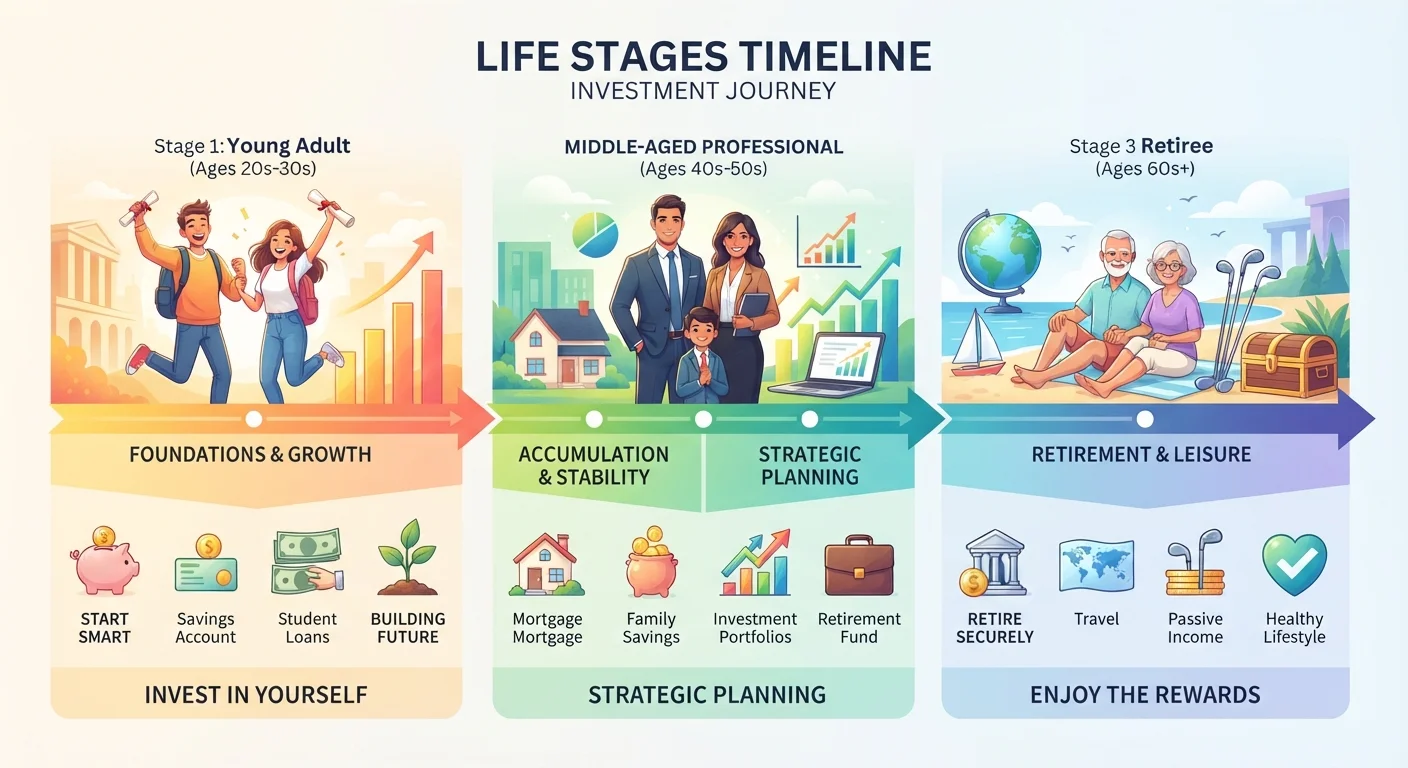
Photo credit: NewBizBuzz.net | Financial Insights For All
The risk-return tradeoff that suits a 25-year-old looks very different at 50 or 65. Explore how priorities and constraints evolve.
Key Takeaways
- Younger investors can generally afford more volatility because time allows recovery from market downturns.
- Mid-career investors must balance growth objectives with rising financial obligations like mortgages and education costs.
- Pre-retirees and retirees typically shift toward capital preservation and income generation over aggressive growth.
- Risk tolerance is shaped by both time horizon and personal financial capacity, not age alone.
- Regular portfolio reviews at each life stage help ensure your asset mix still matches your actual goals and constraints.
Why the Risk-Return Tradeoff Isn't Static
In investing, risk and return are inseparable. Higher potential returns almost always come with greater volatility — meaning larger swings in portfolio value, and a real possibility of loss. The question isn't whether to accept risk, but how much risk is appropriate given your circumstances at any given point in your life.
That calculus changes as you age. A 25-year-old and a 60-year-old can hold the same underlying securities and experience the same market decline, yet face entirely different consequences. The younger investor has decades of future contributions and compounding ahead; the older investor may be drawing on those assets within years. As our complementary guide explores in depth, time horizon fundamentally reshapes the risk-return equation.
Understanding how priorities and constraints evolve across life stages is one of the most practical frameworks any investor can develop. The five phases below reflect general patterns recognized in financial planning — though individual situations vary considerably, and no single framework substitutes for personalized professional guidance.
Early Career (Roughly Ages 22–35): Embrace Growth, Absorb Volatility
Early-career investors hold the most valuable asset in investing: time. A long runway — often 30 or more years before retirement — means short-term volatility is largely recoverable. A portfolio that drops 30% in year two of a 35-year investment horizon has ample time to recover and compound further.
This is the phase where a higher allocation toward growth-oriented assets — such as broadly diversified equity funds — is most defensible from a risk-return standpoint. Volatility feels uncomfortable, but the cost of being too conservative early is often underappreciated: forgoing decades of compounding on assets that could have grown substantially.
That said, even aggressive early-career portfolios benefit from diversification across sectors, geographies, and asset classes. Single-stock concentration is a separate risk category from market risk, and one that younger investors sometimes underestimate.
Time is the early-career investor's most powerful risk-management tool.
Mid-Career Accumulation (Roughly Ages 35–50): Balancing Growth Against Rising Stakes
By mid-career, financial complexity typically increases. Mortgages, dependents, education savings, and career-income variability all introduce constraints that didn't exist a decade earlier. At the same time, investors in this phase are often at or approaching peak earning years, creating strong accumulation capacity.
The risk-return balance here tends to moderate. A portfolio that remains heavily concentrated in equities can still be appropriate for many mid-career investors, but the margin for catastrophic loss begins to narrow — especially if a major market drawdown coincides with a job disruption or large financial obligation.
This is also the phase where tax-advantaged account strategy becomes increasingly consequential. Decisions about Roth versus traditional retirement contributions made during peak-income years carry long-term wealth implications worth analyzing carefully.
Mid-career investors must weigh compounding ambitions against the rising cost of a serious portfolio setback.
Pre-Retirement (Roughly Ages 50–62): Sequencing Risk Becomes the Priority
In the decade or so before retirement, a specific hazard — sequence-of-returns risk — moves to the forefront. This refers to the danger of experiencing significant portfolio losses in the years just before or after retirement, when the portfolio is at its largest and withdrawals are about to begin.
A market decline of 25–30% is recoverable for a 30-year-old who isn't withdrawing funds. For a 60-year-old beginning distributions in three years, the same decline can permanently impair the portfolio's ability to sustain income over a 20–30-year retirement.
Pre-retirees typically begin de-risking — reducing equity concentration, building fixed-income buffers, or holding short-term liquid reserves to avoid forced selling during downturns. The shift in asset allocation across life stages during this window is one of the most consequential portfolio decisions an investor will make.
Sequence-of-returns risk peaks in the years immediately before retirement begins.
Early Retirement (Roughly Ages 62–75): Income Sustainability Over Growth
The transition from accumulation to distribution changes the portfolio's primary job. It must now generate reliable income — or at least support systematic withdrawals — while managing the risk that the investor outlives their assets, sometimes called longevity risk.
Portfolios in this phase typically carry a lower equity weighting than earlier stages, but many financial planners caution against abandoning growth assets entirely. A 65-year-old in good health may have a 20–25-year investment horizon, long enough that some exposure to equities can help offset inflation's erosion of purchasing power over time.
The design of a sustainable withdrawal strategy — including the order in which assets are drawn down across account types — becomes central. This intersects with tax planning decisions that can significantly affect after-tax income throughout retirement.
Longevity risk — outliving one's assets — is as real as market risk for early retirees.
Later Retirement and Legacy Planning (Ages 75+): Capital Preservation and Transfer
In later retirement, the investment horizon shortens further, and priorities often shift toward capital preservation, simplicity, and — for those with assets beyond personal needs — estate and legacy considerations. Volatility that was abstractly acceptable at 35 can now create real distress and practical difficulty.
At this stage, portfolio structure often emphasizes income-generating, lower-volatility instruments, and asset management may increasingly involve decisions about beneficiary designations, trust structures, and charitable giving. Insurance products — including certain annuity structures — may also enter the picture, though their appropriateness depends entirely on individual circumstances.
For a complementary view of how protection needs evolve alongside financial assets, mapping insurance needs across life stages offers useful context. The core principle across all late-retirement planning: complexity is itself a risk, and simplicity has genuine value.
In later retirement, simplicity and predictability often matter more than maximizing potential return.
Putting It All Together
Life-stage investing isn't about rigid rules — it's about aligning your portfolio's risk profile with your actual capacity to absorb loss and your realistic timeline for needing funds. That alignment should be revisited regularly, not just when markets move.
Review Your Allocation at Every Major Transition
Life-stage frameworks are useful starting points, but individual circumstances vary enormously. Major transitions — a new job, a significant inheritance, a health change, or a shift in retirement timeline — are all natural triggers to reassess your portfolio's risk profile. Rather than waiting for annual reviews, build the habit of checking alignment whenever your financial picture materially changes. A licensed financial adviser can help translate life changes into portfolio adjustments grounded in your full financial picture.
For a broader perspective on how portfolio construction evolves alongside wealth-building priorities, see our Portfolio Basics hub and the complementary piece on wealth growth approaches across life stages. Tax considerations — such as the choice between Roth and traditional retirement accounts — also interact meaningfully with life-stage planning; understanding your tax timing options can add important nuance to your strategy.
This article is for general informational and educational purposes only. It does not constitute personalized financial, investment, tax, or legal advice. Past performance does not guarantee future results, and all investing involves risk, including the potential loss of principal. Consult a qualified financial adviser, accountant, or attorney before making decisions based on your individual circumstances.

Author
Investing Fundamentals Editorial Team
Investing Fundamentals Editorial Team is the collective byline for our editorial team and contributor network. Articles published under this byline or an editorial pen name are researched, written, and reviewed according to our editorial standards for clarity, consistency, and independence before publication.
View all articles →