
Roth Conversion vs. Traditional IRA Contributions: Choosing Your Tax Timing
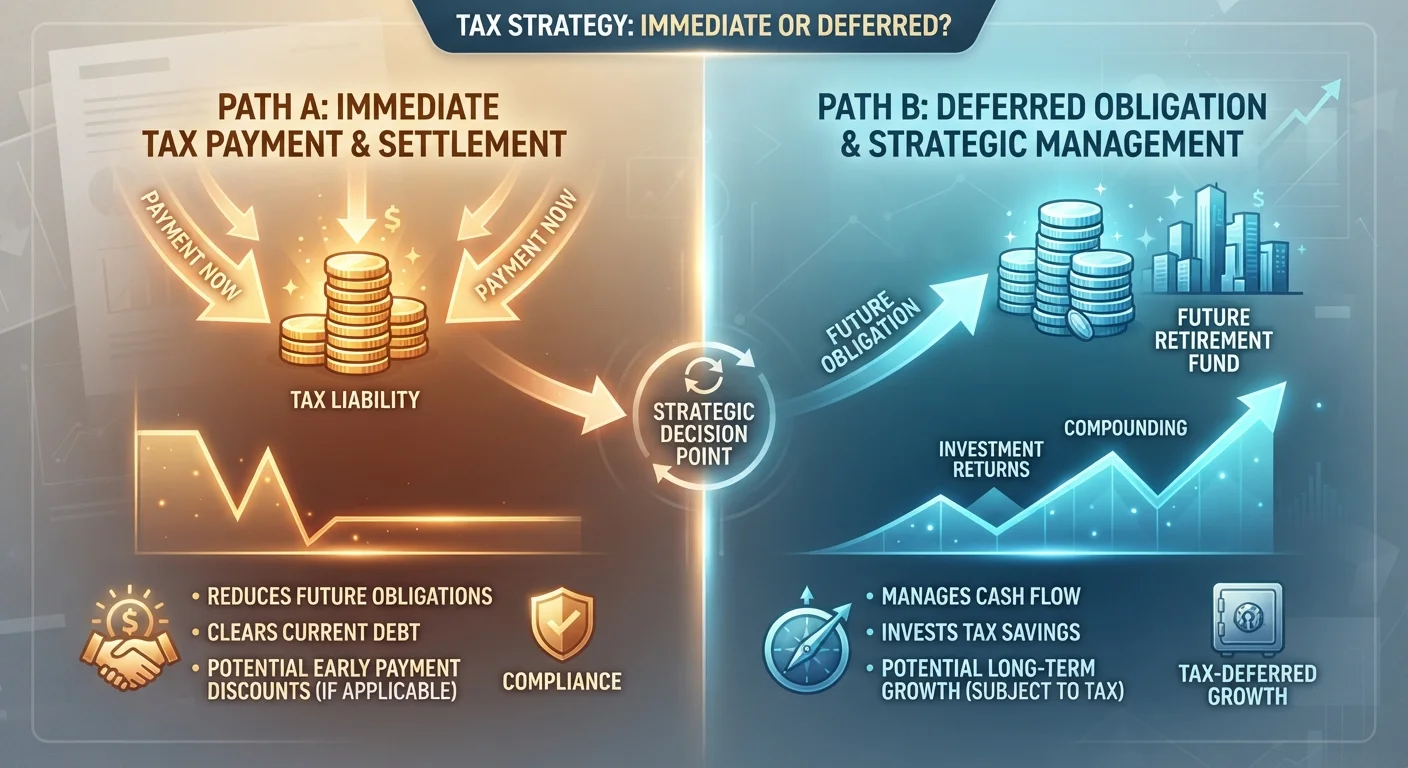
Photo credit: NewBizBuzz.net | Financial Insights For All
In this article
A side-by-side look at paying tax now versus later — exploring how each path affects long-term wealth depending on your income trajectory.
Key Takeaways
- Roth conversions require paying income tax today in exchange for tax-free growth and withdrawals later.
- Traditional IRA contributions may offer an upfront deduction but withdrawals in retirement are taxed as ordinary income.
- Your current versus projected future tax rate is the central variable in this decision.
- Roth accounts carry no required minimum distributions (RMDs) during the owner's lifetime; traditional IRAs do.
- Partial or staged Roth conversions can help manage tax bracket exposure across multiple years.
- Consult a qualified tax professional before executing any conversion or contribution strategy.
Understanding the Core Difference: When Tax Is Paid
Both Roth conversions and traditional IRA contributions are vehicles for retirement savings, but they operate on opposite ends of the tax timeline. With a traditional IRA contribution, eligible taxpayers may deduct the contribution from current taxable income — the tax is deferred until funds are withdrawn in retirement, at which point distributions are taxed as ordinary income. A Roth conversion, by contrast, involves moving funds from a pre-tax account (such as a traditional IRA or 401(k)) into a Roth IRA, triggering a taxable event today in exchange for tax-free growth and qualified withdrawals later.
The fundamental question is not which approach is universally superior — it is which timing produces a lower lifetime tax burden given your individual income trajectory, expected tax rates, and retirement horizon. As a framework, consider the following head-to-head comparison:
| Criterion | Roth Conversion | Traditional IRA Contribution |
|---|---|---|
| When tax is paid | At time of conversion (today) | At time of withdrawal (retirement) |
| Upfront tax deduction | None | Potentially deductible (income limits apply) |
| Withdrawal taxation | Tax-free (qualified distributions) | Taxed as ordinary income |
| Required minimum distributions | None for original owner | Required starting at age 73 |
| Income limits to contribute | No income limit to convert | Deductibility phases out at higher incomes |
| Best tax rate scenario | Current rate lower than future rate | Current rate higher than future rate |
| Estate planning advantage | Passes income-tax-free to heirs | Heirs pay ordinary income tax on distributions |
Tax Rate Trajectory: The Central Variable
The mathematics of this decision hinge almost entirely on your marginal tax rate now versus your effective tax rate in retirement. If you convert at a 22% marginal rate today and retire into a 12% bracket, the conversion likely cost more than necessary. Conversely, if traditional contributions defer income that will eventually be withdrawn at 32%, the upfront deduction was not the bargain it appeared.
73
Age RMDs begin for traditional IRA holders
Under the SECURE 2.0 Act (enacted 2022), the required minimum distribution starting age was raised from 72 to 73, with a further increase to 75 scheduled for 2033.
37%
Top federal marginal income tax rate
The current top federal marginal rate applies to ordinary income above approximately $609,350 for single filers (2024 IRS brackets), making bracket positioning central to conversion timing.
10 years
Inherited IRA distribution window for most beneficiaries
Under the SECURE 2.0 Act, most non-spouse beneficiaries must fully distribute inherited IRA or Roth IRA assets within 10 years of the original owner's death.
Complicating this analysis is tax rate uncertainty at the legislative level. Federal income tax brackets have changed multiple times in recent decades, and future adjustments cannot be predicted with certainty. For this reason, many tax professionals advocate a tax diversification strategy — holding assets across both Roth and traditional vehicles — rather than committing entirely to one path. This hedges against rate shifts in either direction.
Time horizon also matters significantly. The longer funds compound inside a Roth account tax-free, the more consequential the initial conversion tax becomes relative to the total benefit. See how time horizon reshapes risk and return for a broader view of how duration affects financial outcomes.
Required Minimum Distributions and Estate Planning Implications
One structurally important distinction that operates independently of tax-rate forecasting is the required minimum distribution (RMD) rule. Traditional IRAs require account holders to begin taking taxable distributions at age 73 (under current IRS rules). These forced withdrawals can push retirees into higher brackets, trigger Medicare premium surcharges (known as IRMAA — Income-Related Monthly Adjustment Amount), and erode the tax-deferred advantage over time.
Roth IRAs have no RMD requirement for the original account owner during their lifetime. This gives Roth holders significantly more control over income recognition in retirement — a valuable tool for managing bracket exposure year to year. It also means Roth assets can continue compounding untouched for decades if other income sources are sufficient.
IRMAA and Medicare Premium Surcharges
Converting a large IRA balance in a single year can push modified adjusted gross income above Medicare's IRMAA thresholds, triggering higher Part B and Part D premiums two years later. For 2024, IRMAA surcharges begin when MAGI exceeds $103,000 for single filers. This is a frequently overlooked cost of large Roth conversions and underscores the value of staging conversions across multiple years in coordination with a tax adviser.
From an estate planning standpoint, Roth accounts that pass to heirs remain income-tax-free (though non-spouse beneficiaries are generally subject to the 10-year distribution rule under the SECURE 2.0 Act). This makes the Roth conversion a strategy worth examining alongside broader wealth transfer goals. For a deeper look at how tax timing intersects with estate planning, see how estate planning and taxes work together.
Executing a Conversion Strategically: Partial and Staged Approaches
Few taxpayers benefit from converting an entire traditional IRA balance in a single year. Doing so can generate a large taxable income spike, potentially pushing a portion of the conversion into a higher bracket and triggering additional costs. A more measured approach involves staged Roth conversions — converting only enough each year to fill a specific tax bracket without crossing into the next tier.
For example, a retiree with modest Social Security income and a gap between their standard deduction and the top of the 22% bracket might systematically convert that gap amount annually over several years. This laddering strategy reduces cumulative lifetime tax cost while gradually shifting the tax character of retirement assets. It requires careful coordination with other income sources, including capital gains, dividends, and Social Security — which itself becomes partially taxable above certain income thresholds.
Portfolio structure also plays a role. Assets expected to appreciate most aggressively are generally more valuable inside a Roth account, where all growth is sheltered. This consideration connects directly to asset allocation decisions over time — see asset allocation across life stages for guidance on how class mix evolves with age and risk capacity.
This article is for general informational and educational purposes only and does not constitute personalized tax, legal, or investment advice. Tax rules, income limits, and account regulations are subject to change. Please consult a qualified tax professional or financial adviser regarding your specific situation before making any decisions.

Author
Accounting & Tax Editorial Team
Accounting & Tax Editorial Team is the collective byline for our editorial team and contributor network. Articles published under this byline or an editorial pen name are researched, written, and reviewed according to our editorial standards for clarity, consistency, and independence before publication.
View all articles →