
Mapping Your Insurance Needs Across Life's Stages
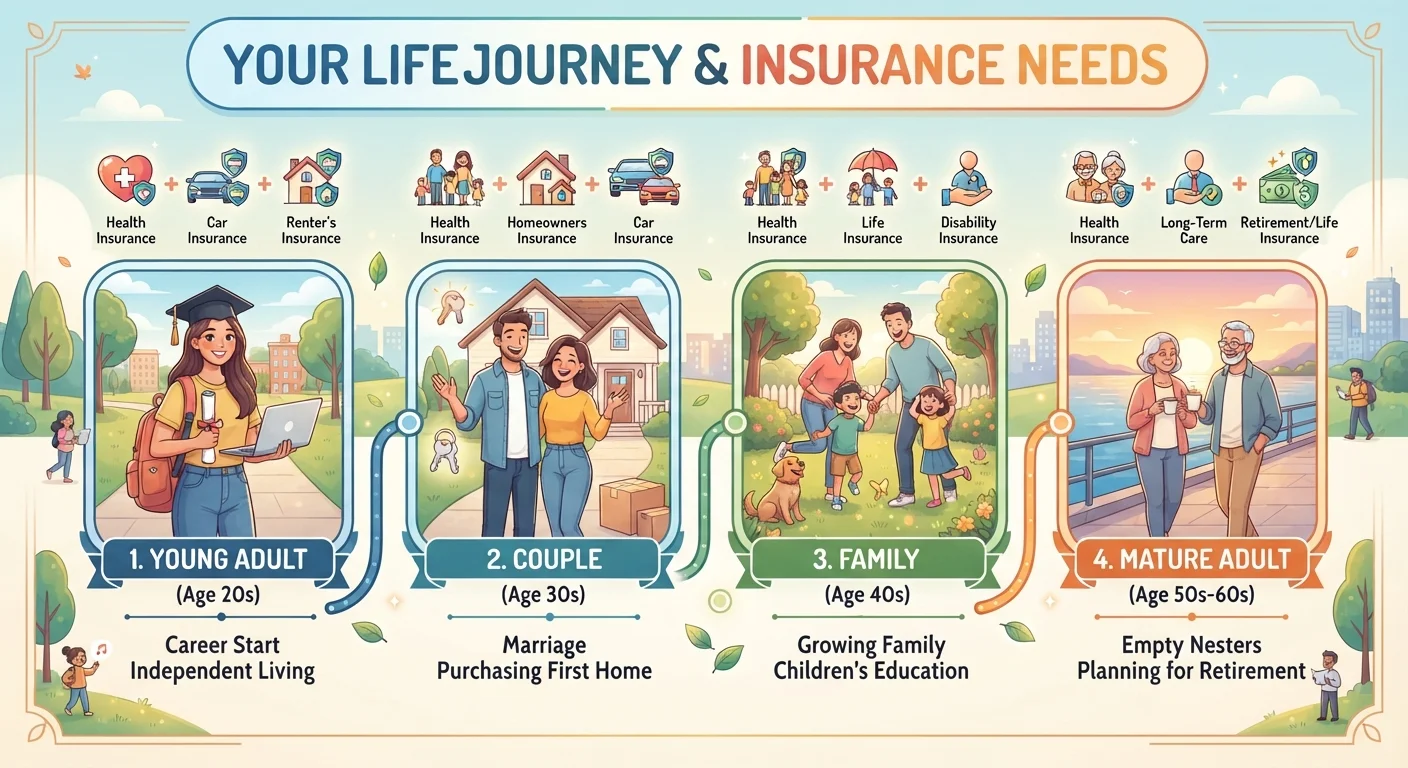
Photo credit: NewBizBuzz.net | Financial Insights For All
In this article
The right coverage mix changes as your life does. This guide walks through how insurance priorities typically shift from early adulthood through retirement.
Key Takeaways
- Insurance priorities shift meaningfully at each major life stage — early career, family formation, mid-life, and retirement.
- Health and disability coverage are often the most critical needs in early adulthood, before significant assets accumulate.
- Life and property insurance typically become more urgent once dependents or owned assets enter the picture.
- As retirement approaches, long-term care insurance becomes a key consideration most people underplan for.
- An annual coverage review helps ensure your policies keep pace with life changes rather than lagging behind them.
Why a Life-Stage Lens Makes Sense for Insurance Planning
Insurance isn't a static checklist — it's a dynamic set of tools that should evolve as your financial responsibilities and risk profile change. A 25-year-old renter has almost nothing in common with a 55-year-old homeowner supporting college tuition and managing a mortgage payoff timeline. Yet many people carry the coverage they happened to acquire years ago, adjusted only when prompted by a renewal or a claim.
Mapping coverage to life stages isn't about buying more insurance — it's about ensuring the coverage you carry is actually aligned with the risks that are most financially consequential right now. This connects directly to broader wealth-building strategy: the way financial priorities shift across life stages applies just as meaningfully to protection planning as to investment planning.
For a grounding in the four core coverage types before working through these steps, our overview of health, life, auto, and property insurance provides the foundational framework. And if you want to audit what you currently have before layering on new decisions, see our structured coverage audit guide.
This Article Is Educational, Not Personalized Advice
The guidance here reflects general patterns in how insurance needs evolve across life stages. It is not a substitute for personalized advice from a licensed insurance agent or financial adviser. Coverage requirements, eligibility, premiums, and exclusions vary widely by provider, state, and individual circumstance. Always review your actual policy documents and consult a qualified professional before making coverage decisions.
Step-by-Step: Mapping Coverage to Your Stage
The six steps below walk through each major life stage in sequence. Work through the step that corresponds to your current stage, but also review the stages immediately ahead — understanding what coverage shifts are coming helps you plan proactively rather than reactively.
What you will need
Current Policy Documents
Allows you to verify existing coverage limits, exclusions, and beneficiary designations at each review stage.
Net Worth Snapshot
Helps determine how much asset protection and life insurance coverage is proportionate to your financial profile.
Licensed Insurance Agent or Financial Adviser
Provides personalized guidance on coverage decisions that general frameworks cannot fully address.
Anchor to Your Current Life Stage
Before evaluating specific policies, locate yourself honestly within a life stage framework. General categories used in financial planning include: early adulthood (roughly 20s, pre-dependents), family formation (partnered or parenting, often 30s), mid-life asset accumulation (40s–50s), and pre-retirement and retirement (late 50s onward). These aren't rigid age brackets — a 38-year-old without dependents has a different profile than a 38-year-old with two children and a mortgage.
Your life stage determines which risks are most financially consequential to you right now. That's the lens through which every coverage decision should be filtered.
Prioritize Health and Disability Coverage in Early Adulthood
In your 20s, your most valuable financial asset is your earning capacity. A serious illness or injury that sidelines you for months — or permanently — can derail wealth-building before it meaningfully begins. Yet disability insurance is one of the most commonly overlooked coverages among younger adults.
- Health insurance: If you're not covered through an employer, explore marketplace plans or check eligibility for Medicaid based on your income. Avoid going uninsured even briefly.
- Short- and long-term disability: If your employer offers group disability coverage, enroll. If not, an individual policy becomes a higher priority than most people realize at this stage.
- Auto insurance: Required in nearly every state; ensure you carry at least the minimum required liability limits, and consider higher limits if you have any savings to protect.
Life insurance is typically a lower priority at this stage unless someone depends on your income. Renter's insurance, however, is inexpensive and covers personal property and liability — it's rarely worth skipping.
Add Life and Property Coverage When Dependents or Assets Arrive
Marriage, children, and homeownership each introduce financial dependents or significant assets — and therefore new coverage obligations. This is when life insurance typically moves from optional to essential.
- Term life insurance: For most households at this stage, a term policy sized to replace several years of income provides cost-effective protection. Our comparison of term and whole life structures can help clarify the trade-offs.
- Homeowners insurance: Required by most mortgage lenders, but the required minimum isn't always sufficient. Review dwelling replacement cost coverage and personal liability limits.
- Umbrella liability insurance: Once you own a home or accumulate meaningful savings, a personal umbrella policy adds a layer of liability protection above your auto and homeowners policy limits at relatively low cost.
Reassess Coverage as Assets Grow in Mid-Life
In your 40s and 50s, your financial picture has likely grown more complex. Asset values are higher, income is often at its peak, and children may be approaching adulthood. This stage calls for a recalibration — not necessarily more coverage across the board, but more precisely matched coverage.
- Life insurance: As children become financially independent and a mortgage approaches payoff, the income-replacement rationale for large death benefits weakens. Review whether your existing coverage is still appropriately sized.
- Disability insurance: Your peak earning years are also the years when a long-term disability would cause the most financial damage. Confirm your coverage limits still reflect your current income.
- Property and auto: Rising asset values — a more valuable home, a second vehicle — may warrant higher coverage limits or riders for specific items.
Plan for Long-Term Care Before You Need It
As retirement approaches, long-term care insurance becomes one of the most consequential and most deferred planning decisions. Long-term care — covering custodial services like in-home assistance, assisted living, or nursing facility care — is not covered by standard health insurance or Medicare in most circumstances.
Premiums for long-term care policies are substantially lower when purchased in your 50s than in your late 60s, and underwriting becomes more restrictive with age. Many financial planners suggest evaluating long-term care options between ages 55 and 65 as a practical window.
This is also the stage to review life insurance beneficiary designations and ensure they reflect your current estate intentions. A policy acquired decades ago may name outdated beneficiaries or carry a benefit amount that no longer aligns with your actual estate plan.
Adjust the Portfolio in Retirement
In retirement, income replacement via life insurance becomes less central for most households, while healthcare cost protection and asset preservation move to the foreground.
- Medicare and supplemental coverage: Medicare Part A and Part B cover a meaningful share of medical costs but leave gaps. Medigap policies or Medicare Advantage plans help manage out-of-pocket exposure. Enrollment timing matters — late enrollment in Medicare Part B carries permanent premium surcharges.
- Property insurance: If you've downsized or relocated, update coverage to reflect the new property. Review whether you need flood or other specialized coverage based on your new location.
- Life insurance review: If estate planning objectives require a death benefit to remain in force, review cash value policies carefully. If no longer needed for income replacement or estate purposes, reconsider whether premiums are justified.
For a full view of all four major coverage categories and how they interact, see our comprehensive coverage overview.
Coverage Gaps Can Be Costly at Any Stage
Assuming your coverage is still adequate because nothing has changed recently is a common and expensive mistake. Marriage, a new child, a home purchase, a job change, or even a paid-off car loan can all affect what coverage you need. Treat a major life event as an automatic trigger to reassess your full insurance profile.
Use Life Events as Coverage Checkpoints
Rather than waiting for an annual review, use significant milestones — getting married, having a child, buying property, changing jobs — as automatic prompts to reassess your coverage. Many insurers allow policy updates within a qualifying event window. See our guide to annual coverage reviews for a structured approach.
This article is for general informational purposes only and does not constitute personalized insurance, financial, or legal advice. Coverage terms, eligibility, exclusions, and premiums vary by provider and by state. Always read your actual policy documents carefully and consult a licensed insurance agent or qualified financial adviser before making coverage decisions for your specific situation.

Author
Insurance Explained Editorial Team
Insurance Explained Editorial Team is the collective byline for our editorial team and contributor network. Articles published under this byline or an editorial pen name are researched, written, and reviewed according to our editorial standards for clarity, consistency, and independence before publication.
View all articles →