
Asset Classes Ranked by Risk Profile: What the Historical Record Suggests
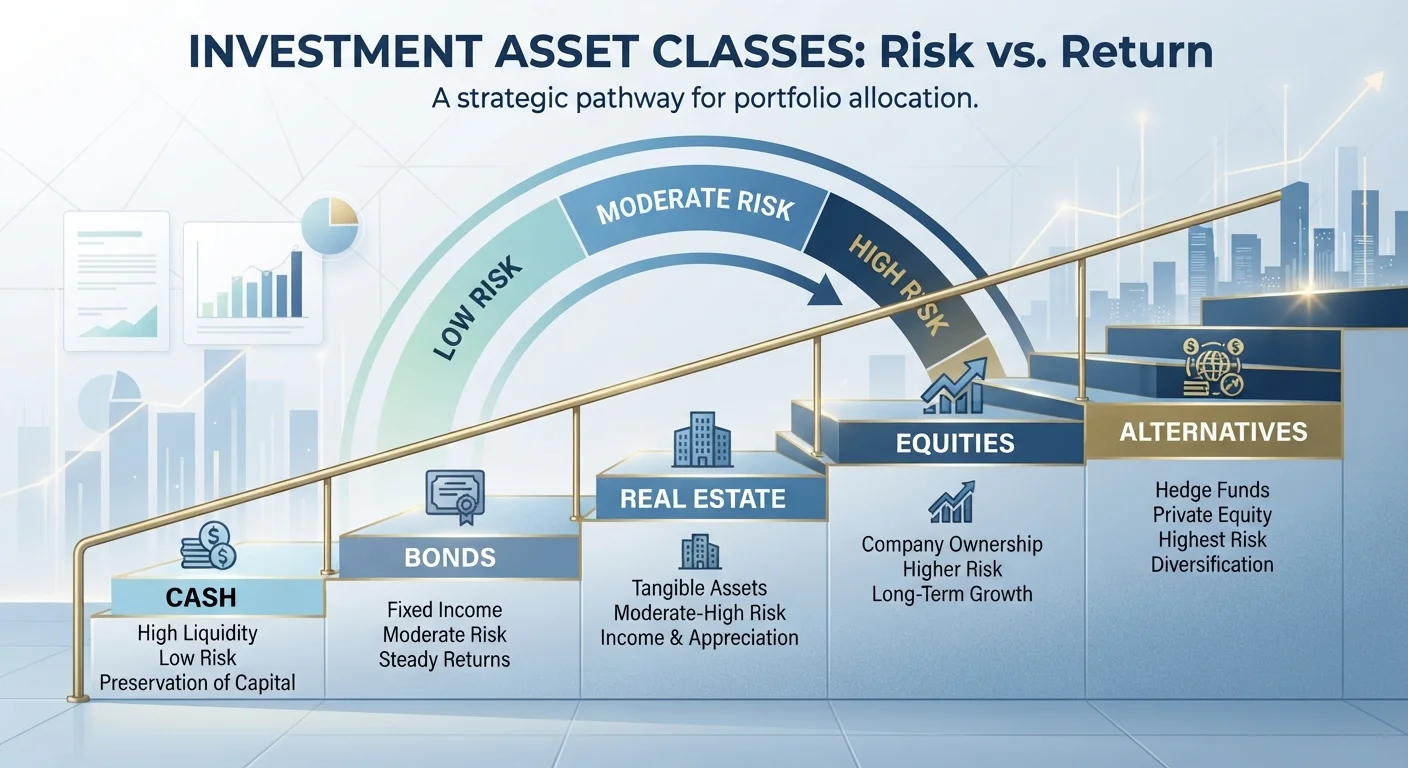
Photo credit: NewBizBuzz.net | Financial Insights For All
In this article
Cash, bonds, equities, real estate, and alternatives carry different risk characteristics. Here's what decades of data generally show.
Key Takeaways
- Historical data shows a general pattern: higher expected returns have tended to accompany higher volatility and loss potential.
- Cash and short-term Treasuries preserve nominal capital but carry real purchasing-power risk over time due to inflation.
- Equities have delivered the strongest long-run real returns among traditional asset classes, but with significant drawdown risk.
- Alternative assets such as commodities and private equity introduce unique risks not always captured by standard volatility measures.
- Risk profile alone does not determine suitability — time horizon, liquidity needs, and diversification context all matter.
Why Ranking Asset Classes by Risk Matters
Understanding how different asset classes behave under stress is foundational to building a resilient portfolio. The historical record — spanning multiple business cycles, recessions, and market crises — gives investors a meaningful, if imperfect, guide to the relative risk of each major category. For a deeper primer on what each class actually is, see our overview of the major asset classes.
Risk, in portfolio terms, typically encompasses three dimensions: volatility (how widely prices fluctuate), drawdown risk (peak-to-trough loss potential), and liquidity risk (how quickly an asset can be converted to cash at fair value). No single ranking captures all three perfectly, but ordering asset classes from lowest to highest risk on these dimensions offers a practical framework for allocation decisions. Keep in mind: past behavior does not guarantee future results, and all investing involves the possibility of loss.
Risk Rankings Are Relative, Not Absolute
The ordering presented here reflects broad historical tendencies across asset classes, not fixed laws. Individual securities within any class can deviate dramatically from category norms — a junk-rated bond carries far more default risk than a blue-chip stock in some scenarios. Additionally, correlations between asset classes can shift during market crises, sometimes undermining the diversification benefits investors expected. Always evaluate risk in the context of your full portfolio, not in isolation.
Asset Classes from Lowest to Highest Risk
Cash and Cash Equivalents — Lowest Volatility, Hidden Inflation Risk
Cash, money-market instruments, and short-duration Treasury bills sit at the low end of the risk spectrum. Nominal capital loss is rare, and liquidity is essentially immediate. However, the historical record is clear: over long periods, cash returns have frequently failed to outpace inflation, eroding real purchasing power. Our article on cash and cash equivalents explores why this overlooked class still plays a critical role in any well-structured portfolio.
Cash preserves nominal value but historically struggles to keep pace with inflation over time.
Investment-Grade Bonds — Moderate Stability With Interest-Rate Sensitivity
High-quality government and corporate bonds sit above cash on the risk ladder. Their prices move inversely with interest rates, meaning they can suffer meaningful drawdowns in rising-rate environments — a lesson many investors relearned in 2022 when long-duration bond indices posted double-digit losses. Default risk is low for investment-grade issuers, but it is not zero. As a group, bonds have historically produced real returns above cash while exhibiting substantially less volatility than equities, making them a traditional ballast in diversified portfolios.
Investment-grade bonds offer more return than cash but carry real interest-rate and credit risk.
Real Estate — Income-Generating With Illiquidity Premium
Real estate — whether held directly or through REITs — sits roughly in the middle of the risk spectrum. Direct property is highly illiquid, transaction costs are substantial, and valuations are infrequent, which can mask volatility. REITs trade on exchanges and therefore exhibit price volatility closer to equities, especially during credit crunches when property financing tightens. Over multi-decade periods, real estate has generally delivered returns between bonds and equities with meaningful income components. For a detailed comparison of the two access methods, see our guide on physical property vs. REITs.
Real estate offers middle-ground returns but introduces illiquidity and leverage risks often underestimated by investors.
Equities — Highest Long-Run Returns, Sharpest Drawdowns
Broad equity indices have historically delivered the strongest long-run real returns among traditional asset classes. US large-cap stocks, for example, have experienced compound real returns averaging roughly 6–7% annually over many decades — but that figure is accompanied by periodic peak-to-trough declines exceeding 40–50%. The 2000–2002 dot-com bust and the 2008–2009 financial crisis each illustrated how quickly paper gains can evaporate. Investors who understand how equities differ from bonds and real estate on volatility and loss potential can use our risk profile comparison as a reference. Time horizon is the critical variable: historically, longer holding periods have meaningfully reduced the probability of nominal loss in diversified equity portfolios, though no outcome is guaranteed.
Equities have historically rewarded long-term holders most, but require tolerance for severe short-term drawdowns.
Alternative Assets and Crypto — Wide Range, Elevated Uncertainty
At the highest end of the risk spectrum sit alternatives: commodities, private equity, hedge funds, and digital assets. Commodities can swing dramatically on supply shocks, geopolitical events, and currency movements. Private equity is illiquid by design — capital may be locked up for years — and valuations are mark-to-model until exit. Cryptocurrencies have displayed volatility multiples higher than equities, with assets routinely moving 50–80% from peak to trough within a single cycle. Our article on crypto as an asset class maps the evidence and open questions carefully. For the broader alternatives universe, see our piece on commodities, private equity, and hedge funds. These categories may offer diversification benefits or return enhancement in certain conditions, but their risk characteristics demand rigorous scrutiny.
Alternatives and crypto carry the widest range of outcomes and demand rigorous due diligence before allocation.
Match Risk Level to Time Horizon
A useful rule of thumb: the shorter your investment horizon, the less capacity you generally have to absorb volatility. Higher-risk assets like equities and alternatives are typically better suited to investors who can remain invested through multiple market cycles. Understanding how each class behaves across economic cycles — explored in our economic cycle guide — can further refine your allocation thinking.
Putting the Risk Spectrum to Work
Ranking asset classes by risk is not the same as recommending a particular allocation. A retiree drawing income and a 30-year-old accumulating wealth may rationally hold very different mixes even if they understand the same risk hierarchy. Risk profile must always be matched against time horizon, income stability, and genuine emotional tolerance for loss — concepts explored further in our guide on what investment risk profiles actually mean.
Diversification across the spectrum — rather than concentration in any single tier — is one of the most durable findings from portfolio research. Combining asset classes with low or negative correlations can reduce overall portfolio volatility without proportionally sacrificing expected return. For a disciplined framework on measuring whether any asset is compensating you adequately for its risk, see our piece on risk-adjusted returns.
This article is for general informational and educational purposes only and does not constitute personalized financial, investment, tax, or legal advice. All investing involves risk, including the possible loss of principal. Consult a qualified financial adviser before making decisions suited to your individual circumstances.

Author
Investing Fundamentals Editorial Team
Investing Fundamentals Editorial Team is the collective byline for our editorial team and contributor network. Articles published under this byline or an editorial pen name are researched, written, and reviewed according to our editorial standards for clarity, consistency, and independence before publication.
View all articles →