
What Market Sentiment Actually Measures — and Why It Moves Prices
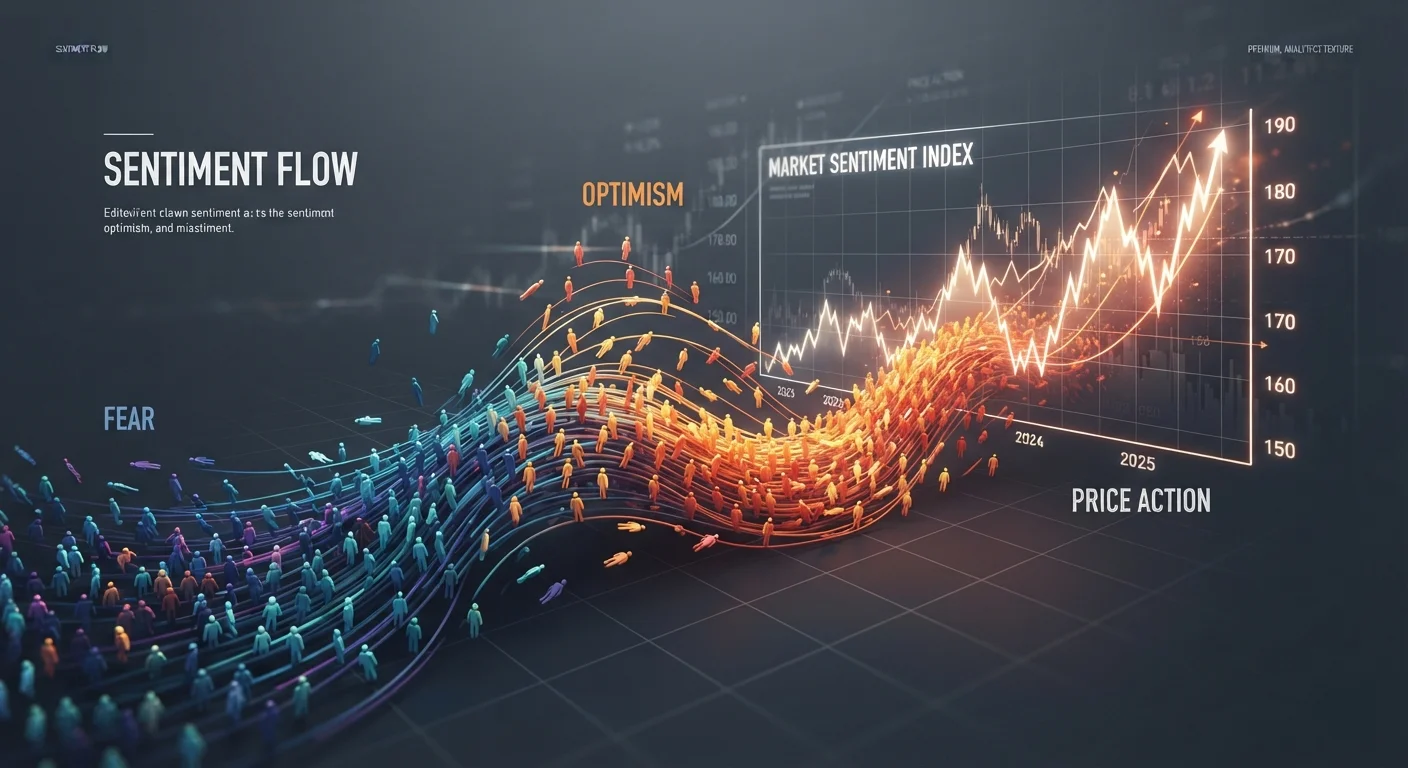
Photo credit: NewBizBuzz.net | Financial Insights For All
In this article
Market sentiment captures the collective mood of investors. Learn how it forms, how it's measured, and why it can diverge from fundamentals.
Key Takeaways
- Market sentiment reflects collective investor psychology, not just underlying business fundamentals.
- Sentiment can sustain price moves that diverge from intrinsic value for longer than logic might suggest.
- Quantitative tools — including surveys, options data, and fund flows — help analysts gauge prevailing sentiment.
- Extreme sentiment readings often act as contrarian signals, warning of potential reversals.
- Sentiment analysis works best when combined with fundamental and technical research, not used in isolation.
How Sentiment Forms in the Market
Markets are not purely rational systems. Every price reflects not just a calculated assessment of value but also the aggregate of fears, expectations, and convictions held by every active participant at that moment. That aggregate is what analysts call market sentiment.
Sentiment forms through a continuous feedback loop. Macro data releases, corporate earnings, geopolitical headlines, and even social media narratives all feed into how investors interpret near-term risk and opportunity. Those interpretations translate into orders — buy, sell, or hold — and the cumulative weight of those orders moves prices. Understanding how economic indicators shape investor outlook helps clarify why certain data releases can shift sentiment rapidly even when the underlying trend has not materially changed.
Critically, sentiment is self-reinforcing. Rising prices attract optimistic buyers, which pushes prices higher still. The same dynamic works in reverse during selloffs. This reflexivity is why sentiment can sustain trends well past the point where fundamentals alone would justify them.
“The market is a voting machine in the short run and a weighing machine in the long run. In the short term, sentiment determines prices; over time, value does.”
— Benjamin Graham, Economist and investor, widely regarded as the father of value investing
Tools Analysts Use to Measure Sentiment
Because sentiment is inherently psychological, it cannot be read directly — it must be inferred from observable market behavior and surveys. Several established tools serve this purpose:
- CBOE Volatility Index (VIX): Often called the "fear gauge," the VIX measures the implied volatility priced into S&P 500 options. A rising VIX signals that investors are paying a premium for downside protection, indicating heightened anxiety. A low VIX typically reflects complacency or confidence.
- Put/Call Ratio: This ratio compares the volume of bearish put options to bullish call options. Elevated readings suggest defensive positioning; depressed readings suggest speculative optimism.
- AAII Investor Sentiment Survey: Published weekly, this survey asks individual investors whether they are bullish, bearish, or neutral over the next six months. It serves as a direct self-reported measure of retail sentiment.
- Fund Flows: Tracking capital moving into or out of equity, bond, or money-market funds reveals how institutional and retail investors are actually repositioning — not just how they say they feel.
~30%
Typical VIX spike during major market stress events
The VIX has historically surged well above its long-run average of roughly 20 during acute stress episodes, reflecting a sharp increase in demand for protective options.
Weekly
Frequency of AAII Investor Sentiment Survey publication
The American Association of Individual Investors has published its sentiment survey consistently since 1987, providing a long historical record of retail investor mood.
No single indicator tells the full story. Analysts treat these tools as a mosaic, looking for corroboration across multiple signals before drawing conclusions about prevailing sentiment.
When Sentiment Diverges from Fundamentals
One of the most practically useful aspects of sentiment analysis is identifying when it decouples from underlying business reality. Historically, periods of extreme bullish sentiment have coincided with stretched valuations — and extreme pessimism has sometimes created opportunities that fundamental analysis alone might flag as undervalued.
This divergence is not random. Behavioral finance research documents recurring patterns: herding, where investors cluster around popular narratives; anchoring, where prior price levels distort expectations; and recency bias, where recent returns are extrapolated indefinitely. These biases amplify sentiment swings and help explain why price corrections, when they come, can be abrupt.
Use Extreme Sentiment as a Risk Signal
When multiple sentiment indicators simultaneously reach historic extremes — either euphoric or deeply pessimistic — it is worth reassessing your portfolio's risk exposure. Extreme readings do not pinpoint exact turning points, but they signal that the margin of safety in the prevailing trend may have narrowed. Combine sentiment signals with valuation and breadth analysis for a more disciplined read.
Sentiment also interacts with capital flows across market segments. When investors rotate out of growth sectors and into defensive ones, the underlying driver is often a sentiment shift rather than a sudden change in earnings prospects. The mechanics of sector rotation are frequently sentiment-driven, particularly at turning points in the economic cycle. Pairing sentiment analysis with market breadth indicators provides a more complete picture of whether a trend reflects genuine broad-based conviction or a narrowing, fragile consensus.
Sentiment analysis is one layer within a broader analytical framework. For a structured approach that integrates macro context, sector dynamics, and valuation, see the complete market analysis framework.
This article is for general informational and educational purposes only and does not constitute personalized financial, investment, or legal advice. All investing involves risk, including possible loss of principal. Past performance does not guarantee future results. Consult a qualified financial professional before making decisions based on your individual circumstances.
Frequently Asked Questions

Author
Stocks & Markets Editorial Team
Stocks & Markets Editorial Team is the collective byline for our editorial team and contributor network. Articles published under this byline or an editorial pen name are researched, written, and reviewed according to our editorial standards for clarity, consistency, and independence before publication.
View all articles →