
Top-Down vs Bottom-Up Investing: Frameworks for Structuring Your Research
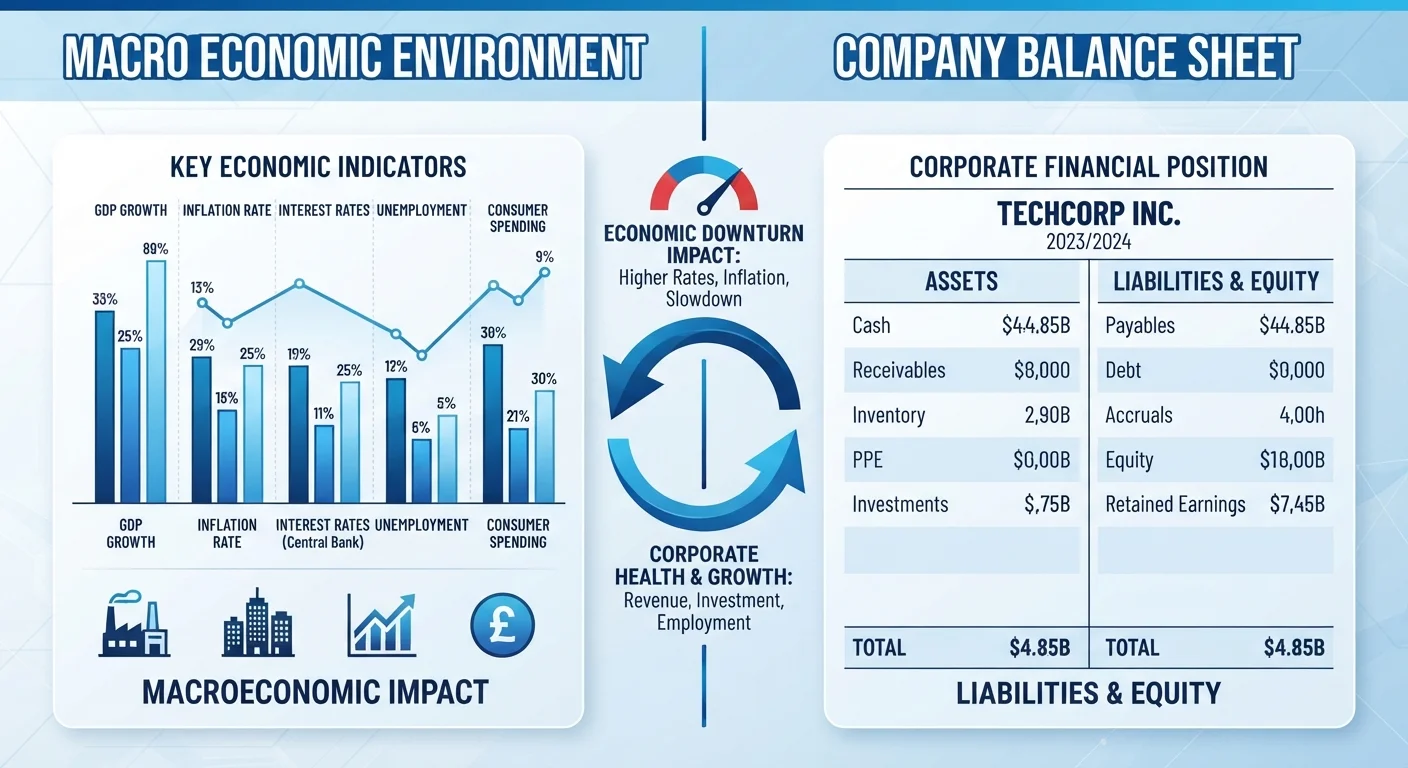
Photo credit: NewBizBuzz.net | Financial Insights For All
In this article
Top-down analysis starts with the economy; bottom-up starts with individual companies. Both are valid — but they answer different questions.
Key Takeaways
- Top-down investing begins with macroeconomic conditions and narrows to sectors and individual securities.
- Bottom-up investing evaluates individual companies first, largely independent of broader market trends.
- Neither approach is universally superior — each has distinct strengths depending on market conditions and investor goals.
- Many professional investors combine both frameworks to cross-validate investment decisions.
- Both approaches ultimately serve fundamental analysis; your entry point determines the research sequence, not the conclusion.
What Separates the Two Frameworks
Investment research doesn't begin at the same place for every analyst. Top-down investing starts at the highest level of abstraction — the global or national economy — and progressively filters down through sectors, industries, and finally individual securities. Bottom-up investing inverts that sequence entirely, beginning with a specific company's financials, competitive positioning, and management quality before considering the broader environment.
Both are forms of fundamental analysis, and both aim at the same destination: identifying investments whose intrinsic value differs meaningfully from their current market price. The difference lies in which signals guide you there. For a deeper look at how these frameworks fit within a complete research process, see the complete market analysis framework.
| Top-Down | Bottom-Up | |
|---|---|---|
| Starting point | Macroeconomic conditions | Individual company fundamentals |
| Research sequence | Economy → Sector → Stock | Stock → Industry → Economy |
| Primary strength | Macro risk management | Identifying mispriced companies |
| Primary weakness | Macro forecasting is unreliable | May ignore structural sector headwinds |
| Best market condition | Rate cycles, sector rotations | Idiosyncratic company dislocations |
| Typical user | Macro-oriented portfolio managers | Value and fundamental stock pickers |
| Time horizon tendency | Medium-term (cycle-driven) | Long-term (intrinsic value realization) |
The Top-Down Approach: Economy First
A top-down analyst typically begins by assessing the macroeconomic cycle — GDP growth trajectory, inflation, interest rate direction, and fiscal policy. From that starting point, they identify which broad asset classes are likely to benefit or suffer. For context on how different asset classes tend to respond across economic cycles, see how asset classes behave across economic cycles.
Once asset class preferences are established, the analyst narrows to sectors. In a rising rate environment, for example, financials may look structurally advantaged while rate-sensitive utilities face headwinds. Only after sector selection does stock picking begin — and at that stage, the macro thesis has already done significant filtering work.
Layer Your Research for Greater Confidence
Even if you prefer a top-down approach, stress-testing your sector thesis against individual company fundamentals adds a critical quality filter. A sector that looks macro-favorable may still contain companies with weak balance sheets or deteriorating margins. Running at least a basic bottom-up check before committing capital can surface risks that the macro view alone would miss.
The primary strength of this approach is its systematic risk management. By anchoring decisions in macro conditions first, investors reduce the risk of owning fundamentally sound companies in structurally challenged sectors. Its main limitation: macro forecasting is notoriously difficult, and errors at the top layer compound down through every subsequent decision.
The Bottom-Up Approach: Company First
Bottom-up investors argue that compelling company fundamentals can generate strong returns across a wide range of macro environments. Their research begins with a company's income statement, balance sheet, and cash flow statement — assessing revenue quality, margin structure, return on invested capital, and competitive moat. The macroeconomic backdrop is considered, but it rarely drives the initial investment thesis.
This approach is particularly associated with value investing traditions, where the goal is to identify businesses trading at a significant discount to their intrinsic value. A bottom-up analyst might find an attractively valued industrial company even during a period of general economic uncertainty, reasoning that the market has overpriced macro risk relative to the company's specific earnings power.
Beware of Confirmation Bias in Both Frameworks
Both top-down and bottom-up analysis carry a risk of confirmation bias — selectively weighting data that supports an existing thesis. With top-down, analysts can over-extrapolate macro trends to justify sector bets. With bottom-up, investors can fall in love with a company's story while discounting valid macro or industry-level risks. Build in an explicit step to actively seek disconfirming evidence before finalising any investment thesis.
The limitation here is context blindness. A company with excellent fundamentals can still underperform for extended periods if it operates in a sector facing structural decline or severe regulatory headwinds — factors a pure bottom-up framework may underweight. This is why many practitioners complement bottom-up stock selection with at least a basic top-down filter on sector and macro exposure. This also connects to broader portfolio construction principles around diversification and risk management.
Using Both Frameworks Together
In practice, the distinction between top-down and bottom-up is rarely binary. Many institutional portfolio managers use top-down analysis to set sector weights and macro guardrails, then deploy bottom-up research to identify the specific securities within those preferred sectors. This layered approach combines macro risk management with company-level precision.
Individual investors can apply the same logic at a smaller scale. A useful sequence: assess the current economic cycle to determine which sectors appear better positioned (top-down), then screen for companies within those sectors that meet specific valuation and quality criteria (bottom-up). For investors evaluating non-traditional asset classes, these same frameworks apply — as explored in digital asset portfolio construction.
It's also worth noting how these frameworks relate to market analysis more broadly. Top-down and bottom-up are both rooted in fundamental analysis — they differ from technical analysis, which relies on price and volume data rather than economic or financial statement inputs. The technical vs. fundamental analysis comparison explores that separate but complementary distinction.
This article is for informational and educational purposes only. It does not constitute personalised financial, investment, tax, or legal advice. Past performance does not guarantee future results. Consult a qualified financial adviser before making investment decisions based on your individual circumstances.

Author
Stocks & Markets Editorial Team
Stocks & Markets Editorial Team is the collective byline for our editorial team and contributor network. Articles published under this byline or an editorial pen name are researched, written, and reviewed according to our editorial standards for clarity, consistency, and independence before publication.
View all articles →