
Stock Market Myths That Can Quietly Erode Your Returns
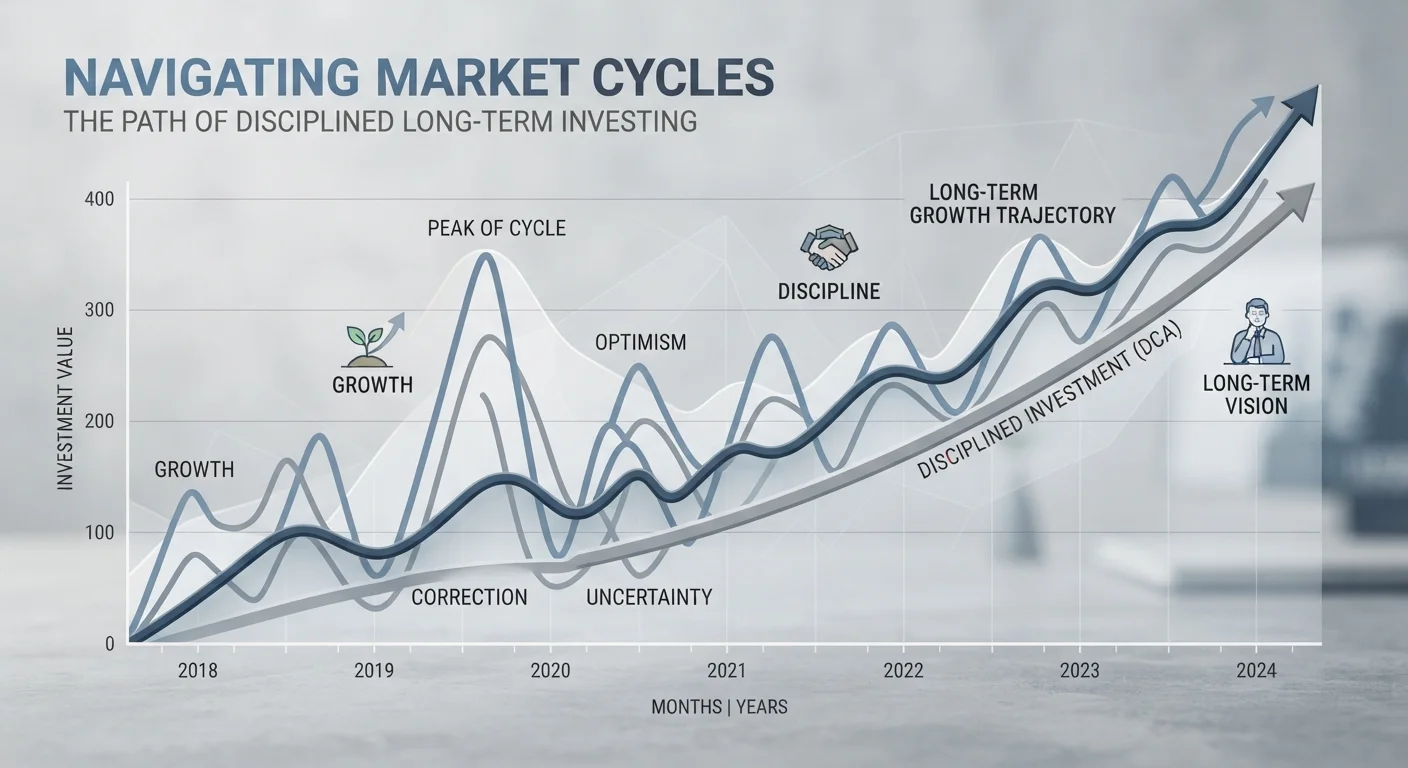
Photo credit: NewBizBuzz.net | Financial Insights For All
Common investing beliefs — like 'sell in May' or 'safer to wait for a dip' — examined against what the data actually supports.
Key Takeaways
- Seasonal rules like 'sell in May' have historically weak and inconsistent supporting evidence.
- Waiting for the 'perfect dip' to invest often results in missing significant market gains.
- Volatility and risk are not the same thing — conflating them leads to poor long-term decisions.
- Past price momentum does not reliably predict future stock performance.
- Evidence-based, disciplined strategies consistently outperform intuition-driven investing approaches.
Why Investing Myths Are Especially Costly
Misconceptions about how financial markets work are not merely harmless folklore. When embedded in investment decision-making, they introduce a consistent drag on returns — through unnecessary trading, poorly timed exits, and misallocated risk. Unlike a single bad trade, a flawed mental model compounds quietly over years, often invisible until the damage is already done.
What makes stock market myths particularly stubborn is that they often contain a kernel of historical truth, a plausible-sounding mechanism, or both. They circulate across financial media, social platforms, and even well-meaning advisers, gaining credibility through repetition rather than rigorous evidence. The antidote is not contrarianism but disciplined engagement with what the data actually shows — and an honest accounting of what it does not.
The myths examined below are among the most consequential for long-term investors. Each one is examined against the best available evidence, with the goal of replacing intuition-driven habits with a more durable, research-grounded framework. For a broader look at misconceptions that affect wealth accumulation, see common myths about getting rich through investing.
Myth
You should 'sell in May and go away' to avoid summer underperformance in the stock market.
Fact
Historical data shows equity returns during May–October are often positive, and sitting out risks missing meaningful gains.
The 'sell in May' adage suggests stocks systematically underperform in the warmer months. While some academic studies have identified a modest seasonal pattern over certain historical periods, the effect is inconsistent, frequently reversed, and largely offset by transaction costs and taxes triggered by the exit. More importantly, missing even a handful of the market's strongest trading days — which often occur within these 'weak' months — can materially reduce long-term returns. Disciplined, fully invested strategies have historically outperformed seasonal timing across most multi-decade horizons.
Myth
It's safer to wait for a market dip before investing a lump sum.
Fact
Research consistently shows that investing a lump sum immediately outperforms waiting for a dip in the majority of historical scenarios.
The logic feels intuitive: buy low, avoid overpaying. But markets rise more often than they fall — historically, US equities have been in positive territory roughly two-thirds of all rolling 12-month periods. Waiting for a dip that may never arrive, or may arrive far later than expected, leaves capital idle and exposed to opportunity cost. Vanguard research examining US, UK, and Australian markets found that lump-sum investing outperformed a 12-month phased entry in about two-thirds of cases. Dollar-cost averaging remains a sensible strategy for managing behavioural anxiety, but it should not be confused with a return-enhancing technique.
Myth
High volatility means a stock is inherently a bad, high-risk investment.
Fact
Volatility measures price fluctuation, not fundamental business risk — the two concepts require separate evaluation.
Standard deviation and beta capture how much a price moves, not whether the underlying business is financially sound or overvalued. A high-quality company reporting strong earnings can exhibit significant short-term price swings driven by macro sentiment, sector rotation, or index rebalancing — none of which reflect the company's intrinsic risk profile. Conversely, a low-volatility stock can carry substantial fundamental risk if it operates with excessive debt or in a structurally declining industry. Investors who equate volatility with risk may avoid excellent long-term opportunities or, worse, hold dangerously misunderstood positions. For a deeper look at how risk and return interact, see the Risk & Return hub.
Myth
A stock that has risen strongly will keep rising — momentum makes it a safer buy.
Fact
While short-term momentum is a documented market factor, it is cyclical, mean-reverts, and requires precise execution to capture reliably.
Academic literature does identify momentum as a persistent factor in equity pricing over short-to-medium horizons. However, momentum strategies suffer from severe drawdowns during factor crashes (notably in 2009 and 2020), require frequent rebalancing, and incur significant transaction costs that erode net returns for individual investors. Buying a stock simply because it has climbed substantially — without evaluating valuation, fundamentals, or the reason for the move — is speculative pattern-chasing, not evidence-based investing. Many retail investors are drawn in near the peak of a momentum cycle, absorbing losses when the trend reverses. These are among the overlooked habits that quietly erode long-term portfolio returns.
Myth
Owning many different stocks means your portfolio is well-diversified.
Fact
True diversification depends on low correlation between holdings, not simply the number of positions held.
Holding 40 stocks concentrated in a single sector — say, technology or energy — provides far less protection than a smaller number of positions spread across asset classes, geographies, and industries with low return correlations. During the 2022 growth equity selloff, many retail investors who believed they were diversified discovered that their broad holdings fell in near-unison because virtually all positions were sensitive to rising interest rates. Effective diversification is architectural: it requires intentional allocation across factors and asset types, not simply accumulating names. This connects directly to foundational portfolio construction principles every investor should understand.
Building a More Disciplined Approach
Correcting individual myths is useful, but the deeper goal is cultivating an investing disposition that is resistant to the next plausible-sounding rule that circulates through the market. That means grounding decisions in a coherent framework — one that prioritises asset allocation, cost control, and time in the market over reactive manoeuvring.
~66%
Of cases where lump-sum investing beat phased entry
Vanguard research across US, UK, and Australian markets found lump-sum investing outperformed 12-month dollar-cost averaging in roughly two-thirds of historical scenarios.
10 days
Best trading days that drive outsized annual returns
Research by J.P. Morgan Asset Management has repeatedly shown that missing the 10 best trading days in a decade can cut long-term equity returns by more than half.
Evidence consistently favours investors who define a strategy aligned with their actual risk tolerance and time horizon, then adhere to it through market cycles. This is easier said than done: behavioural finance research demonstrates that cognitive biases including loss aversion, recency bias, and overconfidence are deeply wired and resurface under pressure. For practical strategies on staying the course when volatility tests conviction, the evidence-based practices for maintaining discipline during market downturns is a useful companion read.
It is also worth noting that portfolio-level myths — not just individual stock myths — carry significant cost. The relationship between diversification, position sizing, and correlation is foundational to managing long-term risk, and misconceptions here are addressed in detail in portfolio construction myths that mislead new investors.
This article is for general informational and educational purposes only. It does not constitute personalised financial, investment, tax, or legal advice. Past performance does not guarantee future results. All investing involves risk, including the possible loss of principal. Consult a qualified, licensed financial adviser before making decisions about your own circumstances.

Author
Stocks & Markets Editorial Team
Stocks & Markets Editorial Team is the collective byline for our editorial team and contributor network. Articles published under this byline or an editorial pen name are researched, written, and reviewed according to our editorial standards for clarity, consistency, and independence before publication.
View all articles →