
Common Myths About Getting Rich Through Investing
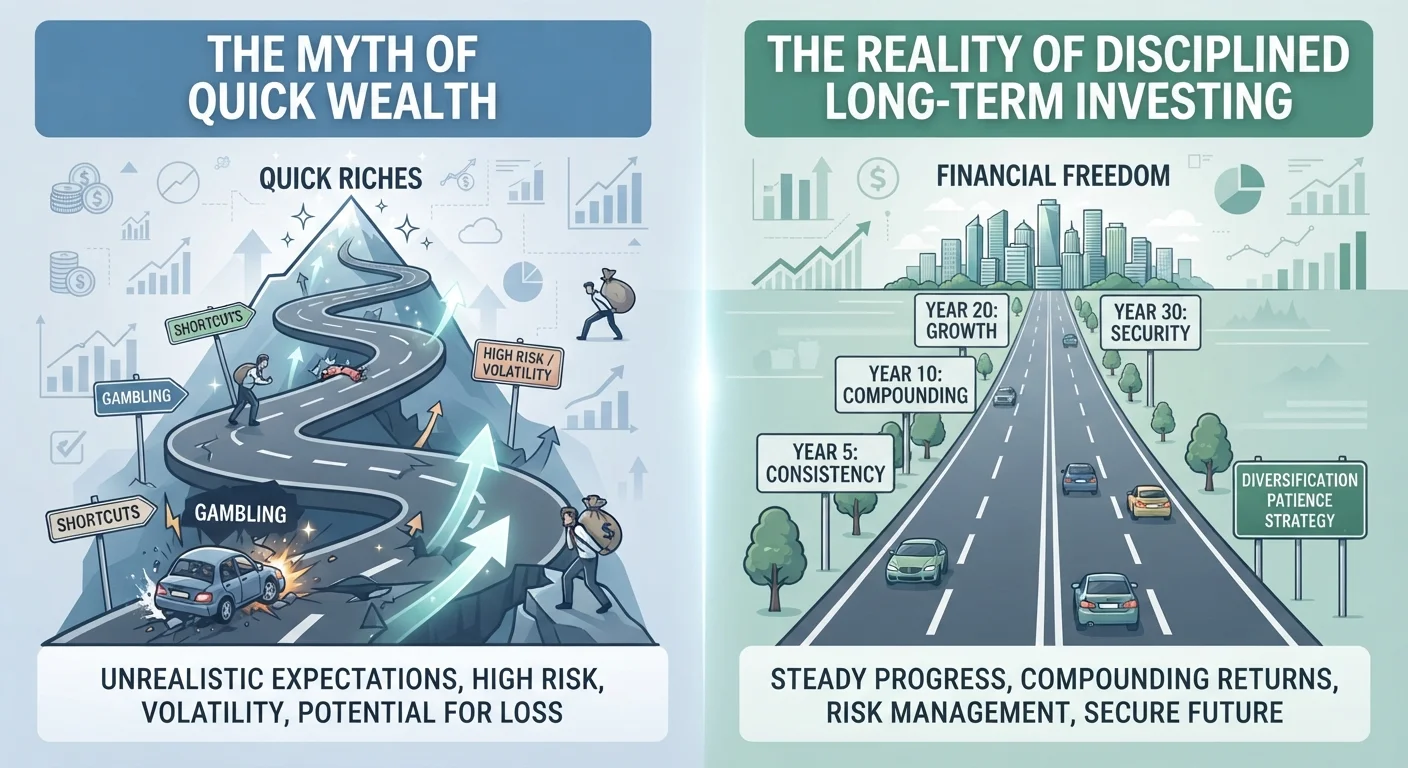
Photo credit: NewBizBuzz.net | Financial Insights For All
In this article
Separate fact from fiction on investing for wealth: market-timing myths, overnight-success stories, and the reality of sustained returns.
Key Takeaways
- Market timing consistently underperforms staying invested over the long term.
- Diversification reduces risk but does not eliminate the possibility of loss.
- Compounding rewards patience — early, consistent contributions matter far more than perfect timing.
- High returns and low risk cannot reliably coexist; reward always carries corresponding risk.
- No investment strategy guarantees wealth; professional guidance is essential for personal decisions.
Why Investment Myths Are Financially Dangerous
Misconceptions about investing aren't just harmless folklore — they cause real financial damage. Investors who act on flawed beliefs delay building wealth, take on uncompensated risks, or abandon sound strategies at precisely the wrong moments. Finance-savvy adults are not immune; many of these myths are sophisticated enough to sound credible, and they circulate widely in financial media, social networks, and even professional circles.
This article examines the most consequential myths about getting rich through investing, corrects each with evidence-based context, and explains why the distinction matters for your net worth. For related misconceptions in adjacent areas, see Stock Market Myths That Can Quietly Erode Your Returns and Portfolio Construction Myths That Mislead New Investors.
Myth
You need to time the market perfectly to build serious wealth.
Fact
Consistent, long-term investment significantly outperforms market timing for the vast majority of investors.
The appeal of buying at the bottom and selling at the top is intuitive, but decades of data show that even professional fund managers fail to do this reliably over time. Missing just a handful of the market's best-performing days in any given decade — days that often follow steep drops — can dramatically reduce total returns. The evidence consistently favors time in the market over timing the market. Regular contributions through dollar-cost averaging smooth out volatility and remove the psychological pressure of predicting short-term moves.
Myth
Investing is only for people who already have a lot of money.
Fact
Starting early with modest amounts is more powerful than starting later with larger sums, due to compound growth.
Compounding — the process by which returns generate their own returns — is exponential over time. An investor who contributes a small amount consistently beginning in their twenties will, under reasonable return assumptions, likely accumulate more wealth than someone who starts with a larger lump sum a decade later. Low-cost index funds and fractional share investing have also significantly lowered the practical barrier to entry. The fundamentals of portfolio construction are accessible regardless of starting capital.
Myth
A sufficiently diversified portfolio eliminates investment risk.
Fact
Diversification reduces unsystematic (company-specific) risk but cannot eliminate market-wide or systemic risk.
Diversification is one of the most well-established principles in investing, and it genuinely does reduce the impact of any single asset's failure on a portfolio. However, when broad market downturns occur — as they periodically do — correlated assets tend to fall together regardless of how many you hold. Investors who assume a diversified portfolio is a safe portfolio may take on more overall risk than they realize. True risk management requires understanding the difference between diversifiable risk and systemic risk, and planning accordingly.
Myth
High returns with low risk are achievable if you find the right strategy.
Fact
Higher potential returns consistently require accepting higher potential risk — this is a foundational principle of finance.
The risk-return tradeoff is one of the most durable relationships in financial economics. Any strategy claiming to deliver above-market returns with below-market risk should be scrutinized intensely. The history of finance is littered with products that appeared to offer this combination and later collapsed, exposing investors to severe losses. This is equally relevant to newer asset classes; crypto investing misconceptions often exploit exactly this myth, implying extraordinary gains without commensurate risk disclosure.
Myth
Carrying credit card balances wisely can free up cash to invest and accelerate wealth-building.
Fact
High-interest consumer debt reliably destroys wealth faster than most investments can build it.
Consumer credit card interest rates are typically far higher than long-term average investment returns. Carrying revolving balances while simultaneously investing creates a negative arbitrage — the cost of the debt exceeds the expected gain from the investment in most realistic scenarios. Addressing high-interest debt before investing aggressively is a foundational wealth-building principle. For broader context on credit misconceptions, see Common Myths About Credit Cards That Cost People Money.
The Data Behind Disciplined, Long-Term Investing
Academic research and decades of market history consistently support the same core principles: diversify broadly, minimize costs, invest regularly, and stay the course through volatility. These principles are unglamorous by design — they are the structural opposite of the overnight-success narratives that dominate financial media.
~90%
Active funds underperforming their benchmark over 20 years
S&P Dow Jones Indices' SPIVA reports have consistently shown that roughly 90% of actively managed US equity funds underperform their benchmark index over 20-year periods.
10 days
Best trading days missed wipes out decade-long gains
Research from JPMorgan Asset Management has illustrated that missing the 10 best trading days in a given 20-year period can cut long-term portfolio returns by more than half compared to staying fully invested.
1.5%+
Annual return drag from high fund expense ratios
The Vanguard Group and independent academic research have shown that high-cost funds consistently deliver lower net returns, with expense ratios above 1% materially eroding compounded wealth over decades.
Investors who internalize that compounding is a slow, exponential process — not a sudden windfall — position themselves far better than those chasing the next high-return story. Tax treatment also compounds the effect of good habits; for a closer look at how misconceptions in that space erode returns, see Tax Myths That Cost Investors Money.
No Strategy Guarantees Wealth
Every investment approach carries risk, including the loss of principal. Market conditions, economic cycles, personal tax situations, and time horizons all interact in ways that make individualized outcomes unpredictable. General principles — diversify, minimize costs, invest consistently — are well-supported by evidence, but they are not guarantees. Always work with a qualified, licensed financial professional before making decisions suited to your specific circumstances.
Building wealth through investing is inherently probabilistic, not guaranteed. Risk management and wealth protection strategies are as important as return-seeking behavior. Consulting a licensed financial adviser before making significant portfolio decisions remains the most important step any investor can take.
This article is for general informational and educational purposes only. It does not constitute personalized financial, investment, tax, or legal advice. All investing involves risk, including the potential loss of principal. Past performance does not guarantee future results. Consult a qualified financial adviser, accountant, or attorney regarding your specific circumstances.

Author
Wealth Management Editorial Team
Wealth Management Editorial Team is the collective byline for our editorial team and contributor network. Articles published under this byline or an editorial pen name are researched, written, and reviewed according to our editorial standards for clarity, consistency, and independence before publication.
View all articles →