
Sector Rotation as an Investment Approach: Mechanics and Limitations
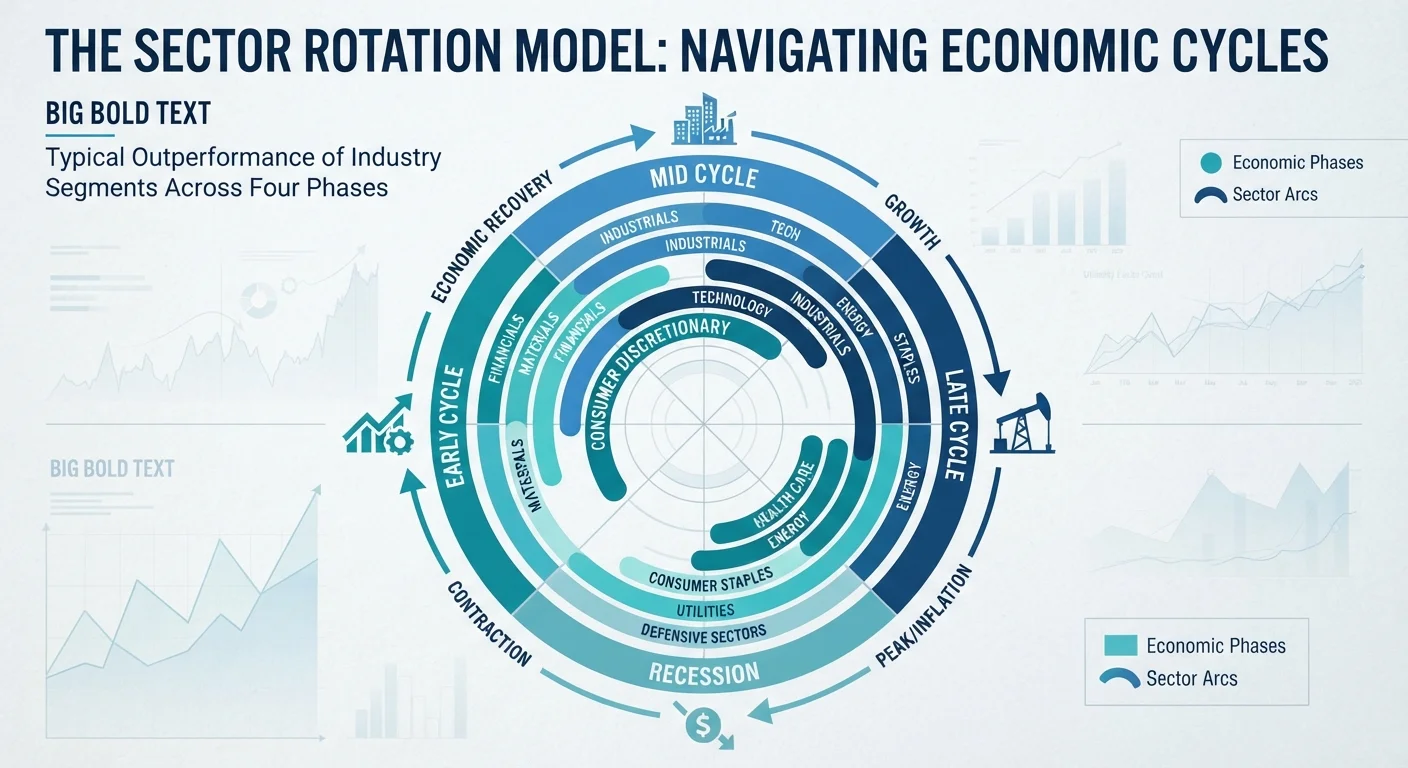
Photo credit: NewBizBuzz.net | Financial Insights For All
In this article
Explore how sector rotation works as a strategy, what drives cyclical shifts between sectors, and why it's harder to execute than it appears.
Key Takeaways
- Sector rotation involves shifting portfolio allocations between industries based on anticipated economic cycle phases.
- The strategy has academic grounding but is notoriously difficult to execute profitably in practice.
- Timing errors, transaction costs, and tax drag can erode any theoretical advantage.
- Most individual investors are better served by understanding rotation as a lens, not a trading system.
- Professional active managers with rotation mandates still frequently underperform broad index benchmarks over time.
Grounded in observable economic cycle patterns
Historical data broadly supports the idea that sectors perform differently across expansion and contraction phases, giving the strategy a defensible academic foundation rather than being purely speculative.
Can reduce exposure to deteriorating sectors
Systematic rotation frameworks prompt investors to reassess allocations regularly, potentially reducing concentration in sectors facing structural or cyclical headwinds.
Encourages macro-level portfolio awareness
Applying a rotation lens forces investors to engage with economic indicators and sector dynamics, which tends to produce more deliberate, informed allocation decisions overall.
Accessible via diversified instruments
Sector-focused exchange-traded funds (ETFs) make it relatively straightforward to implement rotation without needing to pick individual stocks, lowering execution complexity.
Precise cycle timing is extremely difficult
Economic turning points are identified with confidence only in retrospect. Acting on real-time signals routinely leads to early or late entries that undercut the strategy's intended advantage.
Markets price in cycle expectations ahead of time
Because equity markets are forward-looking, sector outperformance tied to a cycle phase often materializes before the phase is officially confirmed, leaving rotation investors chasing already-realized gains.
Transaction costs and taxes erode theoretical gains
Frequent sector shifts generate trading costs and, in taxable accounts, short-term capital gains taxed at ordinary income rates — costs that compound and can eliminate any edge over a passive index approach.
Active managers frequently underperform benchmarks
A substantial body of evidence, including S&P's SPIVA reports, shows that most actively managed funds — including those using rotation — underperform their benchmark indices over multi-year periods after fees.
Cycle phases rarely follow textbook sequencing
Real economic cycles are uneven and disrupted by exogenous shocks — pandemics, geopolitical events, policy surprises — that can make historical sector patterns unreliable guides to current performance.
What Sector Rotation Actually Means
Sector rotation is an investment approach in which a portfolio's exposure is deliberately shifted among industry sectors — such as technology, energy, utilities, consumer discretionary, and financials — based on expectations about where the economy is in its cycle. The core premise is that different sectors tend to outperform or underperform at different stages of economic expansion and contraction.
For example, consumer discretionary and industrials have historically shown relative strength during early economic recoveries, while defensive sectors such as utilities and consumer staples tend to hold up better during slowdowns. Energy often outperforms during mid-cycle expansions when commodity demand is rising. These patterns are well-documented in financial literature, including frameworks popularized by institutional research houses tracking business cycle dynamics.
This differs from simply holding a diversified index. Rotation is an active decision to overweight certain segments and underweight others — a form of tactical allocation. For broader context on how asset classes behave across cycles, see how each asset class tends to behave at different points in the economic cycle. Sector rotation is also discussed within the wider landscape of active approaches in equity investment strategies.
Pros and Cons of Sector Rotation
Like any active strategy, sector rotation involves real tradeoffs. Understanding both sides is essential before incorporating it into an investment framework.
Grounded in observable economic cycle patterns
Historical data broadly supports the idea that sectors perform differently across expansion and contraction phases, giving the strategy a defensible academic foundation rather than being purely speculative.
Can reduce exposure to deteriorating sectors
Systematic rotation frameworks prompt investors to reassess allocations regularly, potentially reducing concentration in sectors facing structural or cyclical headwinds.
Encourages macro-level portfolio awareness
Applying a rotation lens forces investors to engage with economic indicators and sector dynamics, which tends to produce more deliberate, informed allocation decisions overall.
Accessible via diversified instruments
Sector-focused exchange-traded funds (ETFs) make it relatively straightforward to implement rotation without needing to pick individual stocks, lowering execution complexity.
Precise cycle timing is extremely difficult
Economic turning points are identified with confidence only in retrospect. Acting on real-time signals routinely leads to early or late entries that undercut the strategy's intended advantage.
Markets price in cycle expectations ahead of time
Because equity markets are forward-looking, sector outperformance tied to a cycle phase often materializes before the phase is officially confirmed, leaving rotation investors chasing already-realized gains.
Transaction costs and taxes erode theoretical gains
Frequent sector shifts generate trading costs and, in taxable accounts, short-term capital gains taxed at ordinary income rates — costs that compound and can eliminate any edge over a passive index approach.
Active managers frequently underperform benchmarks
A substantial body of evidence, including S&P's SPIVA reports, shows that most actively managed funds — including those using rotation — underperform their benchmark indices over multi-year periods after fees.
Cycle phases rarely follow textbook sequencing
Real economic cycles are uneven and disrupted by exogenous shocks — pandemics, geopolitical events, policy surprises — that can make historical sector patterns unreliable guides to current performance.
Why Execution Is Harder Than the Theory Suggests
The conceptual elegance of sector rotation obscures significant practical obstacles. The most fundamental is cycle identification: economic phases are only clearly visible in hindsight. Leading indicators — such as yield curve shape, purchasing managers' indices, and credit spreads — provide signals, but they are noisy and frequently revised. Rotating into a sector because the data suggests a recovery may be beginning, only to find the economy enters a secondary contraction, is a common outcome.
~85%
Active large-cap funds underperforming S&P 500 over 15 years
According to S&P Dow Jones Indices' SPIVA US Scorecard, approximately 85–90% of actively managed large-cap US equity funds have underperformed the S&P 500 over rolling 15-year periods.
3–6 months
Typical lead time markets price in economic shifts
Equity markets are broadly understood to discount anticipated economic conditions roughly three to six months in advance, meaning visible cycle signals often arrive after sector prices have already adjusted.
Markets are also forward-looking. By the time a cycle phase is broadly recognized, sector prices have often already adjusted. This means rotators are frequently chasing performance that has already happened. Valuations matter too — rotating into an outperforming sector near its peak can lock in poor entry prices. Sector-specific valuation metrics are worth understanding before making any rotation decision, as each industry uses different yardsticks to assess fair value.
Transaction costs and tax implications compound the difficulty. Frequent rebalancing generates short-term capital gains (taxed at ordinary income rates in the US), and even small costs accumulate across multiple rotation cycles. Investors interested in factor-based alternatives that involve less frequent trading may find factor investing a useful contrast to pure sector rotation.
Rotation as a Framework vs. a Trading System
Many professional portfolio managers use sector rotation thinking as a monitoring framework — periodically reviewing whether their allocations remain appropriate given macro conditions — rather than as a signal to trade frequently. This more measured application preserves the analytical benefits while reducing the timing risk and cost drag associated with active switching. For individual investors, this distinction matters significantly.
For investors thinking about rotation within the context of overall portfolio construction, the foundational principles in portfolio basics and the risk and return framework remain directly relevant.
This article is for informational and educational purposes only and does not constitute personalized investment, tax, or financial advice. All investing involves risk, including the potential loss of principal. Past performance does not guarantee future results. Consult a qualified financial adviser before making decisions about your own portfolio.

Author
Stocks & Markets Editorial Team
Stocks & Markets Editorial Team is the collective byline for our editorial team and contributor network. Articles published under this byline or an editorial pen name are researched, written, and reviewed according to our editorial standards for clarity, consistency, and independence before publication.
View all articles →