
Why Your Portfolio Drifts Over Time — and What to Do About It
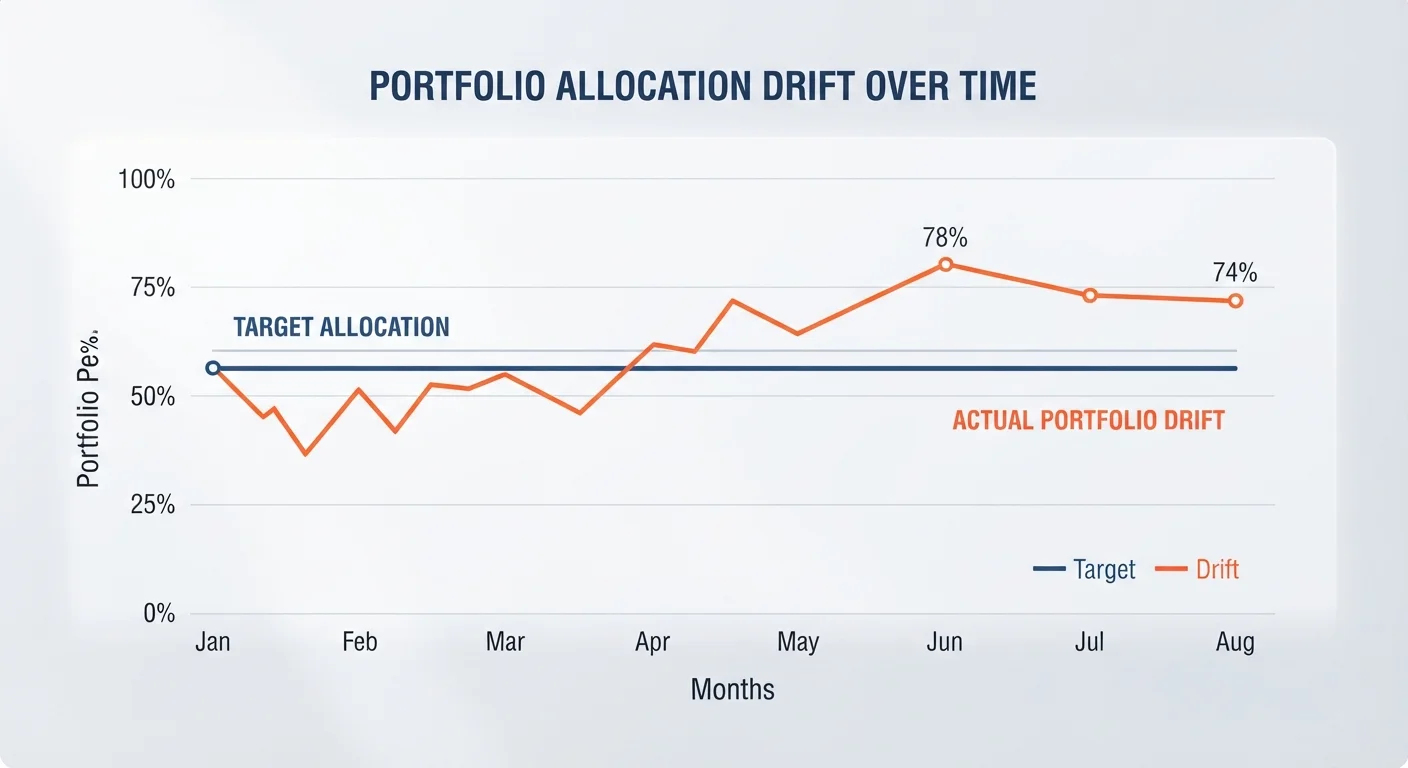
Photo credit: NewBizBuzz.net | Financial Insights For All
In this article
Market movements gradually shift your asset mix away from your original targets. Learn what portfolio drift is and how rebalancing corrects it.
Key Takeaways
- Portfolio drift is a natural consequence of markets moving assets at different rates.
- Drift silently changes your risk profile, often increasing equity exposure beyond your comfort zone.
- A drifted portfolio may no longer match your investment goals or time horizon.
- Rebalancing — selling overweight assets and buying underweight ones — corrects drift.
- Tax implications and transaction costs should be weighed when deciding how and when to rebalance.
How Drift Happens — A Simple Illustration
Imagine you build a portfolio with a deliberate target: 60% in a broad U.S. equity index fund and 40% in an intermediate-term bond fund. You chose that ratio carefully to balance growth potential against downside protection. Then markets move.
After two years of strong equity performance, your stocks have grown to represent 68% of the portfolio while bonds have shrunk to 32%. Nothing went wrong. You made no mistakes. The drift happened simply because stocks outpaced bonds — which is exactly what higher-risk assets tend to do over extended periods.
The risk, however, is real. A portfolio weighted 68/32 behaves differently from a 60/40 portfolio. It is more sensitive to equity downturns and less cushioned by fixed income. If markets reverse sharply, you will absorb more of that loss than your original plan anticipated. Understanding this mechanism is the first step toward managing it. For a deeper look at how asset class combinations interact, see our guide on diversification across asset classes.
60/40 → 75/25
Equity-bond ratio shift after 5-year equity bull run
Analysis of historical equity and bond return differentials shows that sustained equity outperformance can materially shift a balanced portfolio's allocation within a single market cycle.
5%
Common threshold triggering a rebalancing review
Many portfolio management frameworks use a 5-percentage-point band around each asset class target as a practical signal to consider rebalancing action.
Why Drift Matters for Long-Term Investors
Risk tolerance is not static, but it should change on your terms — not the market's. Drift effectively lets market momentum make investment decisions for you. During a prolonged bull market, equities swell in weight, making your portfolio progressively more aggressive precisely when valuations may be stretched. During a downturn, bond allocations can balloon, making the portfolio overly conservative at the moment equities are cheapest.
This dynamic can subtly erode long-term outcomes. Investors who allow equity allocations to run unchecked may face steeper drawdowns than they anticipated. Those whose bond allocations balloon may miss recovery gains. Both outcomes can undermine the original investment thesis.
Drift also interacts with life stage. A 35-year-old with a long time horizon can reasonably tolerate more equity concentration than a 60-year-old approaching retirement. If an older investor's portfolio drifts heavily into equities and a downturn hits near retirement, the consequences can be significant. Our article on asset allocation across life stages explores how target allocations should evolve as your time horizon changes.
Drift Is Not the Same as a Strategy Change
Some investors mistake a drifted portfolio for a deliberate tactical shift. It is important to distinguish between intentional changes to your target allocation — based on updated goals, risk tolerance, or life stage — and passive drift caused by market movements. Only the former reflects a considered investment decision. Regularly reviewing your stated targets against your actual holdings keeps these two things from being confused.
Correcting Drift Through Rebalancing
The standard remedy for portfolio drift is rebalancing — the process of selling assets that have grown above their target weight and using the proceeds to purchase those that have fallen below. Done methodically, rebalancing returns the portfolio to its intended risk profile.
There are several practical approaches. Calendar-based rebalancing — reviewing and adjusting on a fixed schedule (quarterly, semi-annually, or annually) — is simple to implement. Threshold-based rebalancing triggers action only when an asset class drifts beyond a predefined band, such as 5 percentage points from its target. Hybrid methods combine both, checking on a schedule but acting only when thresholds are breached.
Each approach involves tradeoffs in cost, tax efficiency, and discipline. In taxable accounts, selling appreciated assets to rebalance can generate capital gains. One way to minimize this is directing new contributions or reinvested dividends toward underweight asset classes, reducing the need to sell. For a comprehensive breakdown of timing, triggers, and tax considerations, see our dedicated guide on rebalancing a portfolio.
Use New Contributions to Rebalance First
Before selling any holdings to correct drift, consider directing new deposits or reinvested dividends into underweight asset classes. This approach reduces or eliminates taxable events in non-sheltered accounts while gradually restoring your target allocation. In tax-advantaged accounts such as IRAs or 401(k)s, the tax concern is less immediate, giving you more flexibility to sell and buy directly.
It is also worth recognizing that neglecting rebalancing is itself a behavioral pattern with measurable consequences. Investors who avoid this discipline — often because selling winners feels counterintuitive — may find their portfolios quietly drifting into territory that conflicts with their goals. Our article on overlooked habits that erode portfolio returns covers this and related patterns in detail.
This article is for general informational and educational purposes only. It is not personalized investment, tax, or financial advice. Investors should consult a qualified financial adviser before making decisions about their own portfolios.
Frequently Asked Questions

Author
Investing Fundamentals Editorial Team
Investing Fundamentals Editorial Team is the collective byline for our editorial team and contributor network. Articles published under this byline or an editorial pen name are researched, written, and reviewed according to our editorial standards for clarity, consistency, and independence before publication.
View all articles →