
How Amortisation Works and What It Means for Your Monthly Payments
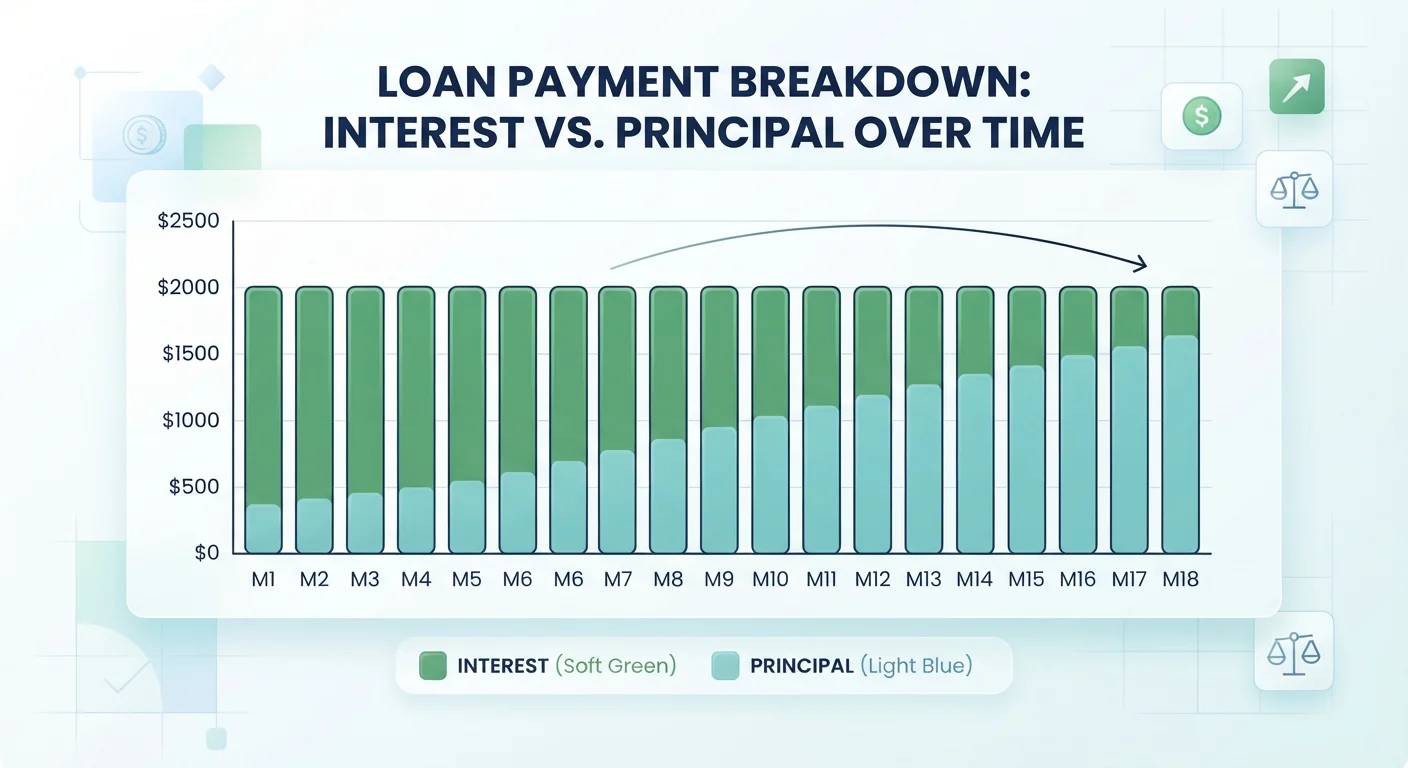
Photo credit: NewBizBuzz.net | Financial Insights For All
In this article
Most instalment loans are amortised—but few borrowers understand what that means for how much interest they pay early vs late in the term.
Key Takeaways
- Fixed monthly payments on amortised loans stay the same, but the interest-to-principal ratio shifts over time.
- You pay proportionally more interest in the early years of a loan and more principal toward the end.
- Making extra principal payments early can substantially reduce total interest paid over the loan's life.
- Most mortgages, auto loans, and personal loans use amortisation as their repayment structure.
- Understanding your amortisation schedule helps you evaluate refinancing and prepayment decisions.
The Core Mechanic: How Each Payment Is Divided
Every payment on an amortised loan serves two purposes: it pays the interest accrued since your last payment, and it reduces your outstanding principal. The split between these two components is not arbitrary — it is governed by a formula that ensures the loan balance reaches zero on the final payment date.
The monthly interest charge is calculated by applying the periodic interest rate (your annual rate divided by 12) to the current outstanding balance. Because that balance is highest at the beginning of the loan, interest consumes the largest share of your early payments. The remainder goes toward principal, which incrementally lowers next month's interest charge — and so the cycle continues.
For example, on a 30-year fixed mortgage, a borrower may find that well over half of their first payment goes toward interest. By the final years of the loan, nearly all of each payment is reducing principal. The dollar amount of each payment never changes; what changes is the allocation between interest and principal.
~$143,000
Total interest on a $300K, 30-year mortgage at 7%
Illustrative calculation based on standard amortisation formula; actual figures vary by rate, term, and any prepayments made.
~18%
Share of first payment applied to principal on a 30-year loan at 7%
Derived from standard amortisation mechanics; the remaining ~82% services interest in the first month of a new 30-year mortgage.
44%
U.S. households carrying mortgage debt
According to the Federal Reserve's Survey of Consumer Finances; most of these borrowers are repaying via fully amortised loan structures.
Why This Structure Matters for Long-Term Borrowing Costs
The front-loading of interest in amortised loans has a meaningful effect on total borrowing cost — particularly for long-term debt like mortgages. A borrower who sells a home or refinances after seven years on a 30-year mortgage will have repaid a relatively small portion of the original principal, even though they've made years of full payments.
This is not a flaw in the system; it reflects the time-value of money. The lender's capital is at risk longest in the early period, so that period carries the highest interest cost. But understanding this dynamic is essential for making informed decisions about refinancing, early repayment, and loan term selection. How payments shift over a loan's life goes deeper into the schedule mechanics and their equity implications.
Use Prepayments Strategically
Even modest additional principal payments made early in a loan's life can reduce total interest significantly, because they lower the balance on which future interest is calculated. Before prepaying, confirm with your lender that extra funds are credited to principal immediately, and check whether your loan has any prepayment penalties — though these are uncommon on most modern consumer loans.
Choosing a shorter loan term — say, 15 years instead of 30 — typically means a higher monthly payment but dramatically less total interest paid, because the principal is retired faster and the interest-heavy early period is compressed. Borrowers evaluating this trade-off should model both scenarios using their actual loan amount and rate.
Amortisation in Practice: Mortgages, Auto Loans, and Personal Loans
Amortisation applies across the main categories of consumer instalment debt. The core mechanic is the same, but the scale, term, and stakes differ significantly.
- Mortgages: The longest-term and largest amortised loans most consumers carry. A 30-year term means the interest-heavy phase extends for many years. Understanding your amortisation schedule is particularly important here — see how each component of a mortgage works for broader context on loan structure.
- Auto loans: Typically amortised over 24 to 84 months. Shorter terms relative to mortgages mean the interest-to-principal shift happens more quickly, but the same front-loading principle applies.
- Personal loans: Usually fixed-rate and fully amortised over one to seven years. Because rates on unsecured personal loans tend to be higher than secured loans, understanding total interest cost is especially important before borrowing.
For a plain-language reference on mortgage-specific terminology — including amortisation — the mortgage glossary provides clear definitions across 40 key terms.
This article is intended for general informational and educational purposes only and does not constitute personalised financial, mortgage, or legal advice. Loan structures, rates, and terms vary by lender and individual circumstances. Consult a qualified financial adviser or licensed mortgage professional before making borrowing decisions.
Frequently Asked Questions

Author
Credit & Lending Editorial Team
Credit & Lending Editorial Team is the collective byline for our editorial team and contributor network. Articles published under this byline or an editorial pen name are researched, written, and reviewed according to our editorial standards for clarity, consistency, and independence before publication.
View all articles →