
Secured vs. Unsecured Credit Cards
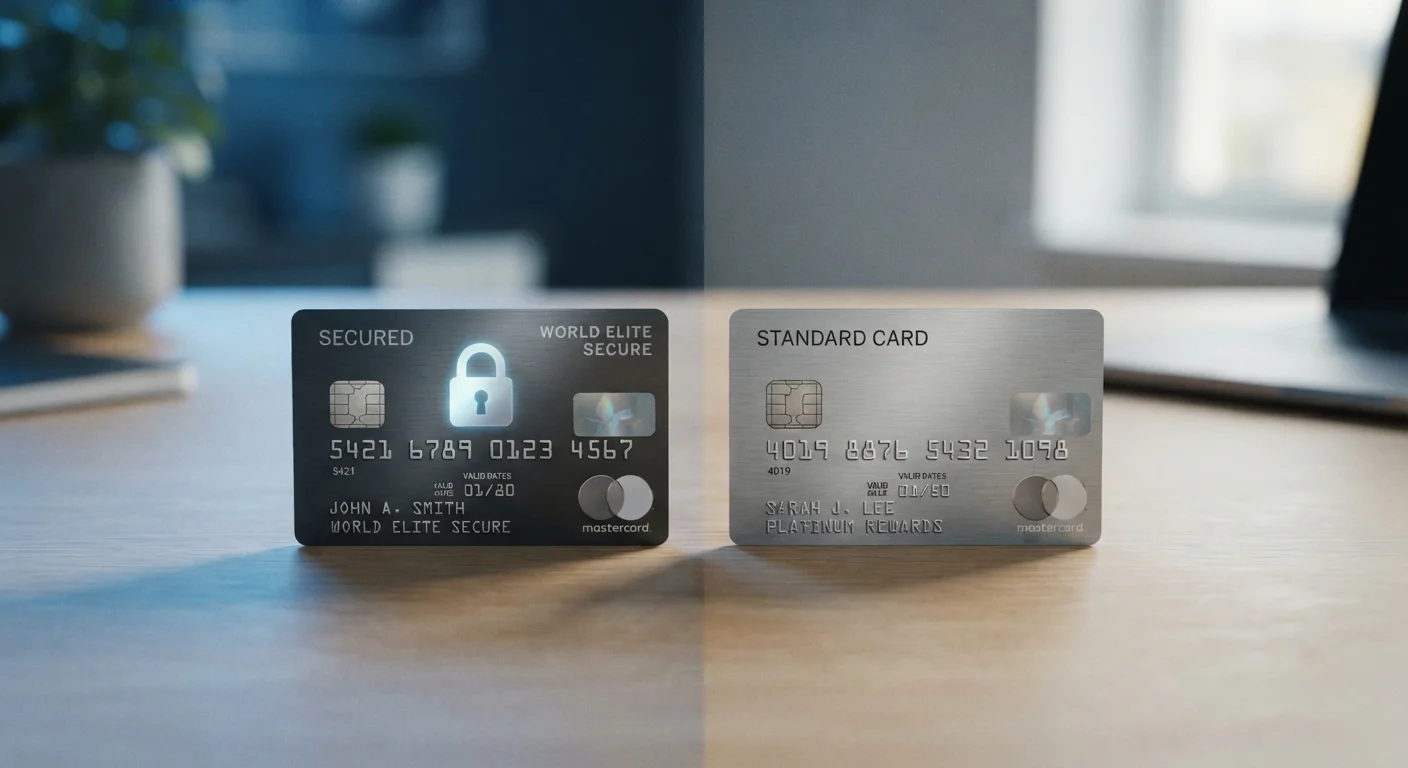
Photo credit: NewBizBuzz.net | Financial Insights For All
In this article
How secured and unsecured cards differ in structure, eligibility, and credit-building potential—and when each makes sense.
Key Takeaways
- Secured cards require a cash deposit that typically becomes your credit limit, reducing lender risk.
- Unsecured cards extend credit based on creditworthiness alone — no collateral is pledged.
- Both card types report to major credit bureaus, making either a viable credit-building tool when used responsibly.
- Secured cards often carry higher fees and interest rates relative to unsecured cards at similar spending limits.
- Graduating from a secured to an unsecured card is a measurable credit milestone that many issuers support.
- Carrying a balance on either card type accrues interest; paying in full monthly avoids this cost entirely.
How Each Card Type Is Structured
The defining difference between secured and unsecured credit cards lies in how the issuer manages risk. With a secured card, the cardholder deposits a sum of money — typically ranging from $200 to $2,500 — which the issuer holds as collateral. That deposit usually sets the card's credit limit. If the cardholder defaults, the issuer can apply the deposit against the outstanding balance. This structure allows issuers to extend credit to applicants who would not qualify for conventional products.
An unsecured card, by contrast, is extended purely on the basis of the applicant's credit profile — their score, payment history, income, and debt-to-income ratio. No collateral is pledged. The issuer bears full exposure if the borrower defaults, which is why creditworthiness thresholds are meaningfully higher. This is the conventional structure most consumers interact with throughout their credit lives.
For a broader view of how collateral functions across the credit landscape, see our comparison of secured vs. unsecured loans.
| Criterion | Secured Credit Card | Unsecured Credit Card |
|---|---|---|
| Collateral required | Yes — cash deposit | No |
| Credit limit basis | Typically equals deposit amount | Based on creditworthiness and income |
| Eligibility threshold | Low — accessible to thin/damaged credit | Higher — requires established credit history |
| Typical APR range | Often higher (20%–29%+) | Wide range; lower for strong credit |
| Annual fees | Common; varies by issuer | Varies; fee-free options available |
| Bureau reporting | Yes — all three major bureaus | Yes — all three major bureaus |
| Deposit refundability | Yes — upon closure or graduation | Not applicable |
| Graduation path | Many issuers offer upgrade to unsecured | N/A — already unsecured |
Credit-Building Potential and Reporting
A common misconception is that secured cards are somehow inferior credit-building instruments. In practice, both secured and unsecured cards report account activity — payment history, credit utilization, account age, and credit limit — to the three major credit bureaus (Equifax, Experian, and TransUnion). From the perspective of a credit scoring model such as FICO or VantageScore, the mechanics of how the card is funded are irrelevant. What matters is the behavioral data the card generates.
Payment history alone accounts for approximately 35% of a FICO score, making consistent on-time payments the single highest-leverage action available to any cardholder, secured or unsecured. Utilization — the ratio of balances to credit limits — represents another 30%. Keeping that ratio below 30% (and ideally below 10%) materially benefits score trajectories on either card type.
35%
FICO score weight: payment history
According to FICO's published score factor breakdown, payment history is the single largest component of a standard FICO score.
~30%
FICO score weight: credit utilization
FICO's model weights amounts owed — including utilization ratio — as the second most influential score factor.
45M+
US adults estimated as credit invisible or unscorable
The Consumer Financial Protection Bureau has estimated tens of millions of US adults lack sufficient credit history to generate a mainstream credit score.
For cardholders who already hold a card and want to accelerate their score improvement, the strategic habits covered in building credit with a card you already have apply equally to secured and unsecured products.
Costs, Fees, and Interest Rate Considerations
Secured cards frequently carry higher annual percentage rates (APRs) and annual fees relative to comparable unsecured products. This reflects the risk-adjusted pricing that issuers apply to products designed for thin-file or subprime applicants, even when a deposit partially offsets that risk. Prospective cardholders should review the Schumer Box — the standardized fee disclosure required on all US credit card agreements — to understand the total cost of a given product before applying.
One often-overlooked cost consideration: the opportunity cost of the security deposit itself. A $500 deposit held by an issuer for 12–18 months cannot be invested or used for other financial goals during that period. This is a real, if indirect, cost that should factor into the decision, particularly for consumers with limited liquidity.
Carrying a Balance Is Never Free
Both secured and unsecured credit cards accrue interest on unpaid balances at the card's stated APR, which is almost always a variable rate tied to the prime rate. Paying the statement balance in full each month is the most effective way to use either card type without incurring interest charges. Minimum payments are designed by issuers to extend repayment timelines and increase total interest paid — not to serve the cardholder's financial interests.
Unsecured cards extend across an extraordinarily wide rate range. Borrowers with strong credit histories typically qualify for lower APRs, while fair-credit unsecured products can approach rates comparable to secured cards. Understanding how interest rate structures work more broadly is addressed in our guide to fixed-rate vs. variable-rate borrowing.
This article provides general financial education and is not personalised financial or credit advice. Consult a qualified financial adviser or credit counsellor for guidance specific to your situation.

Author
Credit & Lending Editorial Team
Credit & Lending Editorial Team is the collective byline for our editorial team and contributor network. Articles published under this byline or an editorial pen name are researched, written, and reviewed according to our editorial standards for clarity, consistency, and independence before publication.
View all articles →