
Why Paying Only the Minimum Due Keeps You in Debt Longer Than You Think
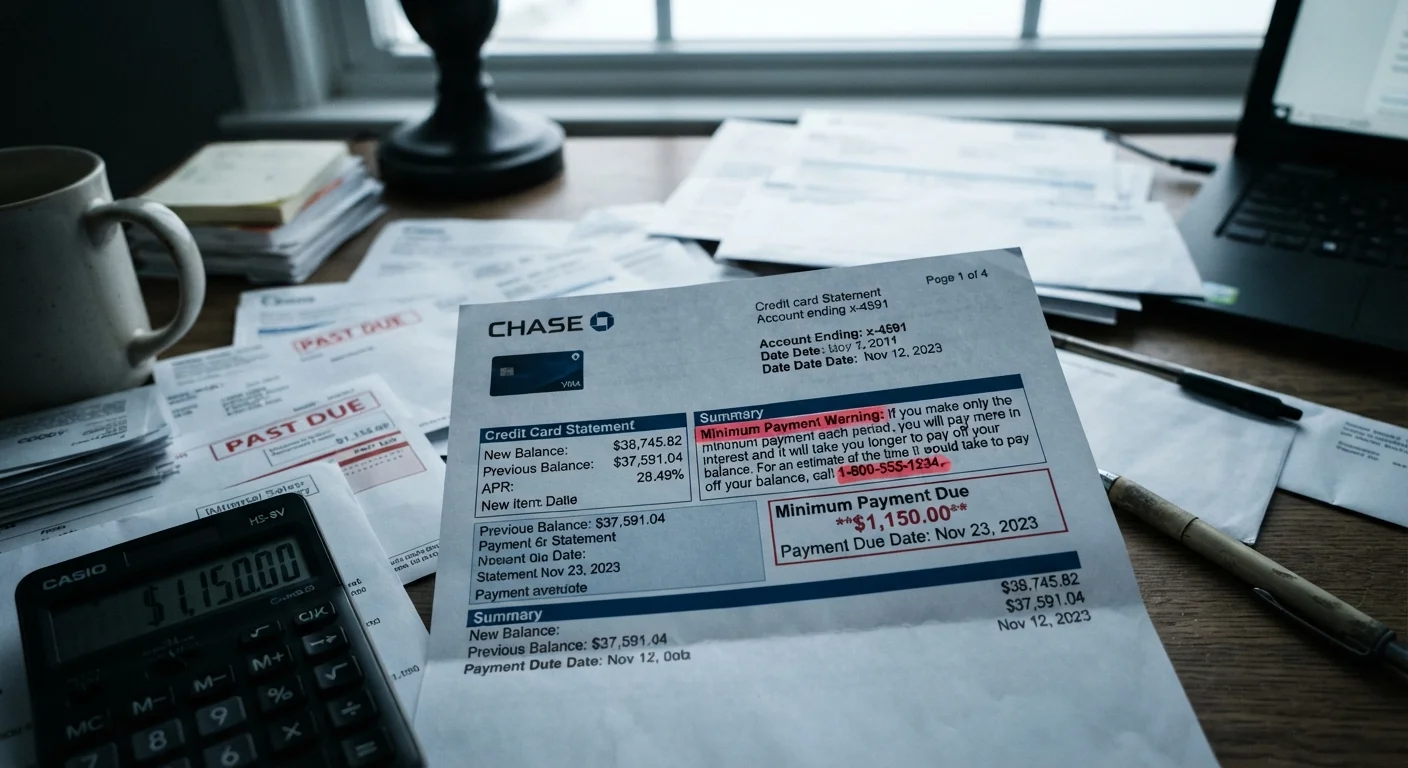
Photo credit: NewBizBuzz.net | Financial Insights For All
In this article
Minimum payments are designed to keep balances alive. Understand the maths behind them and what they cost over time.
Key Takeaways
- Minimum payments are typically structured to maximize interest collected, not to help you pay off debt quickly.
- On a $5,000 balance at 20% APR, paying only minimums can take over 15 years to clear.
- Even small increases above the minimum payment significantly reduce total interest paid and repayment time.
- Credit card issuers are required to disclose payoff timelines on statements — most borrowers overlook this information.
- Understanding how minimum payments are calculated is essential to making informed debt management decisions.
How Minimum Payments Are Actually Calculated
Credit card minimum payments are not arbitrary — they are deliberately engineered. Most issuers calculate the minimum as either a flat dollar amount (commonly $25–$35) or a small percentage of the outstanding balance (typically 1%–3%), plus any accrued interest and fees — whichever is greater. Some use a flat percentage of the total balance, often around 2%.
This structure means that as your balance shrinks, so does your minimum payment. That may seem like good news, but it is precisely what keeps borrowers trapped. A declining minimum payment extends the repayment schedule and ensures that a disproportionate share of each payment goes toward interest rather than principal reduction. The mechanics behind this trap are worth understanding in detail before assuming the minimum is a safe baseline.
20%+
Average credit card APR on revolving balances
The Federal Reserve has reported average credit card interest rates exceeding 20% for accounts assessed interest in recent years, one of the highest levels in several decades.
15+ years
Estimated payoff time on $5,000 balance at minimum payments
Consumer finance analyses consistently show that a $5,000 balance at a 20% APR paid at minimum rates can take well over a decade to retire, with total interest often exceeding the original balance.
$1,000s
Potential interest savings from modest payment increases
Increasing monthly payments by even $50–$100 above the minimum on a mid-sized balance can reduce total interest paid by a significant margin, depending on the rate and balance size.
The Compounding Cost You're Not Seeing
Consider a $5,000 credit card balance at a 20% annual percentage rate (APR) — close to the national average for cards carrying a balance. If a borrower pays only the minimum each month, the repayment period can stretch beyond 15 years, with total interest paid often exceeding the original balance. The federal Truth in Lending Act requires issuers to include a minimum payment warning on monthly statements, projecting exactly this scenario — yet research consistently shows most cardholders do not factor that disclosure into their payment decisions.
The core problem is that high-rate revolving debt compounds against you daily or monthly, depending on the issuer. Every dollar of interest added to your balance becomes new principal — principal that itself earns interest. This is the mechanism that drives total repayment costs far above the original borrowed amount across all forms of consumer credit.
Your Statement Already Shows You the Cost
Under the Credit CARD Act of 2009, credit card issuers are required to include a minimum payment warning on every monthly statement. This disclosure shows how long it will take to pay off your current balance making only minimum payments, and how much you would pay in total interest. Reading this single line item is one of the clearest, most personalized illustrations of what minimum-only repayment actually costs you — in real months and real dollars.
Mistakes That Extend Your Debt Timeline
Several specific behaviors compound the damage of minimum-only payments. Understanding each one — and why borrowers fall into them — is the first step toward correcting course.
Treating the minimum payment as a target rather than a floor.
Why it happens: Minimum payment amounts are prominently displayed and framed as the obligation, leading borrowers to anchor on that figure as the intended monthly payment rather than the bare legal minimum.
Continuing to charge new purchases while only paying the minimum on existing balances.
Why it happens: Revolving credit is designed for ongoing use, and there is no friction stopping borrowers from adding to a balance they are already repaying minimally. The result is a balance that never materially declines.
Ignoring the payoff timeline disclosure printed on monthly statements.
Why it happens: Statement disclosures are formatted in dense regulatory language that many borrowers skip. The minimum payment warning — required under the Credit CARD Act of 2009 — is rarely the first thing a reader sees.
Assuming a lower minimum payment is a sign of improving financial health.
Why it happens: As balances fall (or appear to fall), the minimum required payment decreases. Borrowers sometimes interpret a lower minimum as progress, when in reality it may reflect only marginal balance reduction.
Spreading minimum payments across multiple balances without a prioritization strategy.
Why it happens: Borrowers carrying several credit cards often pay the minimum on all of them to avoid late fees, without directing surplus funds toward the highest-cost balance first. This dilutes repayment impact across all accounts.
For borrowers managing debt on a constrained income, structured repayment approaches designed for financial pressure can provide a realistic path forward without requiring a dramatic income change.
What a Different Payment Strategy Looks Like
Paying even $50–$100 above the minimum each month on a mid-sized credit card balance can cut years off the repayment timeline and reduce total interest by hundreds or thousands of dollars. The math is straightforward: more principal is retired each cycle, the remaining balance shrinks faster, and less interest accrues between statements.
Directing any extra cash — a tax refund, a bonus, a reduced monthly expense — toward high-rate balances delivers a return equivalent to the card's APR, risk-free. That is a meaningful benchmark when evaluating where surplus funds produce the most value. For context, the same logic applies to accelerating mortgage repayment, where overpayments can remove years of interest-bearing debt. The principle is identical: every dollar above the minimum attacks principal directly.
It is also worth dispelling persistent misconceptions. Many borrowers believe that carrying a balance signals creditworthiness to issuers. It does not. Common credit card myths like this one can cost real money over time by encouraging behaviors that serve issuers more than consumers.
This article is for general informational and educational purposes only. It does not constitute personalised financial, tax, or legal advice. Readers should consult a qualified financial adviser regarding their individual circumstances.

Author
Credit & Lending Editorial Team
Credit & Lending Editorial Team is the collective byline for our editorial team and contributor network. Articles published under this byline or an editorial pen name are researched, written, and reviewed according to our editorial standards for clarity, consistency, and independence before publication.
View all articles →