
The Minimum Payment Trap: Why Paying Less Costs More
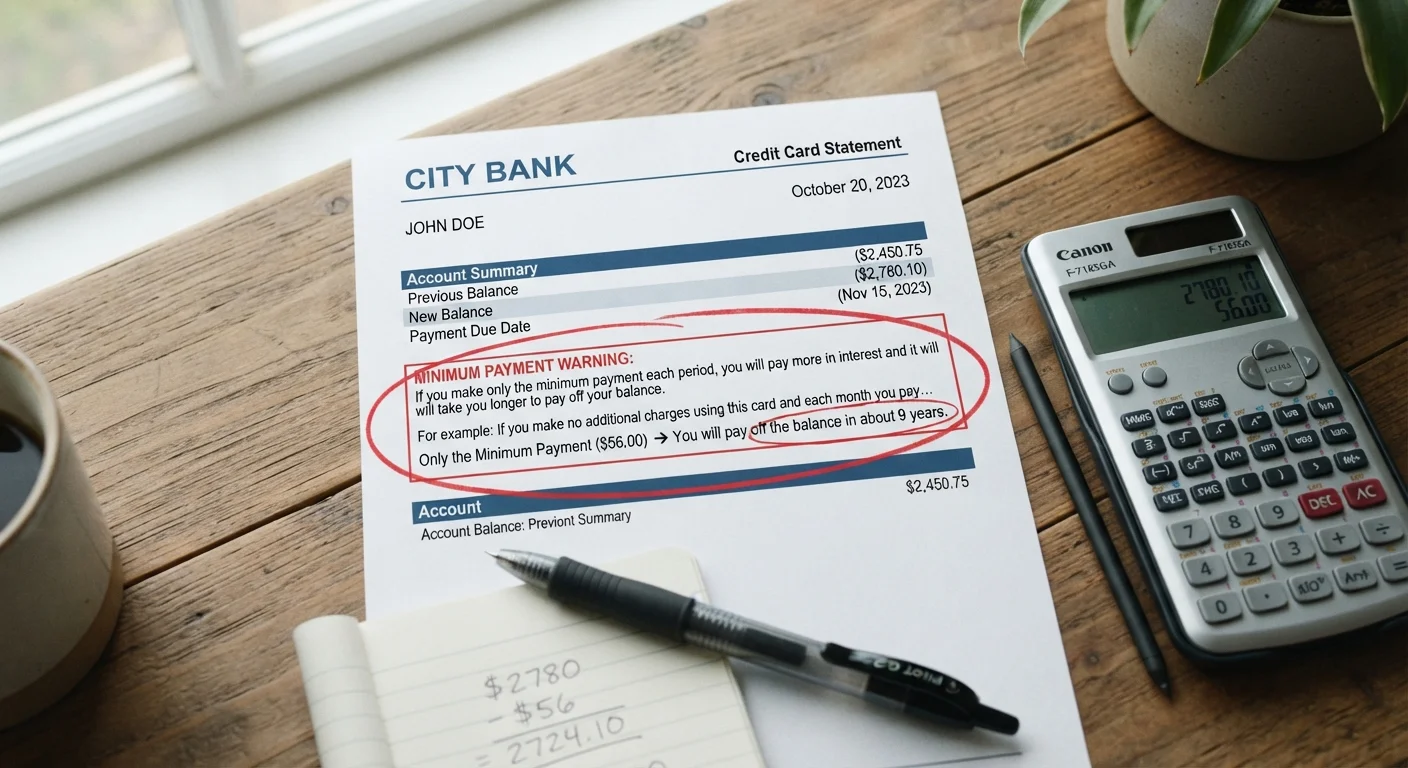
Photo credit: NewBizBuzz.net | Financial Insights For All
In this article
Paying only the minimum each month can extend debt for years. Here's the maths behind it and what to do instead.
Key Takeaways
- Paying only the minimum extends repayment timelines dramatically and multiplies total interest paid.
- Credit card issuers set minimums low by design — typically 1–3% of the balance — to maximize interest revenue.
- Even modest increases above the minimum payment can shave years off debt and save hundreds in interest.
- Carrying a revolving balance does not improve your credit score — a common and costly misconception.
- Treating minimum payments as the target rather than the floor is the core mistake most cardholders make.
How Minimum Payments Are Structured — and Why It Matters
Credit card issuers generally calculate minimum payments as the greater of a flat dollar floor (often $25–$35) or a small percentage of the outstanding balance — typically 1% to 3%, sometimes with interest charges added separately. This formula keeps the required monthly outlay low, which reduces the chance of missed payments. It also ensures that balances persist far longer than most cardholders expect.
Consider a $5,000 balance at a 22% annual percentage rate (APR) — close to the US average for accounts carrying a balance. If only the minimum is paid each month and the minimum is calculated as 2% of the remaining balance, repayment can stretch beyond 20 years, with total interest exceeding the original principal. For the precise mathematics behind these projections, our detailed explainer on why minimum payments keep balances alive walks through the numbers at different APR levels.
The mechanics are straightforward: when a payment barely covers the monthly interest charge, only a marginal portion reduces principal. The following month's interest then accrues on an almost identical balance, creating a cycle that self-perpetuates unless the payment amount increases.
22%+
Average credit card APR on revolving balances
The Federal Reserve's consumer credit data has tracked average credit card interest rates on accounts assessed interest above 20% in recent reporting periods.
20+ years
Potential repayment timeline on minimum-only payments
Consumer Financial Protection Bureau analyses illustrate that a mid-four-figure balance paid only at the minimum can take two decades or more to retire at high APRs.
$1 trillion+
US revolving credit card debt outstanding
Federal Reserve G.19 consumer credit data has shown total revolving credit — primarily credit cards — exceeding one trillion dollars in recent reporting periods.
Common Mistakes That Keep Cardholders Stuck
The minimum payment trap is rarely a single error — it's a cluster of reinforcing misconceptions and habits. Understanding each one is the first step toward breaking the cycle.
Treating the minimum payment as the intended payment amount rather than the contractual floor.
Why it happens: Statements prominently display the minimum due, and for many cardholders that figure becomes the de facto monthly target — a framing the card issuer benefits from.
Ignoring the true cost of the interest rate when making spending decisions.
Why it happens: APRs are quoted annually, which obscures the monthly and daily compounding reality. A 22% APR translates to roughly 1.83% per month — an amount that grows quickly on a four-figure balance.
Making new purchases on a card while simultaneously trying to pay down the existing balance.
Why it happens: Cardholders often separate their mental accounts — new spending feels distinct from the existing debt — even though both carry the same APR and compound together.
Accepting an introductory 0% APR offer without a clear plan to eliminate the balance before the promotional period ends.
Why it happens: The interest-free window creates a false sense of security; minimum payments feel sufficient because no interest accrues. When the rate resets — often sharply — the remaining balance immediately becomes expensive.
Confusing a reduced minimum payment — triggered by a lower balance — with financial progress.
Why it happens: As balances decline slightly, the percentage-based minimum also drops, which can feel like relief. But maintaining the lower payment simply restores the extended-repayment dynamic.
One persistent myth worth addressing separately: many cardholders believe that carrying a revolving balance signals responsible credit use to lenders and therefore boosts their FICO score. It does not. Credit scoring models reward on-time payments and low utilization — not unpaid balances. For a fuller review of credit card misconceptions, see our piece on common myths about credit cards that cost people money.
Carrying a Balance Does Not Build Credit
A widely circulated misconception holds that keeping a small revolving balance improves credit scores by demonstrating active card use. FICO and VantageScore models do not reward unpaid balances — they reward payment consistency and low credit utilization. Paying your statement balance in full each month is both cost-free and credit-positive. Retaining debt to 'help' your score costs money without providing the benefit cardholders expect.
Practical Strategies to Escape the Minimum Payment Cycle
Breaking the minimum payment habit does not require a dramatic income increase. Incremental, deliberate changes compound quickly in your favor.
- Fix your payment at a set dollar amount above the minimum. If the minimum is $75, commit to $150 every month regardless of where the balance moves. This prevents the declining-minimum effect from extending your repayment horizon.
- Apply any irregular income directly to the balance. Tax refunds, bonuses, or freelance income applied as lump sums can significantly reduce the principal on which interest accrues.
- Prioritize the highest-rate balance first. The debt avalanche method — paying minimums on all accounts except the one with the highest APR, which receives every available extra dollar — minimizes total interest paid across a portfolio of debt.
- Track your payoff date, not just your balance. Free amortization calculators can show the exact payoff date under different monthly payment scenarios. Seeing a concrete timeline often motivates more consistent over-payment.
If budget constraints make even modest increases feel impossible, a structured approach can still yield progress. Our step-by-step guide to getting out of debt on a tight budget outlines how to build momentum without requiring significant disposable income.
Balance Transfer Resets Can Catch Cardholders Off Guard
Transferring a balance to a 0% promotional card is a legitimate debt-reduction tool, but it carries a structural risk. If the balance is not fully paid before the promotional period ends, the remaining amount typically begins accruing interest at the card's standard purchase APR — which may be higher than the original card's rate. Minimum-only payments during the promotional window almost never eliminate the balance in time. Model the full payoff schedule before initiating any transfer.
It's also worth auditing any assumptions about debt more broadly. Several deeply held beliefs — including the idea that carrying some credit card debt is strategically useful — are addressed in our review of common debt myths that keep people from getting ahead.
This article is for general informational and educational purposes only and does not constitute personalised financial, tax, or legal advice. Credit terms, APRs, and minimum payment formulas vary by issuer and individual account. Consult a licensed financial adviser or credit counsellor before making decisions based on your specific financial situation.

Author
Credit & Lending Editorial Team
Credit & Lending Editorial Team is the collective byline for our editorial team and contributor network. Articles published under this byline or an editorial pen name are researched, written, and reviewed according to our editorial standards for clarity, consistency, and independence before publication.
View all articles →