
The Three Core Financial Statements and What They Actually Tell You
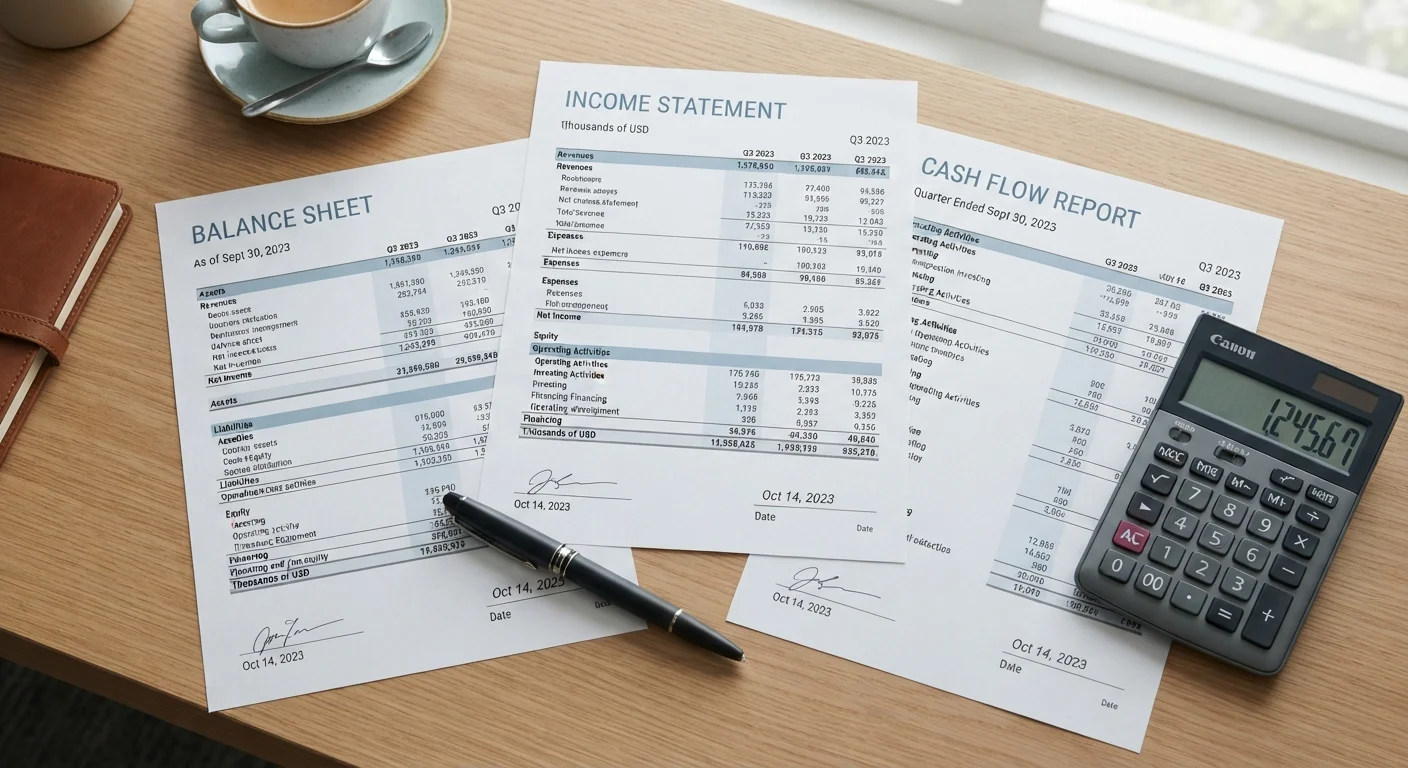
Photo credit: NewBizBuzz.net | Financial Insights For All
In this article
Income statement, balance sheet, cash flow statement — learn what each reveals about a company's financial health and why all three matter together.
Key Takeaways
- The income statement shows whether a company is profitable over a specific period.
- The balance sheet reveals what a company owns and owes at a single point in time.
- The cash flow statement tracks the actual movement of cash — separate from reported profit.
- Profit and positive cash flow do not always coincide; understanding both is essential.
- Reading all three statements together provides a far more accurate view than any one alone.
- Footnotes to financial statements often contain critical disclosures that the main figures obscure.
The Income Statement: Measuring Profitability Over Time
The income statement — also called the profit and loss statement (P&L) — answers one central question: did the company make money during this period? It covers a defined span of time, typically a quarter or fiscal year, and summarizes revenues, costs, and the resulting profit or loss.
The structure flows from top to bottom. Revenue (or net sales) sits at the top. Cost of goods sold (COGS) is subtracted to arrive at gross profit. Operating expenses — including salaries, marketing, and rent — are then deducted to produce operating income. After accounting for interest, taxes, and other items, the bottom line is net income.
Investors watch revenue growth trends, gross margin percentages, and whether operating expenses are growing faster than revenue — a potential warning sign. The income statement is the primary source for earnings-per-share (EPS) calculations used widely in equity valuation. However, because it follows accrual accounting principles, reported income does not necessarily reflect cash actually received. That distinction matters enormously.
Compare Margins Across Periods, Not Just Figures
When reading an income statement, raw revenue or profit numbers are less informative than margin trends. Gross margin, operating margin, and net margin — each expressed as a percentage of revenue — reveal whether profitability is improving or eroding even as the top line grows. Tracking these ratios across multiple periods gives context that a single snapshot cannot.
The Balance Sheet: A Snapshot of Financial Position
While the income statement covers a period of time, the balance sheet captures a single moment — the last day of a reporting period. It answers: what does the company own, what does it owe, and what's left for shareholders?
The balance sheet is organized around the foundational accounting equation: Assets = Liabilities + Shareholders' Equity. Assets include current items like cash and receivables, plus long-term items like property, equipment, and intangibles. Liabilities include short-term obligations (accounts payable, current debt) and long-term debt. Shareholders' equity represents the residual interest — what would remain for owners after all debts were settled.
Key ratios derived from the balance sheet include the debt-to-equity ratio (measuring leverage) and the current ratio (current assets divided by current liabilities, measuring short-term liquidity). A heavily leveraged balance sheet can amplify risk, particularly in rising interest rate environments.
For a thorough breakdown of balance sheet mechanics, see reading a balance sheet without an accounting degree or our deeper reference on balance sheet literacy.
~10,000
Public companies filing with the SEC annually
The SEC's EDGAR system hosts filings from thousands of registered public companies, all of which must submit audited financial statements under GAAP.
44%
Of S&P 500 firms with free cash flow below net income
Academic research on large-cap U.S. equities consistently finds a substantial share of companies where reported earnings exceed free cash flow in any given year, underscoring the importance of the cash flow statement.
The Cash Flow Statement: Following the Actual Money
Of the three statements, the cash flow statement is often the least instinctive — and arguably the most revealing. It reconciles the gap between accounting profit and real cash movement, answering: how is the company actually generating and spending cash?
The statement is divided into three sections:
- Operating activities: Cash generated or used by core business operations. This is the most scrutinized section — sustained negative operating cash flow is a red flag regardless of reported profits.
- Investing activities: Cash spent on or received from capital expenditures, acquisitions, and asset sales. Heavy investment can be a growth signal or a liquidity drain, depending on context.
- Financing activities: Cash flows related to debt issuance or repayment, equity raises, and dividend payments.
A company can report net income while burning cash — a scenario common in businesses with long payment cycles or aggressive revenue recognition. Free cash flow (operating cash flow minus capital expenditures) is widely used by analysts as a more grounded profitability measure.
The notes accompanying financial statements often clarify non-cash transactions and accounting choices that affect all three reports. See our article on what financial statement footnotes reveal for why skipping them is a costly habit.
Why All Three Must Be Read Together
Each statement has blind spots that the others correct. Net income from the income statement flows into retained earnings on the balance sheet. Operating cash flow on the cash flow statement reconciles back to net income. These linkages are not incidental — they are built into double-entry accounting and serve as a cross-check against errors or misrepresentation.
Consider a company reporting three consecutive quarters of profit but steadily declining cash from operations: the income statement alone looks healthy; the cash flow statement raises urgent questions. Conversely, a negative net income quarter driven by a one-time write-down may still reflect solid operating cash flow and a clean balance sheet.
For investors evaluating asset classes that include equities, understanding financial statements is a prerequisite for informed analysis. These documents are the primary evidence behind any valuation. Treat them as interconnected, not interchangeable. When making decisions about your own portfolio or tax situation, consult a qualified financial adviser or CPA who can apply these concepts to your specific circumstances.
This article is for general informational and educational purposes only and does not constitute personalized financial, investment, tax, or legal advice. Always consult a qualified professional before making financial decisions.
Frequently Asked Questions

Author
Accounting & Tax Editorial Team
Accounting & Tax Editorial Team is the collective byline for our editorial team and contributor network. Articles published under this byline or an editorial pen name are researched, written, and reviewed according to our editorial standards for clarity, consistency, and independence before publication.
View all articles →