
Accrual Accounting vs. Cash-Basis Accounting: How the Method Shapes the Numbers
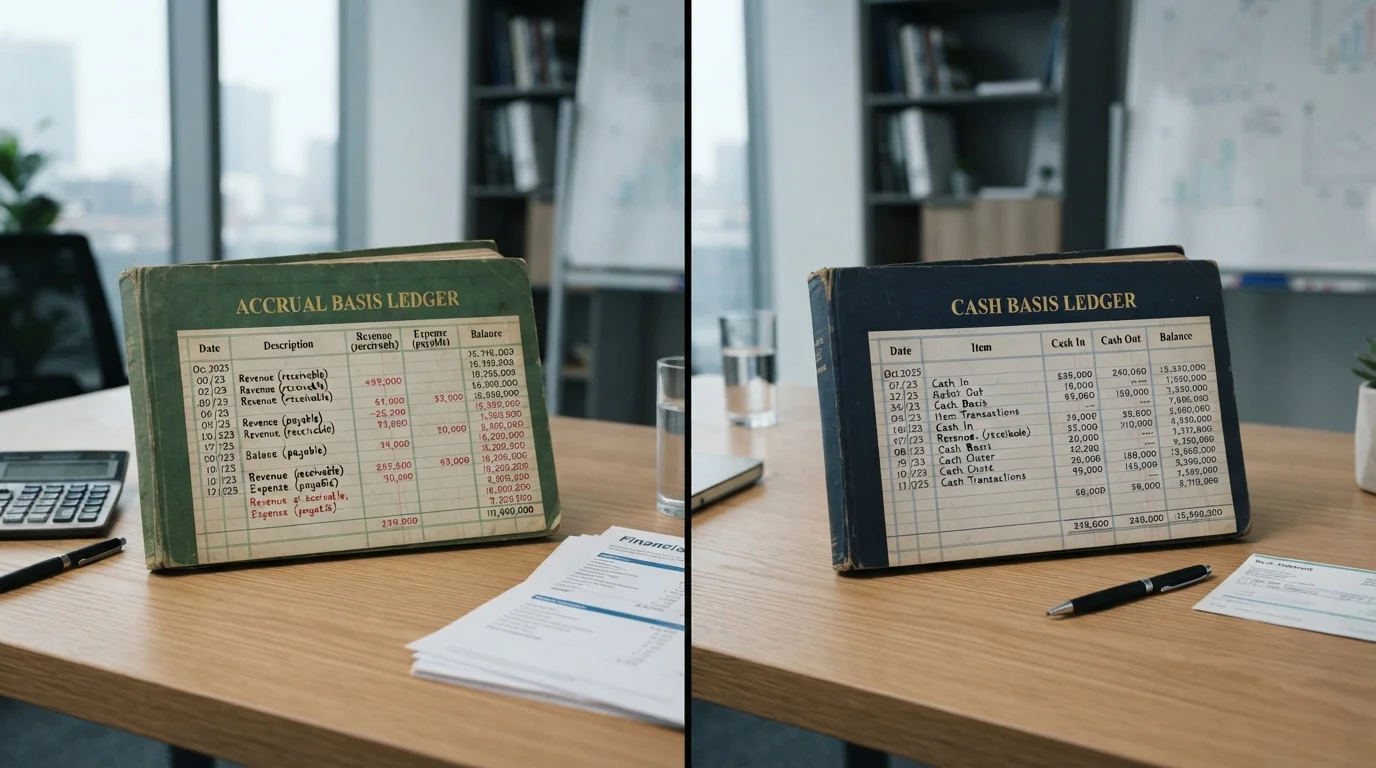
Photo credit: NewBizBuzz.net | Financial Insights For All
In this article
The accounting method a company uses directly affects how its financials look. Understand the core difference and what it means when evaluating reported earnings.
Key Takeaways
- Accrual accounting records revenue and expenses when earned or incurred, not when cash changes hands.
- Cash-basis accounting records transactions only when payment is received or made.
- GAAP requires publicly traded companies in the US to use accrual accounting for external reporting.
- Reported net income can differ substantially between the two methods for the same business activity.
- Cash-basis financials may look healthier or weaker than accrual statements depending on payment timing.
- Investors should identify which method underlies reported earnings before drawing conclusions.
The Core Difference: When a Transaction Is Recorded
The fundamental divide between accrual and cash-basis accounting comes down to timing. Under accrual accounting, a business records revenue when it is earned — when goods are delivered or services are rendered — and records expenses when they are incurred, regardless of when cash actually moves. Under cash-basis accounting, a transaction only hits the books when money physically changes hands.
Consider a contractor who completes a project in December but receives payment in January. Under accrual accounting, that revenue appears in December's income statement. Under cash-basis accounting, it shows up in January. The work is identical; the financial picture is not. This distinction is why two companies with identical business activity can report meaningfully different earnings depending on the method they use.
For a deeper grounding in how these transactions ultimately balance, see the accounting equation explained, which covers how every recorded entry must keep Assets = Liabilities + Equity in balance.
| Criterion | Accrual Accounting | Cash-Basis Accounting |
|---|---|---|
| Revenue recorded when | Earned (goods/services delivered) | Cash is received |
| Expenses recorded when | Incurred (obligation exists) | Cash is paid |
| GAAP compliance | Required for public companies | Not GAAP-compliant for public reporting |
| Balance sheet complexity | Includes receivables, payables, deferrals | Simpler; limited balance sheet entries |
| Cash flow visibility | Requires separate cash flow statement | Income closely mirrors cash position |
| Typical users | Public companies, larger private firms | Small businesses, sole proprietors |
| IRS eligibility | Available to all entities | Subject to gross receipts thresholds |
How Each Method Shapes Reported Numbers
The choice of accounting method directly influences several key financial metrics investors and analysts rely on.
Revenue Recognition
Under accrual accounting, revenue is recognized in the period the obligation is fulfilled, which aligns with GAAP's revenue recognition standard (ASC 606). A software company that sells an annual subscription records that revenue ratably across twelve months, not as a lump sum when the customer pays upfront. Cash-basis accounting, by contrast, records the entire payment when received, potentially inflating a single period's income.
Expense Matching
Accrual accounting applies the matching principle — expenses are recorded in the same period as the revenue they help generate. Depreciation of equipment, accrued wages, and deferred costs are all examples. Cash-basis accounting ignores this alignment; a large supply purchase paid in March hits March's books in full, even if the supplies support six months of operations.
Accounts Receivable and Payable
Accrual accounting creates balance sheet entries for amounts owed to and by the business. These accounts receivable and accounts payable figures have no equivalent in cash-basis records, which means cash-basis balance sheets present a narrower snapshot of obligations and entitlements.
These structural differences are explored in practical terms in our side-by-side breakdown of accrual vs. cash accounting.
$29M
IRS cash-method gross receipts threshold
Under the Tax Cuts and Jobs Act of 2017, businesses averaging up to approximately $29 million in annual gross receipts (inflation-adjusted) may generally elect cash-basis accounting for federal tax purposes.
ASC 606
GAAP revenue recognition standard
The FASB's ASC 606 standard governs when and how revenue is recognized under accrual accounting for US public companies, standardizing reporting across industries.
Regulatory Requirements and Practical Constraints
In the United States, GAAP — as established by the FASB — mandates accrual accounting for all publicly traded companies issuing external financial statements. The SEC enforces this requirement for companies filing under US securities laws. As a result, any investor reading a public company's 10-K or quarterly 10-Q is always reading accrual-based financials.
The IRS permits certain smaller businesses to use cash-basis accounting for tax reporting purposes, subject to gross receipts thresholds. Under the Tax Cuts and Jobs Act of 2017, businesses with average annual gross receipts of $29 million or less (as adjusted for inflation) may generally elect the cash method. This creates situations where a business maintains cash-basis books for tax purposes and accrual-basis records for management reporting — a dual-method approach that requires careful reconciliation.
Internationally, IFRS similarly requires accrual accounting for companies reporting under those standards. GAAP and IFRS differ on several reporting details, but both frameworks share this foundational accrual requirement.
Cash Flow Statements Bridge the Gap
Under both GAAP and IFRS, companies using accrual accounting must also prepare a statement of cash flows. This document reconciles net income to actual cash generated or used, helping readers distinguish paper profits from liquid resources. When evaluating financial health, reviewing the cash flow statement alongside the income statement is standard analytical practice.
What This Means When Reading Financial Reports
For anyone evaluating a business — whether as a potential investor, lender, or analyst — identifying the accounting method in use is a prerequisite for interpretation. Accrual-basis income statements can include revenue that has not yet been collected, meaning strong reported profits do not always signal strong cash generation. A company can be profitable on paper while simultaneously facing a cash shortfall if receivables are slow to convert.
Conversely, a cash-basis business may show lower income in a period when it has delivered significant work but not yet been paid — understating economic performance in that window. Recognizing these timing gaps helps avoid misreading financial health based solely on a single line item.
Analysts frequently supplement accrual income statements with the cash flow statement, which reports actual cash inflows and outflows and is required under GAAP regardless of the entity's revenue recognition approach. Comparing net income to operating cash flow helps reveal how closely reported earnings track real liquidity. Large, persistent divergences between the two warrant closer scrutiny.
For additional context on how accounting choices distort common financial conclusions, common accounting misconceptions examined and corrected addresses several widely held but inaccurate assumptions. The method also intersects with asset valuation — depreciation method choices similarly affect reported profit under accrual-based reporting.
This article provides general financial and accounting information for educational purposes only. It does not constitute personalized financial, tax, or legal advice. Readers should consult a qualified accountant, tax professional, or financial adviser regarding their specific circumstances.

Author
Accounting & Tax Editorial Team
Accounting & Tax Editorial Team is the collective byline for our editorial team and contributor network. Articles published under this byline or an editorial pen name are researched, written, and reviewed according to our editorial standards for clarity, consistency, and independence before publication.
View all articles →