
Accrual vs Cash Accounting: What Changes and What Stays the Same
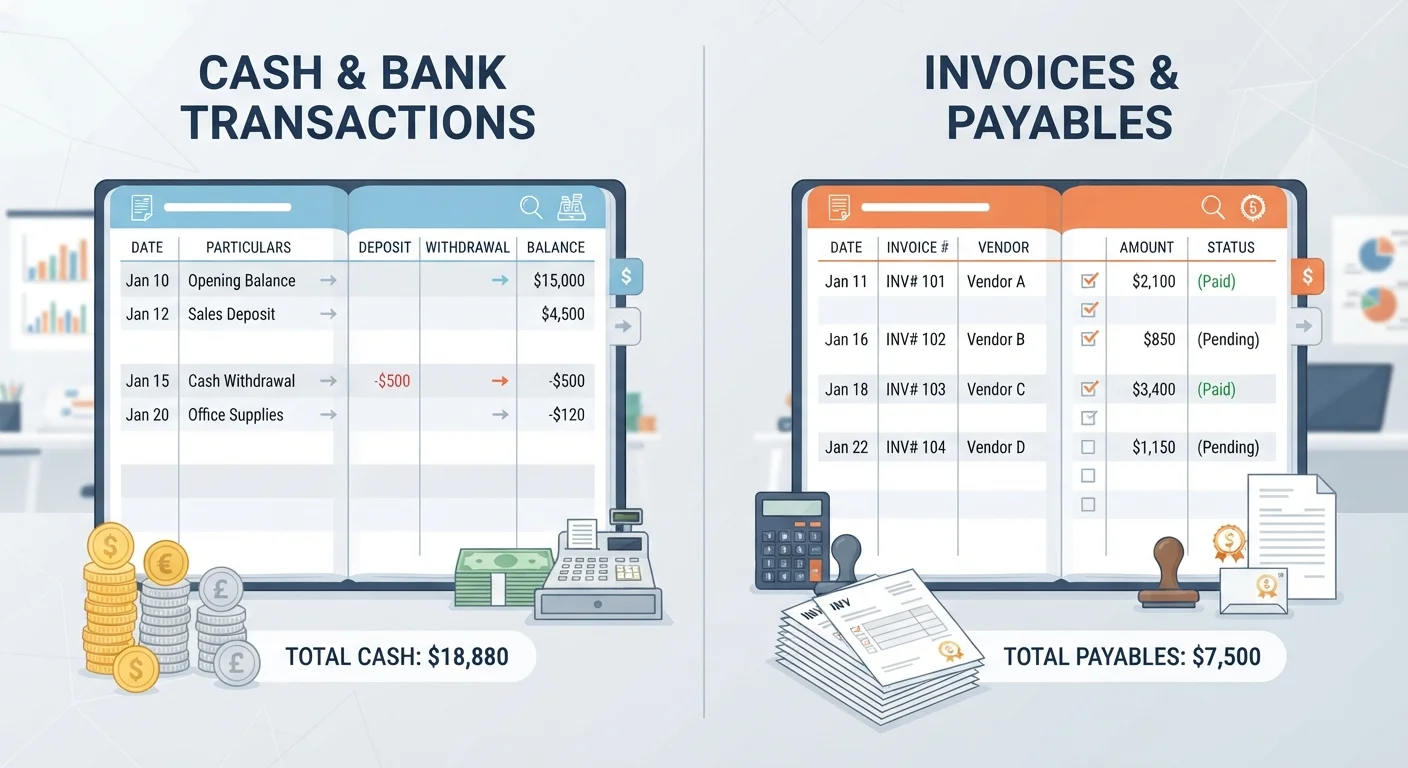
Photo credit: NewBizBuzz.net | Financial Insights For All
In this article
A side-by-side look at accrual and cash basis accounting — how each records income and expenses, and when each approach is typically used.
Key Takeaways
- Accrual accounting records income and expenses when earned or incurred, not when cash changes hands.
- Cash basis accounting records transactions only when cash is received or paid out.
- The IRS generally requires businesses with average annual gross receipts above $29 million to use the accrual method.
- Accrual accounting is mandated for GAAP compliance, making it standard for audited financial statements.
- Cash basis offers simplicity and a real-time cash picture but can misrepresent profitability over time.
- Switching between methods requires IRS approval and careful adjustment of prior-period records.
The Core Difference: When Does a Transaction Count?
The fundamental distinction between accrual and cash basis accounting comes down to timing - specifically, when a financial event is recorded in the books.
Under accrual accounting, income is recognized when it is earned and expenses are recognized when they are incurred, regardless of whether cash has actually been exchanged. If you invoice a client in December but receive payment in January, accrual accounting records that revenue in December. Similarly, if you receive a service in March but pay the bill in April, the expense appears in March.
Under cash basis accounting, transactions are recorded only when cash physically moves. That same December invoice would appear as revenue in January - when you actually receive the money. This approach mirrors how most individuals naturally think about personal finances.
For a deeper grounding in how these principles fit into the broader discipline, see the introduction to financial record-keeping covering the full accounting cycle.
| Criterion | Accrual Accounting | Cash Basis Accounting |
|---|---|---|
| Revenue recognition | When earned (invoice issued) | When cash is received |
| Expense recognition | When incurred | When cash is paid |
| GAAP compliant | Yes | No |
| IRS threshold (gross receipts) | Required above ~$29M avg. | Permitted below ~$29M avg. |
| Complexity | Higher - tracks A/R, A/P, deferrals | Lower - records cash flows only |
| Cash flow visibility | Indirect - requires reconciliation | Direct - mirrors bank activity |
| Profitability accuracy | More accurate across periods | Can distort period comparisons |
| Typical users | Corporations, audited entities | Small businesses, sole proprietors |
Regulatory Requirements and Who Uses Each Method
The choice of accounting method is not always discretionary. The IRS and GAAP impose rules that govern which businesses may - or must - use each approach.
GAAP compliance requires the accrual method. Any business that undergoes an independent audit, seeks institutional financing, or plans to go public will need accrual-basis financial statements. GAAP's matching principle - which holds that expenses should be recognized in the same period as the revenues they helped generate - is only achievable through accrual accounting.
The IRS sets its own thresholds. Under the Tax Cuts and Jobs Act of 2017, the gross receipts test was updated: businesses with average annual gross receipts of $29 million or less (adjusted periodically for inflation) over the prior three tax years generally qualify to use cash basis for tax purposes. Businesses exceeding that threshold are typically required to use the accrual method.
$29M
IRS gross receipts threshold for accrual requirement
Under IRS rules updated by the Tax Cuts and Jobs Act of 2017, businesses averaging $29 million or less in annual gross receipts generally may use the cash method for federal tax purposes.
~60%
Small businesses using cash basis accounting
Industry surveys consistently find that the majority of small US businesses with fewer than 10 employees rely on cash basis accounting due to its simplicity and lower administrative burden.
It is worth noting that a business may use one method for tax reporting and another for internal financial statements - a common and legitimate practice, though it requires careful reconciliation.
Understanding why the gap between these methods matters to investors is explored further in cash flow vs. net income.
Strengths, Limitations, and What Stays Constant
Each method carries genuine trade-offs, and understanding both sides prevents financial misjudgments.
Accrual Accounting
- Strength: Provides a more accurate picture of long-term profitability and financial position.
- Strength: Required for GAAP, making it essential for audits and external stakeholders.
- Limitation: More complex to maintain; requires tracking accounts receivable, accounts payable, and deferred items.
- Limitation: Can show strong profits even when cash is tight - a distinction that trips up many business owners.
Cash Basis Accounting
- Strength: Simple to implement and easy to understand at a glance.
- Strength: Directly reflects available liquidity, making cash management more intuitive.
- Limitation: Can distort profitability across periods - booking a large payment in one month can make financials look misleadingly strong or weak.
- Limitation: Not accepted for GAAP-compliant reporting.
What stays the same regardless of method: the underlying economic reality of the business. Both methods ultimately account for the same transactions - they simply record them at different points in time. The chart of accounts, double-entry bookkeeping structure, and foundational principles of financial integrity apply equally to both. For common misunderstandings about what accounting numbers actually represent, accounting misconceptions that distort decisions is a useful companion read.
Switching Methods Requires IRS Approval
A business that wants to change its accounting method - say, from cash to accrual - must generally file IRS Form 3115 (Application for Change in Accounting Method). The switch can create a one-time adjustment known as a Section 481(a) adjustment, which accounts for income and expense items that might otherwise be duplicated or omitted during the transition. Consulting a qualified tax professional before initiating a method change is strongly advisable.
This article is for general informational and educational purposes only and does not constitute personalized accounting, tax, or financial advice. Businesses should consult a licensed CPA or tax adviser before selecting or changing their accounting method.

Author
Accounting & Tax Editorial Team
Accounting & Tax Editorial Team is the collective byline for our editorial team and contributor network. Articles published under this byline or an editorial pen name are researched, written, and reviewed according to our editorial standards for clarity, consistency, and independence before publication.
View all articles →