
Depreciation Methods and Why the Choice Matters
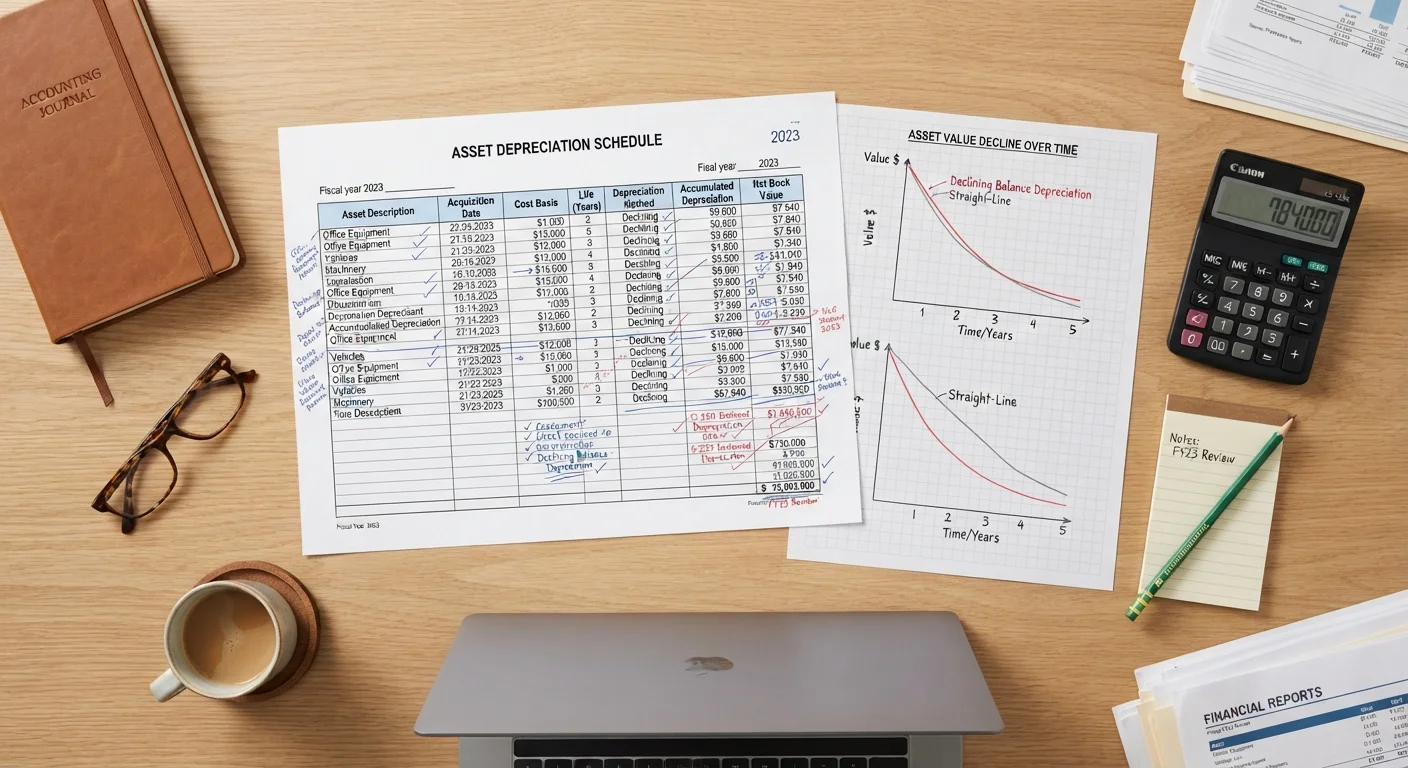
Photo credit: NewBizBuzz.net | Financial Insights For All
In this article
Compare straight-line, declining balance, and units-of-production depreciation, and understand how each affects reported profit over time.
Key Takeaways
- Depreciation spreads the cost of a long-term asset over its useful life, reducing taxable income each period.
- Straight-line, declining balance, and units-of-production are the three primary depreciation methods under GAAP.
- The chosen method affects reported profit, asset book values, and comparability across financial statements.
- Accelerated methods front-load expense recognition, reducing early-period profits but potentially improving cash flow via tax timing.
- Businesses should consult a qualified accountant before selecting or changing a depreciation method.
What Depreciation Actually Does to Your Financial Statements
Depreciation is the systematic allocation of a tangible asset's cost over its expected useful life. Rather than expensing a piece of equipment entirely in the year of purchase, a business spreads that cost across multiple accounting periods - matching the expense to the periods in which the asset generates revenue. This principle sits at the heart of accrual-based accounting under GAAP.
The practical consequence is straightforward: depreciation reduces reported net income each period without involving an actual cash outflow in that period. It also reduces the asset's book value on the balance sheet over time. Because depreciation is deductible for tax purposes under IRS rules (subject to method constraints), the choice of method influences not just reported earnings but also the timing of tax obligations.
For investors and analysts, understanding which depreciation method a company uses is essential for meaningful comparison. Two businesses holding identical assets can report substantially different profits simply because they use different depreciation approaches. This is why depreciation method disclosures appear in the notes to financial statements - and why the financial reporting framework demands transparency around the choice. See also our complementary piece on how accounting method choice shapes reported numbers.
The Three Core Methods Compared
GAAP permits several depreciation methods, but three dominate in practice.
Straight-Line Depreciation
The simplest approach: subtract the asset's estimated salvage value from its cost, then divide by its useful life in years. The resulting annual expense is identical every period. A $50,000 machine with a $5,000 salvage value and a 10-year life generates $4,500 of depreciation expense each year - no variation, no surprises.
Declining Balance (Accelerated)
Instead of applying the same dollar amount each year, declining balance applies a fixed percentage rate to the asset's remaining book value. The double-declining balance (DDB) variant uses twice the straight-line rate. Because the book value shrinks each year, the dollar expense also shrinks - but the early-year charges are substantially higher than under straight-line. This front-loading reduces reported profit in early periods while preserving more profit in later years.
Units-of-Production
This method ties depreciation directly to actual output. Depreciable cost is divided by the asset's estimated total production capacity (units, hours, miles), yielding a depreciation rate per unit. In high-output years the expense rises; in low-output years it falls. It is particularly well-suited to manufacturing equipment or vehicles where physical wear tracks usage closely.
| Straight-Line | Declining Balance | Units-of-Production | |
|---|---|---|---|
| Expense pattern | Equal each period | Higher early, lower later | Varies with usage |
| Complexity | Low | Moderate | Moderate |
| Best asset fit | Buildings, furniture | Technology, vehicles | Machinery, fleet |
| Effect on early profits | Moderate reduction | Largest reduction | Depends on output |
| GAAP compliant | Yes | Yes | Yes |
| Tracks physical wear | Indirectly | Partially | Directly |
How Method Choice Flows Through to Profit and Tax
Consider the same $50,000 asset across all three methods in Year 1. Straight-line might record $4,500 in expense. Double-declining balance could record $10,000. Units-of-production might record $6,800 if output was above average. Each figure flows directly into operating income - meaning the same underlying business can appear significantly more or less profitable depending solely on the depreciation method selected.
Switching Methods Requires Disclosure
Under GAAP, a change in depreciation method is treated as a change in accounting estimate and must be disclosed in the financial statement notes. Unexplained mid-stream switches can be a red flag for analysts reviewing financial statements for consistency and quality of earnings.
This has real consequences for financial analysis. Earnings per share, return on assets, and EBITDA margins all shift with depreciation choices. Analysts sometimes adjust reported earnings back to a common depreciation basis to improve comparability across companies in the same industry - a practice known as normalizing earnings. For a broader view of how individual performance metrics can mislead in isolation, our piece on profit vs. profitability provides useful context.
On the tax side, the IRS governs depreciation through the Modified Accelerated Cost Recovery System (MACRS), which specifies asset class lives and mandates accelerated recovery schedules for most business property - often diverging from book depreciation under GAAP. This creates temporary differences that must be tracked on the balance sheet as deferred tax liabilities or assets. Managing this complexity is one reason businesses should work with a licensed CPA or tax professional when establishing or revising depreciation policies.
This article is for general informational and educational purposes only and does not constitute tax, accounting, or financial advice. Depreciation rules are complex and fact-specific. Consult a qualified accountant or tax professional for guidance tailored to your situation.

Author
Accounting & Tax Editorial Team
Accounting & Tax Editorial Team is the collective byline for our editorial team and contributor network. Articles published under this byline or an editorial pen name are researched, written, and reviewed according to our editorial standards for clarity, consistency, and independence before publication.
View all articles →