
Concentrated vs. Diversified Portfolios: The Trade-Offs Every Investor Should Understand
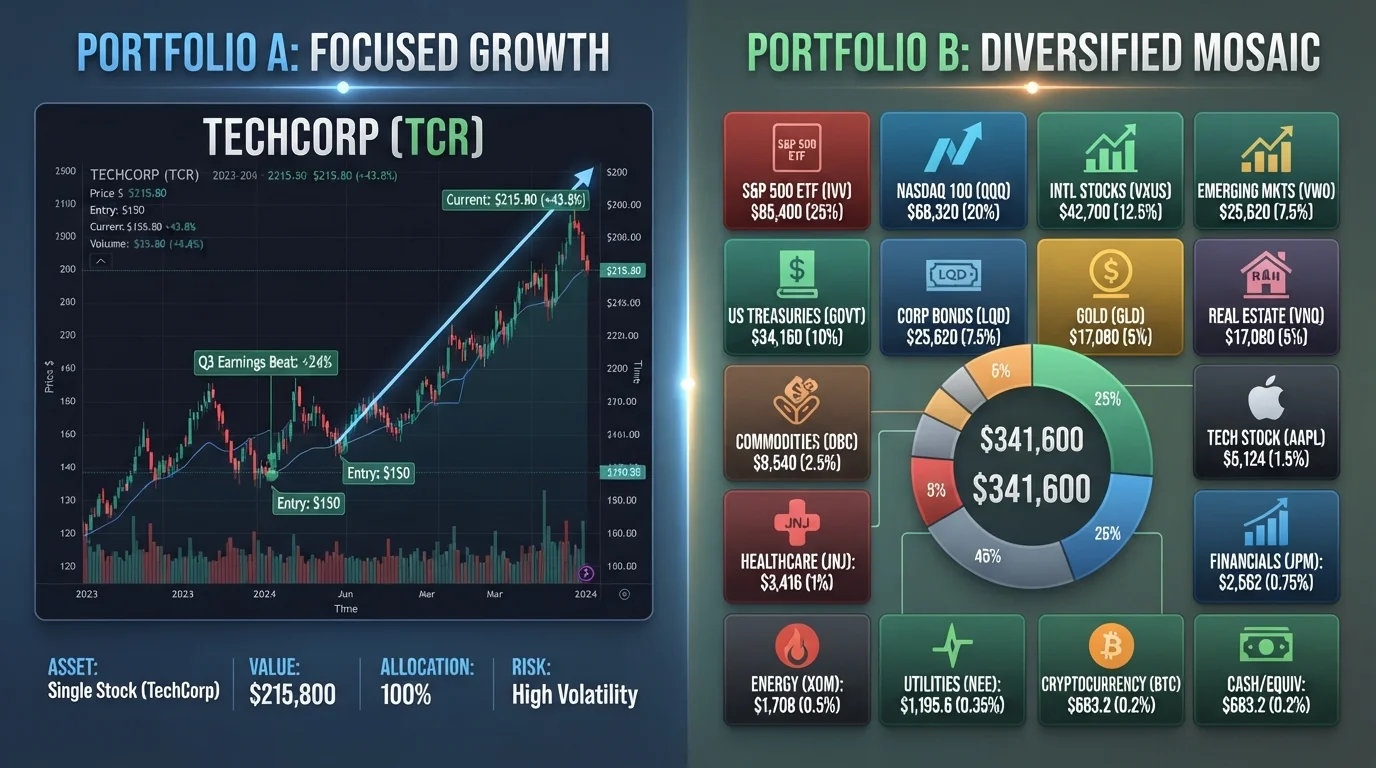
Photo credit: NewBizBuzz.net | Financial Insights For All
In this article
Weigh the risk-return trade-offs of holding a focused stock portfolio against a broadly diversified one, with real-world context for each approach.
Key Takeaways
- Concentrated portfolios can amplify returns but expose investors to outsized single-position risk.
- Diversification reduces volatility but may limit outperformance relative to a benchmark index.
- Neither approach is universally superior — the right structure depends on investor knowledge, time horizon, and risk tolerance.
- Most professional frameworks treat diversification as the default, evidence-backed starting point.
- Tax consequences and liquidity constraints often influence how concentration develops in real portfolios.
High-conviction bets can generate outsized returns
When research is sound and timing is reasonable, a concentrated position in a strong performer can substantially outpace a diversified benchmark over time.
Forces deep research and genuine understanding
Owning fewer positions creates an incentive to know each business thoroughly — its competitive dynamics, financial health, and valuation — rather than relying on broad market exposure.
Potentially lower turnover and tax drag
Investors with a small number of long-held positions may incur fewer taxable events than those frequently rebalancing a large portfolio, though this depends heavily on individual circumstances.
Clarity and simplicity in monitoring holdings
A focused portfolio is easier to track and evaluate; each position's contribution to overall performance is transparent and directly attributable.
Single-company or sector failures carry catastrophic risk
A concentrated bet on a company that experiences fraud, regulatory action, or competitive disruption can permanently impair capital in ways a diversified portfolio would absorb with far less impact.
Requires sustained research skill and discipline
The return advantage of concentration depends entirely on the investor's ability to consistently identify mispriced securities — a bar that is difficult to clear reliably over long periods, even for professionals.
Behavioral vulnerability during drawdowns is heightened
Large losses in a small number of positions can trigger panic selling at exactly the wrong time; the psychological pressure of concentrated losses is substantially greater than comparable portfolio-level losses spread across many holdings.
May produce returns far below the market average
Concentration cuts both ways: the same mechanism that enables outperformance equally enables persistent underperformance when thesis errors occur sequentially.
Defining the Two Approaches
A concentrated portfolio holds a small number of positions — sometimes as few as five to fifteen securities — with meaningful weight assigned to each. A diversified portfolio spreads capital across many securities, sectors, geographies, and sometimes asset classes, deliberately reducing dependence on any single holding.
Both approaches have serious practitioners. Legendary value investors have argued that owning a handful of deeply understood businesses is more prudent than spreading capital thin. Academic finance, by contrast, has long demonstrated that unsystematic risk — the risk tied to individual companies — can be largely eliminated through broad ownership. Understanding what each approach actually does to your risk-return profile is essential before choosing a path. For a foundational look at how diversification works mechanically, see how diversification reduces concentration risk.
The Case for Concentrated Portfolios
Proponents of concentration argue that genuine investment insight is scarce, and spreading capital across dozens of positions dilutes the impact of your best ideas. If an investor has done the analytical work to identify a genuinely mispriced security, holding a small position limits the payoff.
High-conviction bets can generate outsized returns
When research is sound and timing is reasonable, a concentrated position in a strong performer can substantially outpace a diversified benchmark over time.
Forces deep research and genuine understanding
Owning fewer positions creates an incentive to know each business thoroughly — its competitive dynamics, financial health, and valuation — rather than relying on broad market exposure.
Potentially lower turnover and tax drag
Investors with a small number of long-held positions may incur fewer taxable events than those frequently rebalancing a large portfolio, though this depends heavily on individual circumstances.
Clarity and simplicity in monitoring holdings
A focused portfolio is easier to track and evaluate; each position's contribution to overall performance is transparent and directly attributable.
However, the practical risks are significant. Concentration works when the investor's thesis is correct. When it isn't, losses can be severe and difficult to recover from. Concentration risk is also not always a deliberate choice — it frequently develops through stock appreciation, employer equity grants, or inheritance, creating dangerous exposure investors may not fully recognize.
The Case for Diversified Portfolios
Modern Portfolio Theory, developed by Harry Markowitz in the 1950s, established the mathematical basis for diversification: combining assets whose returns are not perfectly correlated reduces a portfolio's overall volatility without proportionally reducing expected return. This framework remains central to institutional and evidence-based investing today.
Single-company or sector failures carry catastrophic risk
A concentrated bet on a company that experiences fraud, regulatory action, or competitive disruption can permanently impair capital in ways a diversified portfolio would absorb with far less impact.
Requires sustained research skill and discipline
The return advantage of concentration depends entirely on the investor's ability to consistently identify mispriced securities — a bar that is difficult to clear reliably over long periods, even for professionals.
Behavioral vulnerability during drawdowns is heightened
Large losses in a small number of positions can trigger panic selling at exactly the wrong time; the psychological pressure of concentrated losses is substantially greater than comparable portfolio-level losses spread across many holdings.
May produce returns far below the market average
Concentration cuts both ways: the same mechanism that enables outperformance equally enables persistent underperformance when thesis errors occur sequentially.
It is worth noting that diversification has real limits. During acute market stress, correlations between asset classes often converge — assets that typically move independently can fall together. Several common beliefs about spreading risk don't hold up under scrutiny, including the assumption that holding many funds guarantees genuine diversification.
~1 in 3
Individual stocks that underperform T-bills lifetime
Research by Hendrik Bessembinder found that approximately one-third of individual stocks have delivered negative lifetime returns relative to short-term Treasuries, underscoring the asymmetry of single-stock risk.
20–30
Holdings to approximate market diversification
Classic portfolio theory, supported by Markowitz's work and subsequent research, suggests that 20–30 uncorrelated securities capture most of the available diversification benefit within a single asset class.
For investors thinking about how concentration or diversification fits within a broader asset mix, the relationship between risk and return is the right conceptual starting point.
Key Trade-Offs at a Glance
The core tension between the two approaches can be framed around three dimensions:
- Volatility: Concentrated portfolios typically exhibit higher short-term price swings. Diversified portfolios smooth out individual-security volatility, though they cannot eliminate market-wide (systematic) risk.
- Potential return: Concentration creates the possibility of significant outperformance — and significant underperformance. Diversification tends to produce returns closer to the market average over time.
- Cognitive and time demands: Maintaining a concentrated portfolio with genuine conviction requires deep, ongoing research. A broadly diversified, low-cost index approach demands less active management but still requires periodic rebalancing and behavioral discipline.
Concentration Can Develop Unintentionally
Many investors end up concentrated not by strategic choice but through stock appreciation, equity compensation, or inheritance. A position that begins as 5% of a portfolio can grow to 30% or more over time simply by outperforming other holdings. Periodically reviewing allocation weights — not just absolute values — is a practical discipline for any investor. For a structured view of how to think about true diversification, see diversification as a defensive tool.
Investors holding concentrated positions — particularly in a single employer's stock — face an additional layer of risk where income and investment value are tied to the same underlying entity. How professionals think about reducing concentrated stock risk is a critical complement to this discussion.
Portfolio construction decisions rarely exist in isolation. The choice between concentration and diversification intersects with investing philosophy — for instance, whether a value or growth orientation shapes how many positions you'd expect to hold. See value investing vs. growth investing for how these philosophies affect portfolio structure.
This article is for general informational and educational purposes only and does not constitute personalized investment advice. All investing involves risk, including the possible loss of principal. Past performance does not guarantee future results. Consult a qualified financial adviser before making decisions about your own portfolio.

Author
Stocks & Markets Editorial Team
Stocks & Markets Editorial Team is the collective byline for our editorial team and contributor network. Articles published under this byline or an editorial pen name are researched, written, and reviewed according to our editorial standards for clarity, consistency, and independence before publication.
View all articles →