
Reading an Asset Class the Wrong Way: Errors That Distort Risk Perception
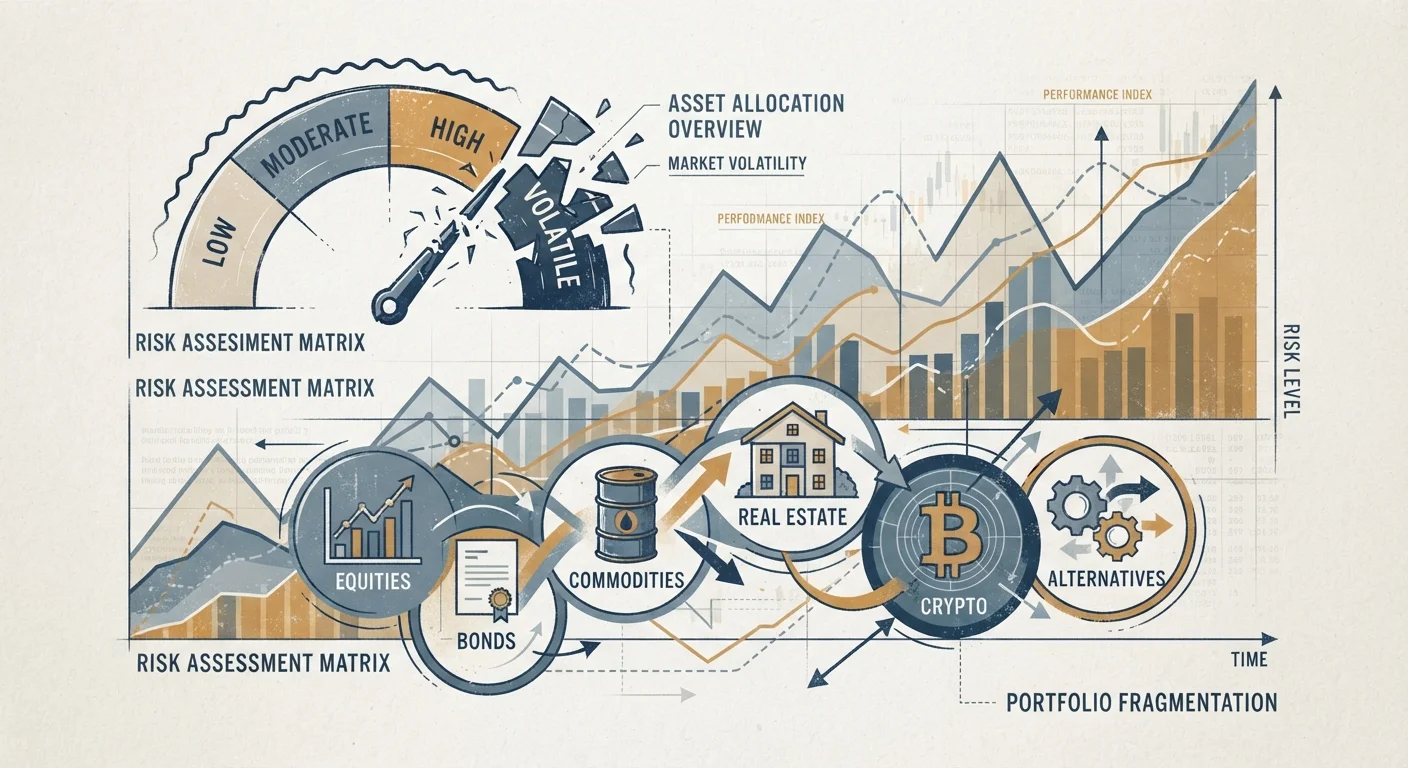
Photo credit: NewBizBuzz.net | Financial Insights For All
In this article
Investors often misjudge asset class risk by focusing on the wrong signals. These are the analytical errors most likely to skew portfolio decisions.
Key Takeaways
- Volatility alone does not capture the full risk picture of any asset class.
- Correlation assumptions often break down precisely when diversification is needed most.
- Recency bias causes investors to anchor risk expectations to recent market conditions, not long-term norms.
- Liquidity risk is frequently overlooked until a stress event forces an untimely exit.
- Understanding the structural role of each asset class matters as much as its standalone return history.
Why Risk Perception Fails Before a Single Trade Is Made
Risk assessment errors rarely look like errors at the time they occur. They surface instead as confident allocations built on incomplete analysis — portfolios that appear diversified, instruments that seem safe, and return assumptions that feel grounded in data. The problem is that the data is being read through a distorted lens.
The most consequential analytical mistakes tend to cluster around how investors define and measure risk for each asset class. Volatility metrics, correlation tables, and yield figures are all useful tools, but each one captures only a partial picture. When investors treat a partial picture as a complete one, their risk perception drifts — sometimes dangerously far from reality.
This article identifies the most common reading errors across asset classes and explains the precise analytical adjustments that correct them. For context on how these mistakes connect to broader portfolio-level decisions, see portfolio construction myths that mislead new investors.
Risk Assessment Is Not One-Size-Fits-All
Each asset class carries distinct risk dimensions — credit risk, liquidity risk, duration risk, currency risk, and volatility — that interact differently under various market conditions. Evaluating any asset using a single lens, such as annualized standard deviation alone, routinely produces a distorted picture. Consult a qualified financial adviser before making portfolio decisions based on risk assessments of any asset class.
The Most Common Asset Class Reading Errors
Across equities, fixed income, alternatives, and digital assets, a consistent set of analytical blind spots drives distorted risk perception. Understanding each one — including why it occurs and how to correct it — is the foundation of more accurate portfolio decision-making.
Treating price volatility as a complete measure of risk.
Why it happens: Standard deviation is widely taught and easily calculated, which leads investors to default to it as a proxy for all risk. This works reasonably well for liquid, normally distributed return streams but misses tail risk, drawdown duration, and structural vulnerabilities.
Assuming historical correlations will hold during a market crisis.
Why it happens: Correlations are typically measured across full market cycles, making assets appear more diversifying than they are. Investors then build portfolios assuming steady relationships that can collapse under stress.
Anchoring risk expectations to a recent low-volatility period.
Why it happens: Recency bias causes investors to extrapolate from the most familiar conditions. A multi-year period of suppressed volatility — in equities or credit — can create false confidence that an asset is structurally safer than its long-run history shows.
Underestimating liquidity risk in alternative and private asset classes.
Why it happens: Investors compare expected returns of private credit, real estate, or private equity against public market benchmarks without fully pricing in the illiquidity premium they are implicitly accepting. The risk only becomes visible when capital needs to be accessed quickly.
Evaluating fixed income purely on yield without accounting for duration risk.
Why it happens: Yield is the most visible number in bond investing, so investors naturally focus on it. Duration — the sensitivity of a bond's price to interest rate changes — is less intuitive and therefore frequently underweighted in risk assessments.
Misclassifying an asset's portfolio role based on its label rather than its behavior.
Why it happens: Investors often assume that all bonds provide stability, all equities offer growth, and all commodities hedge inflation. These generalizations break down at the sub-asset class level and during atypical cycles.
0.76
US equity–bond correlation during 2022 drawdown
During the 2022 rate-shock sell-off, the correlation between US equities and investment-grade bonds turned sharply positive, undermining the traditional diversification assumption for balanced portfolios.
~30%
Private equity allocation lacking liquidity modeling
Industry surveys have consistently found a significant share of retail-facing alternative fund investors do not formally model the liquidity horizon of their illiquid allocations against anticipated cash needs.
These errors are not limited to inexperienced investors. Recency bias, anchoring on familiar metrics, and underpricing illiquidity are patterns that appear consistently even among investors with substantial market experience. Related patterns in technical analysis are explored in misreading trend signals, while valuation-specific blind spots are covered in valuation errors that distort investment decisions.
For investors in digital assets, where volatility and structural risks are particularly pronounced, early crypto errors that cost new investors offers a practical inventory of category-specific pitfalls. The behavioral dimension of these mistakes is examined in depth in chasing high returns without understanding the downside.
This article is for general informational and educational purposes only and does not constitute personalized financial, investment, tax, or legal advice. All investing involves risk, including the possible loss of principal. Past performance does not guarantee future results. Consult a qualified financial adviser before making decisions about your own portfolio.

Author
Investing Fundamentals Editorial Team
Investing Fundamentals Editorial Team is the collective byline for our editorial team and contributor network. Articles published under this byline or an editorial pen name are researched, written, and reviewed according to our editorial standards for clarity, consistency, and independence before publication.
View all articles →