
Agreed Value, Actual Cash Value, and Replacement Cost: What the Difference Costs You
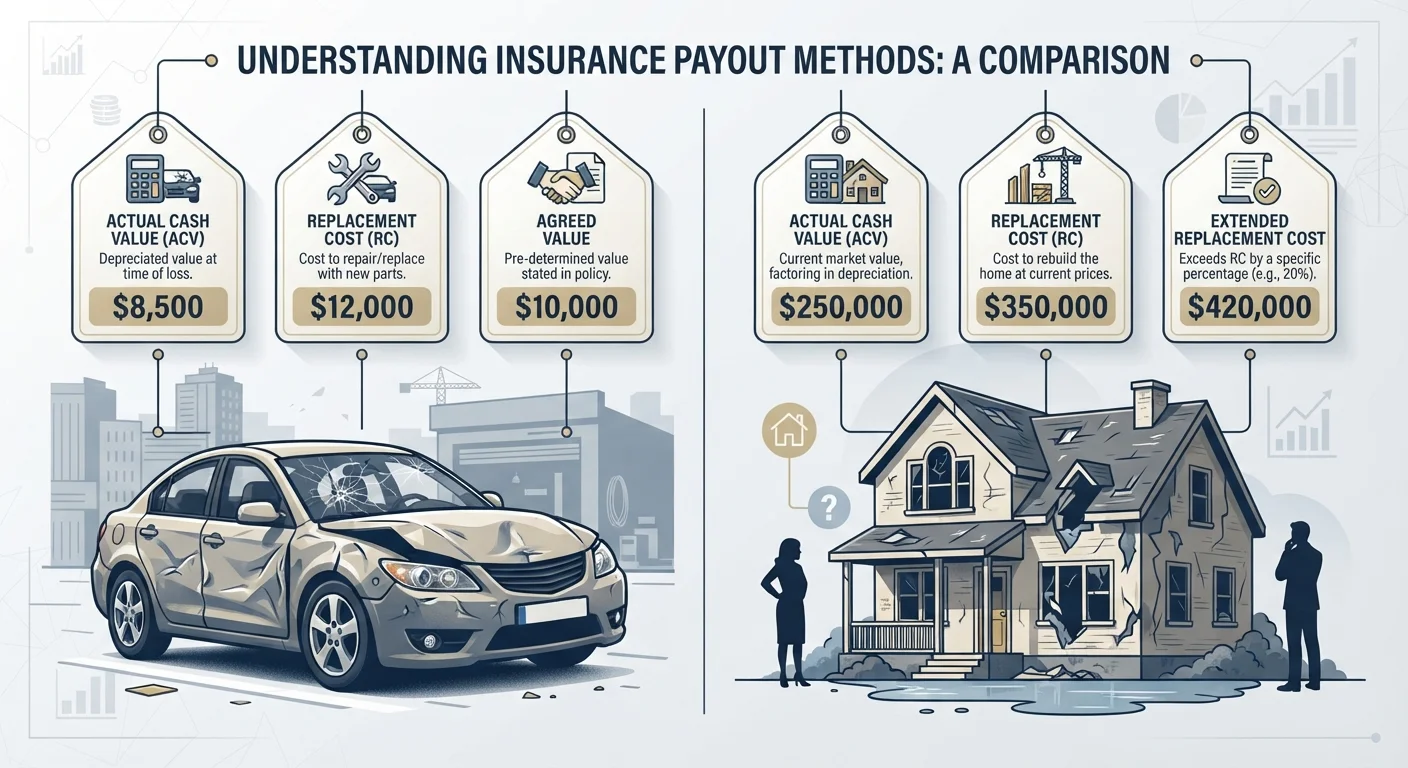
Photo credit: NewBizBuzz.net | Financial Insights For All
In this article
The valuation method in your policy determines your payout. Here's how each approach works and what it means for your financial recovery after a loss.
Key Takeaways
- Actual Cash Value pays what your asset is worth today, after depreciation — often significantly less than replacement cost.
- Replacement Cost coverage reimburses you for what it costs to buy a comparable new item, without a depreciation deduction.
- Agreed Value locks in a payout figure at policy inception, eliminating depreciation disputes — common in classic car and specialty coverage.
- The valuation method you choose directly affects your premium and your financial recovery after a covered loss.
- Reading your declarations page carefully reveals which method applies to each covered item in your policy.
Why Valuation Method Is the Most Important Clause in Your Policy
Most policyholders focus on coverage limits and deductibles when shopping for insurance. Those numbers matter — see our overview of deductibles, premiums, and copays for how they interact — but the valuation method buried deeper in the policy is what actually governs your payout after a loss.
Valuation method refers to the formula an insurer uses to calculate what it owes you when a covered asset is damaged or destroyed. Three methods dominate the US market: Actual Cash Value (ACV), Replacement Cost Value (RCV), and Agreed Value. Each can produce dramatically different settlement figures for the identical loss event.
~40%
Depreciation applied to aging roofs in ACV claims
Industry claims data indicates insurers commonly apply 35–50% depreciation to roofs over 10 years old when settling on an ACV basis.
10–20%
Typical premium increase for Replacement Cost over ACV
Insurance industry analyses generally find Replacement Cost homeowners policies carry a 10–20% premium above comparable ACV policies, though variation by market is significant.
Actual Cash Value: The Depreciation Gap
Actual Cash Value is calculated as replacement cost minus depreciation. Depreciation accounts for an asset's age, wear, and obsolescence. The practical result: the older your property, the less an ACV policy pays.
For example, if a five-year-old roof costs $20,000 to replace and the insurer determines it has depreciated by 40%, your ACV settlement is $12,000 — leaving an $8,000 gap you fund out of pocket. The same math applies to personal property, vehicles, and equipment.
ACV policies carry lower premiums, which is why they are common in standard renters and auto insurance. But the depreciation gap can be substantial enough to derail financial recovery after a major loss. Understanding how insurers price that risk is covered in our guide to insurer risk assessment.
ACV Gaps Can Exceed Your Deductible
Many policyholders focus only on their deductible when estimating out-of-pocket costs after a claim. On an ACV policy, the depreciation withheld can dwarf the deductible itself — particularly for structural components like roofing, HVAC systems, or older personal property. Factor this into your financial recovery planning before a loss occurs, not after.
Replacement Cost Value: Closing the Gap
Replacement Cost Value reimburses you for the cost of replacing the damaged property with a new item of like kind and quality, with no deduction for depreciation. For a homeowner, this means the insurer funds rebuilding at current construction costs. For a renter, it means replacing a three-year-old laptop with a comparable new model.
Many RCV policies operate on a two-step payment schedule: the insurer pays ACV first, then releases the withheld depreciation (called recoverable depreciation) once you document that you have actually repaired or replaced the item. Failing to complete repairs can mean forfeiting that second payment.
RCV coverage typically costs 10–20% more in premium than an equivalent ACV policy, though the differential varies by asset type, insurer, and location. For high-value or hard-to-replace assets, that premium difference is often worth examining carefully.
Agreed Value: Locking In the Number Upfront
Agreed Value coverage works differently from both ACV and RCV. At policy inception, you and the insurer agree on a specific dollar value for the insured asset — often supported by an independent appraisal. If the asset is declared a total loss, the insurer pays that agreed amount, period. No depreciation calculation. No dispute over market value.
This method is most common for assets where standard depreciation models break down: classic and collector vehicles, fine art, musical instruments, antiques, and certain commercial equipment. A classic car that has appreciated in value, for instance, would be severely undercompensated under ACV.
Agreed Value requires an upfront appraisal (with associated cost) and periodic reappraisal to keep the insured value current. It also typically carries higher premiums, reflecting the insurer's commitment to a fixed payout. For a deeper look at what happens when a total loss is declared, see our guide to total loss settlements.
| Actual Cash Value | Replacement Cost Value | Agreed Value | |
|---|---|---|---|
| Depreciation deducted? | Yes — fully deducted | No deduction | Not applicable |
| Payout basis | Current market value of asset | Cost to replace with new equivalent | Pre-agreed fixed amount |
| Typical premium level | Lower | Moderate to higher | Higher (plus appraisal cost) |
| Out-of-pocket gap risk | High for older assets | Low if repairs completed | None on total loss |
| Common asset types | Autos, older property | Homes, renters, businesses | Classic cars, art, antiques |
| Dispute risk at claims time | Moderate (depreciation method) | Low to moderate | Very low — value pre-set |
Check Your Declarations Page First
Your policy's declarations page lists the valuation method applied to each coverage category. Don't assume it matches what an agent described verbally — the written policy controls. If you find ACV where you expected Replacement Cost, contact your insurer before your next renewal to discuss an endorsement or policy change.
Choosing the Right Method for Your Situation
The valuation method that makes sense depends on three factors: the nature of the asset, your financial capacity to absorb a shortfall, and your premium budget.
- Standard home and renters coverage: Replacement Cost is generally the stronger protection for primary residences and everyday belongings, where rebuilding or replacing at today's prices is the realistic recovery goal.
- Older vehicles: ACV is standard for auto comprehensive and collision. As a vehicle ages and its market value falls, the gap between ACV and what you need to replace it narrows — but it does not disappear.
- Specialty and appreciating assets: Agreed Value is the most reliable method when market value is subjective or rising, and when a claims dispute over valuation would be costly and time-consuming.
The gap between ACV and Replacement Cost can be substantial — reviewing your declarations page to confirm which method applies to each category of property is a practical first step before your next renewal.
This article is for general informational purposes only and does not constitute personalized insurance, financial, or legal advice. Coverage terms, valuation methods, and claim outcomes vary by policy, provider, and state. Always read your policy documents carefully and consult a licensed insurance agent or adviser for guidance specific to your situation.

Author
Insurance Explained Editorial Team
Insurance Explained Editorial Team is the collective byline for our editorial team and contributor network. Articles published under this byline or an editorial pen name are researched, written, and reviewed according to our editorial standards for clarity, consistency, and independence before publication.
View all articles →