
Debt Snowball vs Debt Avalanche: Two Repayment Philosophies Compared
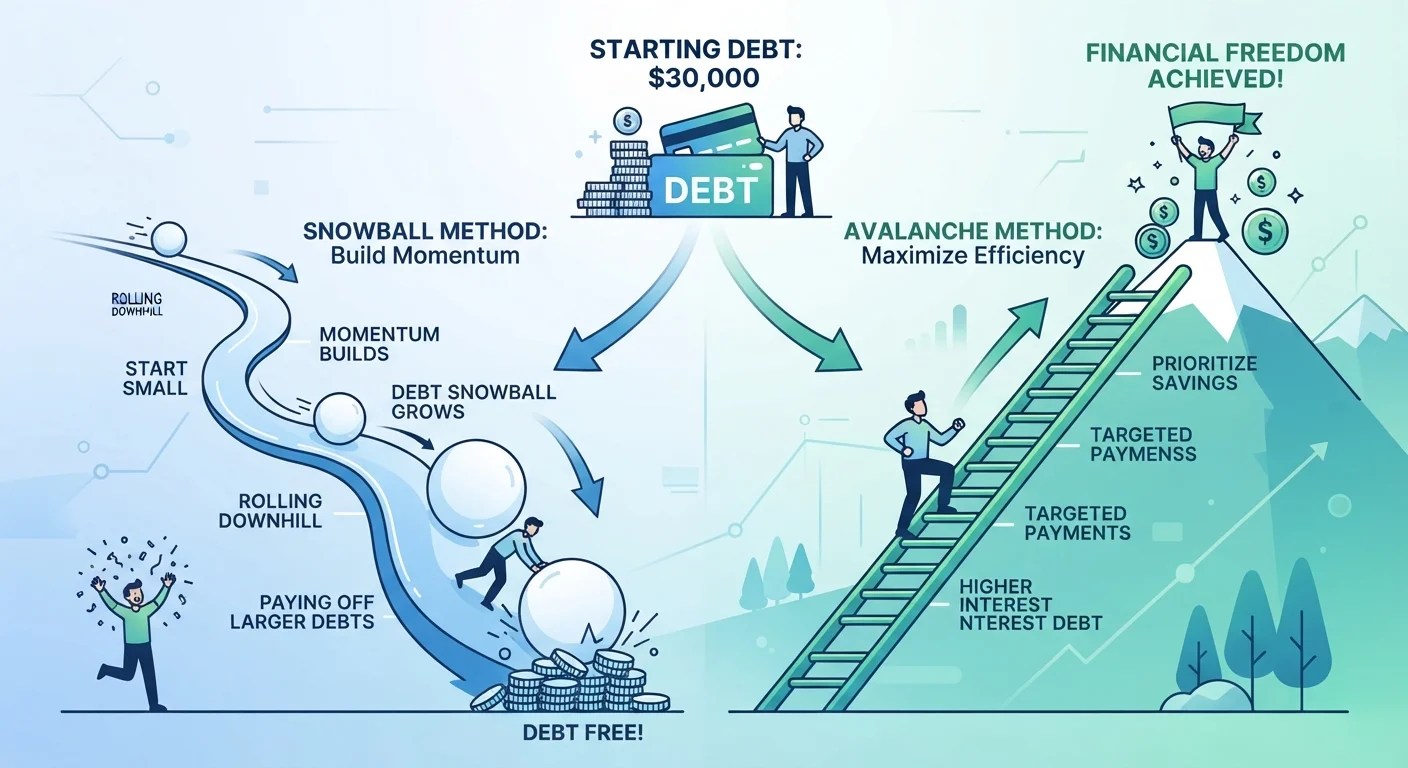
Photo credit: NewBizBuzz.net | Financial Insights For All
In this article
The snowball and avalanche methods both pay down debt—but they prioritise very differently. See which approach fits your situation.
Key Takeaways
- The debt snowball method prioritises smallest balances first, generating early psychological wins.
- The debt avalanche method targets highest-interest debt first, minimising total interest paid over time.
- Neither method is universally superior — the best choice depends on your financial profile and motivation style.
- Both strategies require paying more than the minimum on the targeted debt while maintaining minimums elsewhere.
- Consistency matters more than method: any structured repayment plan outperforms no plan.
How Each Method Works
Both the debt snowball and debt avalanche share a common structure: you make minimum payments on all debts, then direct any extra funds toward one priority debt. Where they diverge is in how that priority is determined.
Debt Snowball: You rank your debts from smallest to largest balance — interest rate is irrelevant at this stage. All surplus funds attack the smallest balance first. Once it's eliminated, you roll that payment amount onto the next smallest, building momentum as each account closes.
Debt Avalanche: You rank debts by APR from highest to lowest. Extra payments target the most expensive debt first. As each high-rate balance is cleared, the freed-up payment amount moves to the next highest-rate account.
The mechanics of payment redirection are identical — only the ordering logic differs. If you're also evaluating debt consolidation tools, see our comparison of balance transfer cards vs. personal loans as complementary strategies.
| Debt Snowball | Debt Avalanche | |
|---|---|---|
| Prioritisation logic | Smallest balance first | Highest APR first |
| Total interest paid | Typically higher | Typically lower |
| Speed of first payoff | Faster (smaller debts close sooner) | Slower if top-rate debt is large |
| Psychological motivation | High — frequent early wins | Moderate — wins are financial, less visible |
| Best for | Motivation-driven borrowers | Mathematically focused borrowers |
| Complexity | Low | Low to moderate |
The Numbers: Interest Savings and Payoff Timeline
The avalanche method wins on pure arithmetic. By eliminating high-APR balances first, you reduce the principal on which interest compounds most aggressively. Over a multi-year repayment journey, this can translate to hundreds or even thousands of dollars in avoided interest charges — a gap that widens with higher balances and rates.
The snowball method's trade-off is that it may leave high-rate balances accruing interest longer. However, this cost is not always as large as it appears in simplified illustrations. When balances are similar in size, the two methods may produce comparable total interest costs. The meaningful divergence appears when a borrower carries a small, low-rate balance alongside a large, high-rate one.
~$1,200+
Potential interest savings with avalanche vs. snowball
Consumer finance modelling suggests the gap widens significantly when high-rate balances exceed $5,000 at APRs above 20%.
20%+
Average APR on revolving credit card debt in the US
Federal Reserve data has shown average credit card rates exceeding 20% in recent rate environments, underscoring the cost of delayed paydown on high-rate accounts.
It's also worth noting that paying only minimum amounts on any debt dramatically amplifies total cost — a dynamic explored in depth in our article on the minimum payment trap.
The Psychology of Debt Repayment
Behavioural finance research consistently demonstrates that adherence to a plan depends as much on motivation as on its mathematical optimality. The snowball method was designed around this insight: closing an account — regardless of its size — creates a concrete sense of progress that reinforces continued effort.
For borrowers managing five or six accounts, eliminating even a small balance reduces mental load and simplifies the monthly payment landscape. This is not trivial. Debt fatigue — the discouragement that sets in when progress feels invisible — is one of the most common reasons structured repayment plans stall.
Track Progress in a Format That Motivates You
Snowball users benefit from a visual checklist of accounts to cross off. Avalanche users often find it more motivating to track a running total of interest saved rather than watching a large balance decrease slowly. Choose a tracking format that makes your progress tangible and review it monthly to reinforce the habit.
The avalanche requires patience. Progress is measured in interest savings that aren't always visible month-to-month, particularly when the highest-rate debt also carries a large balance. Borrowers who choose this method should track cumulative interest savings explicitly to maintain a sense of momentum.
If broader misconceptions about debt are shaping your approach, our article on common debt myths addresses several that can quietly undermine financial progress.
Choosing the Right Method — and Starting
Before selecting a method, list every debt with its current balance, minimum payment, and APR. This inventory is essential regardless of which approach you choose. From there, the decision framework is relatively straightforward:
- If your highest-rate debt also carries one of your smaller balances, the two methods may largely coincide — start with avalanche.
- If you have struggled to maintain repayment plans in the past or find the payoff timeline discouraging, the snowball's early closures may be more sustainable for you.
- If you carry several debts at similar interest rates, balance size becomes a reasonable tiebreaker either way.
Working with limited income doesn't disqualify either method — it simply requires more precise budgeting. Our practical guide to getting out of debt on a tight budget outlines how to build a repayment structure even when surplus cash is thin.
Ultimately, both methods represent disciplined alternatives to unstructured minimum payments. The difference in total cost between the two is often smaller than the difference between using either method and using neither.
This article is for general informational purposes only and does not constitute personalised financial, tax, or legal advice. Readers should consult a qualified financial adviser before making decisions about their own debt repayment strategy.

Author
Credit & Lending Editorial Team
Credit & Lending Editorial Team is the collective byline for our editorial team and contributor network. Articles published under this byline or an editorial pen name are researched, written, and reviewed according to our editorial standards for clarity, consistency, and independence before publication.
View all articles →