
What the Cash Flow Statement Reveals That Other Reports Don't
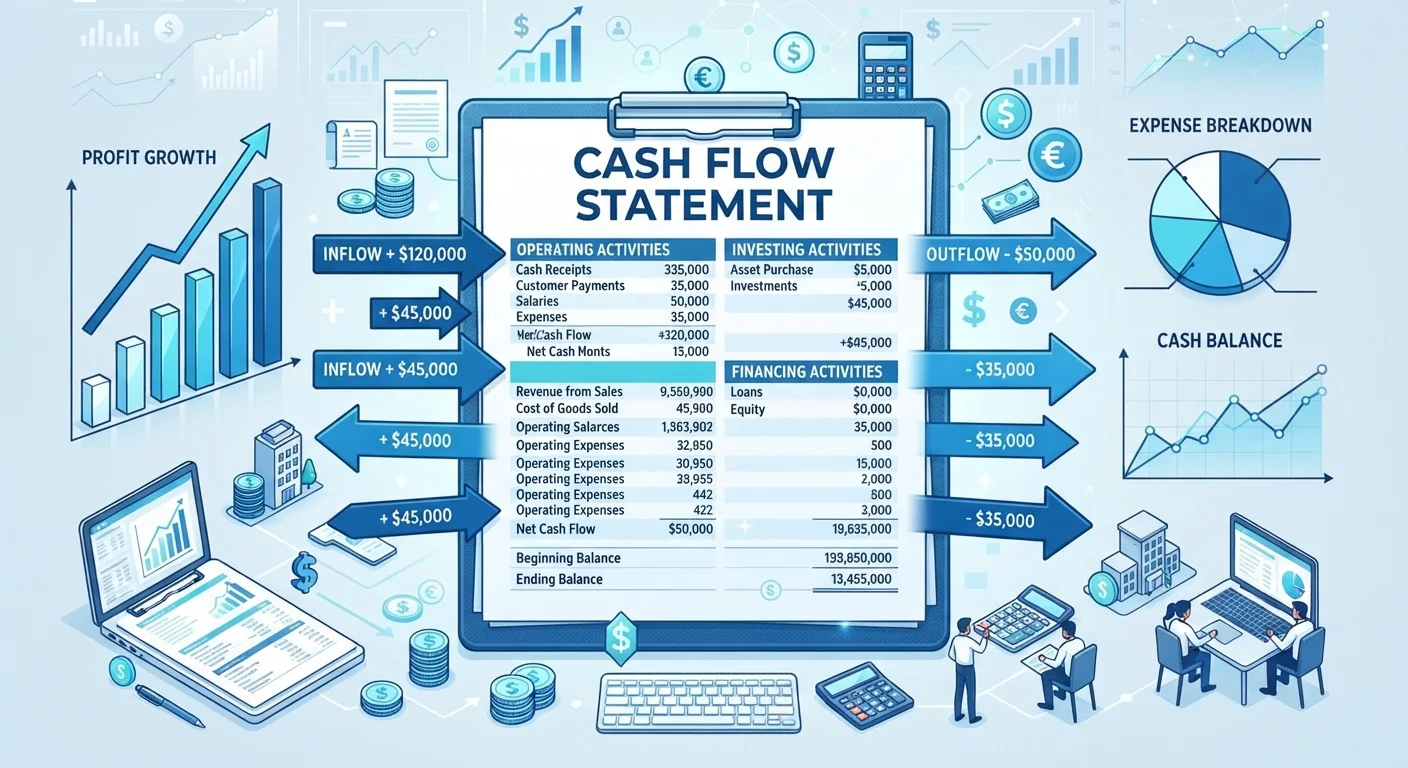
Photo credit: NewBizBuzz.net | Financial Insights For All
In this article
Explore how cash flow statements track operating, investing, and financing activities — and why a profitable business can still run out of cash.
Key Takeaways
- A business can report strong net income and still run out of cash — the cash flow statement explains why.
- Operating cash flow reveals whether core business activities actually generate real dollars.
- Investing activities show how aggressively a company is deploying capital for growth.
- Financing activities expose reliance on debt or equity to fund operations.
- Comparing cash flow to net income is one of the most useful checks on earnings quality.
Why the Cash Flow Statement Exists
The income statement answers whether a business is profitable. The balance sheet answers what the business owns and owes. But neither report tells you the one thing that determines short-term survival: does the company have enough cash to pay its bills today?
That is the job of the cash flow statement. Because most businesses use accrual accounting — recording revenue when earned and expenses when incurred, regardless of when cash actually moves — reported profit and actual cash on hand can diverge significantly. The cash flow statement exists to close that gap.
For a deeper look at how all three reports connect, see what each core financial statement reveals.
82%
Of small business failures tied to cash flow problems
According to U.S. Bank research cited broadly in small business literature, the majority of business failures stem from poor cash flow management rather than lack of profitability.
3 Sections
Operating, investing, and financing activities
Under both U.S. GAAP and IFRS, the statement of cash flows is required to present cash movements across these three standardized categories.
Indirect
Method used by most public companies
The vast majority of U.S. public companies use the indirect method to present operating cash flows, reconciling from net income rather than listing individual cash transactions.
The Three Sections and What Each Exposes
The statement is organized into three distinct activities, each probing a different dimension of financial behavior.
Operating Activities
This section captures cash generated or consumed by the company's core business — collecting from customers, paying suppliers, covering payroll, and managing working capital. Healthy, mature businesses typically show strong, positive operating cash flow consistently. When operating cash flow lags far behind net income, it raises questions about earnings quality, specifically whether reported profits are real or inflated by favorable accrual timing.
Investing Activities
This section records cash spent acquiring or selling long-term assets — property, equipment, or other businesses. Sustained negative investing cash flow is often a sign of healthy capital reinvestment in growth; however, it should be funded by operating cash generation, not perpetually by borrowing. Asset sales that generate positive investing cash flow warrant scrutiny: are they a sign of strategic portfolio management or a cash-flow lifeline masking operating weakness?
Financing Activities
Financing activities track cash flowing between the company and its capital providers — debt issuance and repayment, equity raises, and dividend payments. Heavy reliance on financing inflows to cover operating shortfalls is a warning sign. It suggests the business cannot self-fund its own operations and depends on external capital to stay solvent.
The Profit-Cash Gap: Why It Matters
The most important insight the cash flow statement delivers is this: profit and cash are not the same thing. A company can record millions in net income while its bank account dwindles. This happens routinely through mechanisms including:
- Accounts receivable growth — Revenue is recognized when invoiced, but cash only arrives when paid. Rapid receivables growth inflates income without adding cash.
- Inventory buildup — Cash spent building inventory is an expense on the balance sheet, not the income statement, until goods are sold.
- Depreciation reversal — Depreciation reduces net income without consuming cash, which is why it is added back under the indirect method.
Understanding this divergence is foundational to evaluating any business. Explore why cash flow and net income diverge — and what that gap signals to investors.
“Revenue is vanity, profit is sanity, but cash is reality. The cash flow statement is where financial reality lives.”
— Warren Buffett, Chairman and CEO, Berkshire Hathaway — paraphrased from widely attributed commentary on cash flow importance in business valuation
Using Cash Flow Data in Financial Analysis
Analysts and investors frequently derive free cash flow (FCF) from the statement: operating cash flow minus capital expenditures. FCF represents what remains after maintaining the asset base — the cash available for debt repayment, dividends, buybacks, or reinvestment. Consistent FCF generation is widely regarded as a hallmark of business quality.
Common analytical checks using the cash flow statement include comparing operating cash flow to net income over several periods, assessing whether capital expenditure is maintenance-level or growth-oriented, and examining whether financing inflows are propping up operating deficits.
For a structured approach to incorporating these checks before making investment decisions, see how to build a financial statement analysis routine. And to go deeper into reading each section of the statement in practice, the step-by-step guide to interpreting cash flow statements walks through the specific questions each section should prompt.
Compare Cash Flow to Net Income Over Time
A single year's divergence between operating cash flow and net income may reflect normal timing differences. A persistent multi-year gap — where net income consistently exceeds operating cash flow by a wide margin — is a more significant signal that warrants deeper investigation into receivables, inventory management, or the quality of reported earnings.
This article is for general informational and educational purposes only and does not constitute personalized financial, investment, accounting, or tax advice. Readers should consult a qualified financial adviser or CPA for guidance specific to their circumstances.
Frequently Asked Questions

Author
Accounting & Tax Editorial Team
Accounting & Tax Editorial Team is the collective byline for our editorial team and contributor network. Articles published under this byline or an editorial pen name are researched, written, and reviewed according to our editorial standards for clarity, consistency, and independence before publication.
View all articles →