
Inflation, Market Crashes, and Currency Devaluation: Mapping the Real Threats to Accumulated Wealth
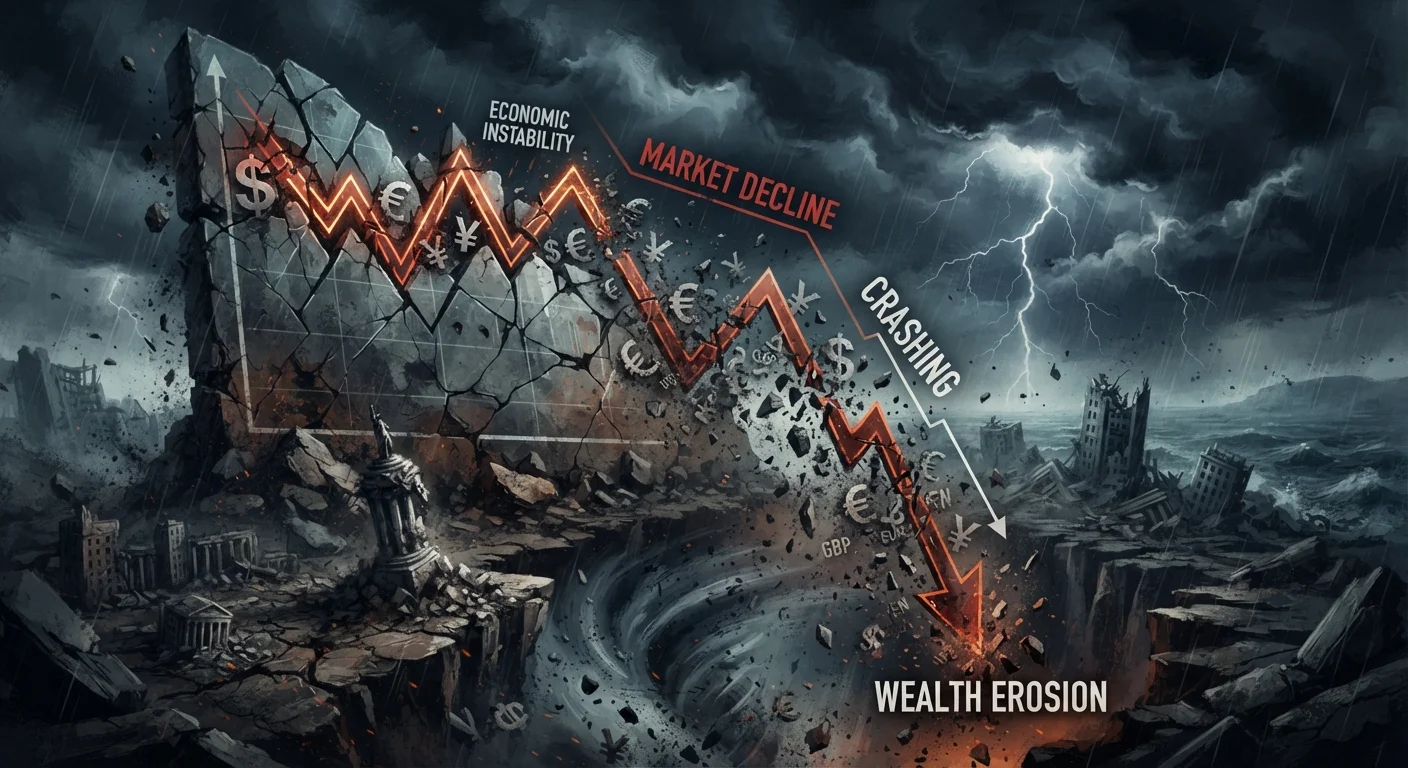
Photo credit: NewBizBuzz.net | Financial Insights For All
In this article
A clear-eyed look at the economic forces most likely to erode wealth over time and how each operates differently on a portfolio.
Three Distinct Threats, Three Distinct Mechanisms
Wealth erosion rarely arrives as a single catastrophic event. More often, it is the slow, compounding work of forces that operate quietly across different dimensions of a portfolio. Understanding how inflation, market crashes, and currency devaluation each function — and how they differ — is the foundation of any credible defensive strategy.
| Primary mechanism — Inflation | Erodes purchasing power of money and fixed-income assets over time |
| Primary mechanism — Market Crash | Rapidly destroys nominal asset values through price compression and panic selling |
| Primary mechanism — Currency Devaluation | Reduces domestic purchasing power and distorts cross-border asset returns |
| Speed of impact | Inflation: slow/chronic; Market crash: acute; Currency: variable |
| Most exposed assets — Inflation | Cash, fixed-rate bonds, long-duration fixed-income instruments |
| Most exposed assets — Market Crash | Concentrated equities, leveraged positions, illiquid holdings |
| Most exposed assets — Currency Devaluation | Domestic cash savings, unhedged foreign equity holdings |
These threats are not mutually exclusive. Historically, they have appeared in sequence or simultaneously, amplifying each other's damage. A currency crisis, for instance, can accelerate domestic inflation while also triggering equity market sell-offs. Recognizing their interdependence is as important as understanding each in isolation.
For a comprehensive walkthrough of defensive frameworks, see our wealth protection strategies guide.
Inflation: The Silent Compounding Tax
Inflation reduces the purchasing power of money over time. At a sustained 3% annual rate, the real value of a dollar-denominated asset falls by roughly half over 24 years — without a single market event occurring. For wealth holders, this is not merely a macroeconomic abstraction; it is a direct drag on net worth expressed in constant dollars.
Real Return
The investment return after adjusting for inflation. A nominal gain of 5% with 3% inflation produces a real return of approximately 2%. Real return is the more meaningful measure of whether purchasing power is growing.
Sequence-of-Returns Risk
The danger that poor investment returns occur at the wrong time — particularly early in retirement — forcing asset sales at depressed prices. Even if long-run average returns recover, early losses can permanently reduce a portfolio's longevity.
Currency Devaluation
A decline in a currency's value relative to other currencies or a basket of goods. It increases the cost of imports, erodes domestic purchasing power, and affects the dollar-translated value of foreign investments.
Purchasing Power Parity (PPP)
An economic theory holding that, over time, exchange rates should adjust so that identical goods cost the same in different countries. It is commonly used as a benchmark for assessing whether a currency is overvalued or undervalued.
Drawdown
The peak-to-trough decline in a portfolio's value over a specific period. A 40% drawdown requires a subsequent 67% gain just to return to the previous peak, illustrating the asymmetric mathematics of loss recovery.
Fixed-income portfolios are particularly exposed: a bond paying a nominal 4% yield delivers a real return of just 1% when inflation runs at 3%, and negative real returns when inflation exceeds the coupon. Cash and cash equivalents face the same erosion. Equity holdings can provide partial inflation hedges over long horizons, but their real returns during inflationary spikes can be highly variable and are never guaranteed.
Tangible assets have historically offered more reliable inflation linkage. Our companion article on hard assets and commodities as wealth preservation vehicles examines their role and risk profiles in detail.
Market Crashes: Sequence Risk and Concentrated Exposure
Equity market crashes operate differently from inflation. Rather than gradually eroding purchasing power, they can destroy nominal portfolio values rapidly — sometimes by 30–50% within months. The 2008–2009 financial crisis and the early-2020 pandemic drawdown both illustrated how swiftly asset values can contract when credit conditions tighten and sentiment reverses.
~50%
S&P 500 peak-to-trough decline, 2008–2009 financial crisis
The S&P 500 fell approximately 57% from its October 2007 peak to its March 2009 trough, one of the steepest drawdowns in modern market history.
~67%
Gain required to recover from a 40% portfolio drawdown
Loss recovery is mathematically asymmetric: a 40% loss requires a 67% subsequent gain to restore the original portfolio value, illustrating why capital preservation matters.
~50%
Purchasing power lost at 3% inflation over 24 years
At a sustained 3% annual inflation rate, the real purchasing power of a fixed nominal amount halves in approximately 24 years, per standard compound interest mathematics.
Two factors determine how severely a crash affects a specific portfolio: concentration and timing. Portfolios concentrated in a single sector, asset class, or individual security face asymmetric downside risk. The risks of concentrated stock positions deserve particular scrutiny — a position that has performed strongly can reverse dramatically when conditions shift.
Timing matters especially for wealth holders approaching or in distribution phases. Selling depreciated assets to fund living expenses — known as sequence-of-returns risk — can permanently impair a portfolio's ability to recover, even when markets eventually rebound. Crashes also tend to expose structural weaknesses that were invisible during bull markets, a dynamic examined in depth in our article on how economic downturns expose weaknesses in wealth protection plans.
Currency Devaluation: The Cross-Border Dimension
Currency devaluation is the most globally interconnected of the three threats. When a domestic currency loses value relative to trading partners, import costs rise, purchasing power shrinks for internationally priced goods, and USD-denominated debt held by foreign entities becomes more expensive to service. For US-based investors, dollar weakness erodes the real value of domestic cash holdings and can reduce the purchasing power of retirement income against imported goods and services.
Currency risk also flows in the opposite direction for internationally diversified portfolios. Holdings in foreign equities or bonds generate returns denominated in foreign currencies; if those currencies weaken against the dollar, the dollar-translated return shrinks even when the underlying asset performs well in local terms. Hedging currency exposure adds cost and complexity, and imperfect hedges can themselves introduce new risks.
Understanding how these forces combine over a wealth-building lifecycle connects directly to core wealth growth strategies and, eventually, to wealth transfer planning, where currency and inflation assumptions must be embedded in long-horizon projections.
These Threats Often Arrive Together
History shows that inflation, market stress, and currency weakness frequently overlap rather than occur in isolation. The 1970s stagflation era combined high inflation with stagnant equity markets and significant dollar weakness simultaneously. Defensive planning that accounts for only one threat at a time may leave meaningful gaps in overall wealth protection. A licensed financial adviser can help model multi-threat scenarios specific to your situation.
This article is for general informational and educational purposes only and does not constitute personalized financial, investment, tax, or legal advice. Individual circumstances vary; consult a qualified financial adviser, accountant, or attorney before making decisions about your own portfolio.

Author
Wealth Management Editorial Team
Wealth Management Editorial Team is the collective byline for our editorial team and contributor network. Articles published under this byline or an editorial pen name are researched, written, and reviewed according to our editorial standards for clarity, consistency, and independence before publication.
View all articles →