
Compounding Explained: Why Time Is the Most Powerful Variable in Wealth Building
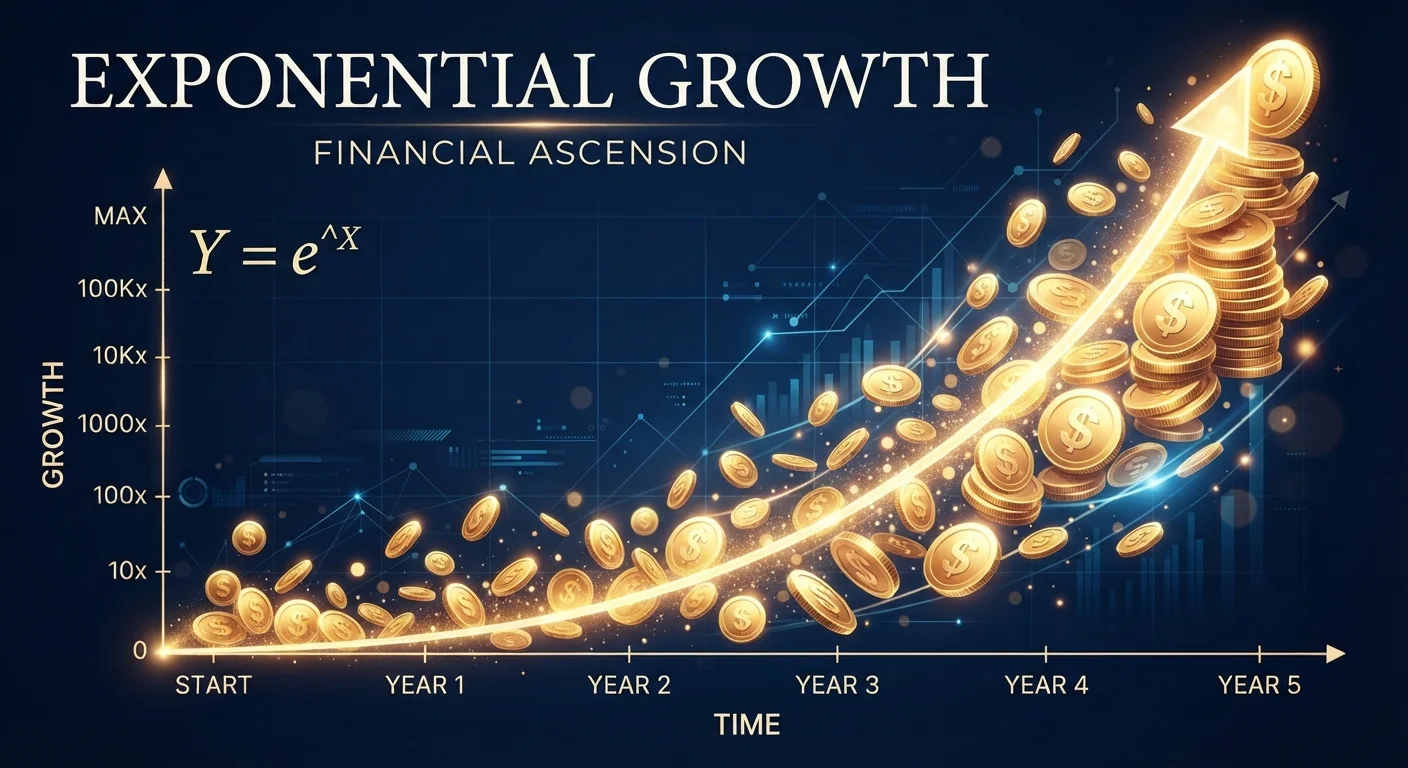
Photo credit: NewBizBuzz.net | Financial Insights For All
In this article
Understand how compound growth works, why starting early matters, and how the mathematics of compounding shapes long-term net worth.
Key Takeaways
- Compounding generates returns on previously earned returns, producing exponential rather than linear growth.
- Time in the market is the single most powerful lever available to a long-term investor.
- Starting a decade earlier can outperform a larger but later investment, even with identical rates of return.
- Fees, taxes, and inflation all compound negatively — they erode principal in the same exponential way.
- Consistent reinvestment of returns, not market timing, is what sustains compounding over the long run.
The Mathematics Behind the Multiplier
At its core, compounding is simple: you earn a return, that return is added to your base, and your next period's return is calculated on the larger amount. Repeat this thousands of times over decades, and the cumulative effect becomes extraordinary.
Consider a $50,000 portfolio growing at a hypothetical 7% annual return. After 10 years, it reaches roughly $98,000 — nearly double. After 30 years, the same portfolio approaches $381,000, without a single additional dollar contributed. The growth in the final decade alone exceeds the total growth of the first two decades combined. That acceleration is the compounding effect made visible.
The formula A = P(1 + r/n)^(nt) captures this mathematically, but the intuition is what matters most for wealth planning: the base keeps growing, so returns keep landing on larger and larger ground. This is fundamentally different from earning a flat return on an unchanged principal every year.
~$381,000
Value of $50,000 growing at 7% for 30 years
Illustrative calculation using standard compound interest formula; assumes consistent 7% annual return with no withdrawals or additional contributions.
~50%
Reduction in ending balance from a 10-year delay
Illustrative comparison: $10,000 invested at 7% for 40 years vs. 30 years — a 10-year delay roughly halves the final outcome despite identical inputs.
20–25%
Portfolio value lost to a 1% annual fee over 30 years
Estimate based on standard compound interest modeling; exact impact varies by return rate, contribution pattern, and compounding frequency.
Why Time Dominates Rate of Return
Most investors focus on finding higher-returning assets. That instinct is understandable but can distract from an even more powerful variable: how long the capital stays invested.
A straightforward illustration: an investor who contributes $10,000 at age 25 and earns a hypothetical 7% annually will have approximately $149,000 by age 65 — without adding another cent. An investor who waits until age 35 to make the same $10,000 contribution at the same rate ends with roughly $76,000. The 10-year delay costs nearly half the final outcome, despite identical capital and identical returns.
This is why financial educators often describe time as "the eighth wonder of the world" in compounding contexts. Seeking an extra percentage point of return is valuable, but it cannot replace years lost to inaction. For a deeper look at how strategy should adapt across different life phases, see wealth-building priorities by life stage.
“Compound interest is the eighth wonder of the world. He who understands it, earns it; he who doesn't, pays it.”
— Widely attributed to Albert Einstein, This quote, though its true origin is debated by historians, has been widely cited in financial education contexts to underscore the exponential power of compounding over time.
What Compounds Against You
The same exponential logic that grows wealth can also erode it. Three forces compound negatively and deserve sustained attention from any long-term investor.
- Fees: Investment management fees, fund expense ratios, and transaction costs are deducted before returns are reinvested. A seemingly small 1% annual fee, compounded over 30 years, can reduce a portfolio's ending value by roughly 20–25% depending on return assumptions. Keeping costs low preserves more of each gain for the compounding base.
- Taxes: Every taxable realization — a sale, a dividend, a capital gain distribution — reduces the amount available for reinvestment. Understanding tax-efficient structures matters enormously over long horizons. Tax-efficient growth principles can help investors retain more of each compounding cycle.
- Inflation: If nominal returns do not outpace inflation, real purchasing power erodes even when account balances appear to grow. A 7% nominal return in a 3% inflation environment produces a 4% real gain — and that real gain, not the nominal figure, is what determines actual wealth accumulation.
Protecting the compounding base from these three forces is as strategically important as selecting the investments themselves. Wealth protection strategies cover this defensive dimension in depth.
Minimize Compounding Drag Before It Starts
Review the total cost of every investment vehicle you hold — including expense ratios, advisory fees, and trading costs. Even a 0.5% reduction in annual fees can meaningfully increase your ending portfolio balance over a 20–30 year horizon. Tax-deferred and tax-exempt accounts further protect the compounding base by deferring or eliminating taxable realizations.
Compounding in Practice: Consistency Over Perfection
Compounding does not require a lump-sum windfall or market-timing skill. Regular, consistent contributions — regardless of market conditions — allow the mechanism to function continuously. This is precisely why strategies such as dollar-cost averaging complement the compounding principle so well: they keep capital flowing into the market without requiring perfect entry points. See how dollar-cost averaging supports long-term compounding for a closer look at the mechanics.
The most common behavioral barrier to compounding is interruption — withdrawing funds early, pausing contributions during volatility, or reallocating to cash during downturns. Each interruption reduces the base on which future returns are calculated and resets part of the exponential trajectory.
For investors building a comprehensive approach, compounding sits at the center of a broader strategic framework. Building and compounding personal wealth provides an end-to-end reference that integrates compounding with diversification, risk management, and tax planning. The fundamental principle remains consistent: keep capital invested, keep costs low, and let time do the heavy lifting.
This article is for informational and educational purposes only and does not constitute personalized financial, investment, tax, or legal advice. All hypothetical return figures are illustrative only — past performance does not guarantee future results, and all investing involves risk, including the potential loss of principal. Consult a qualified financial adviser before making decisions about your own circumstances.
Frequently Asked Questions

Author
Wealth Management Editorial Team
Wealth Management Editorial Team is the collective byline for our editorial team and contributor network. Articles published under this byline or an editorial pen name are researched, written, and reviewed according to our editorial standards for clarity, consistency, and independence before publication.
View all articles →