
Building Your First Portfolio From the Ground Up
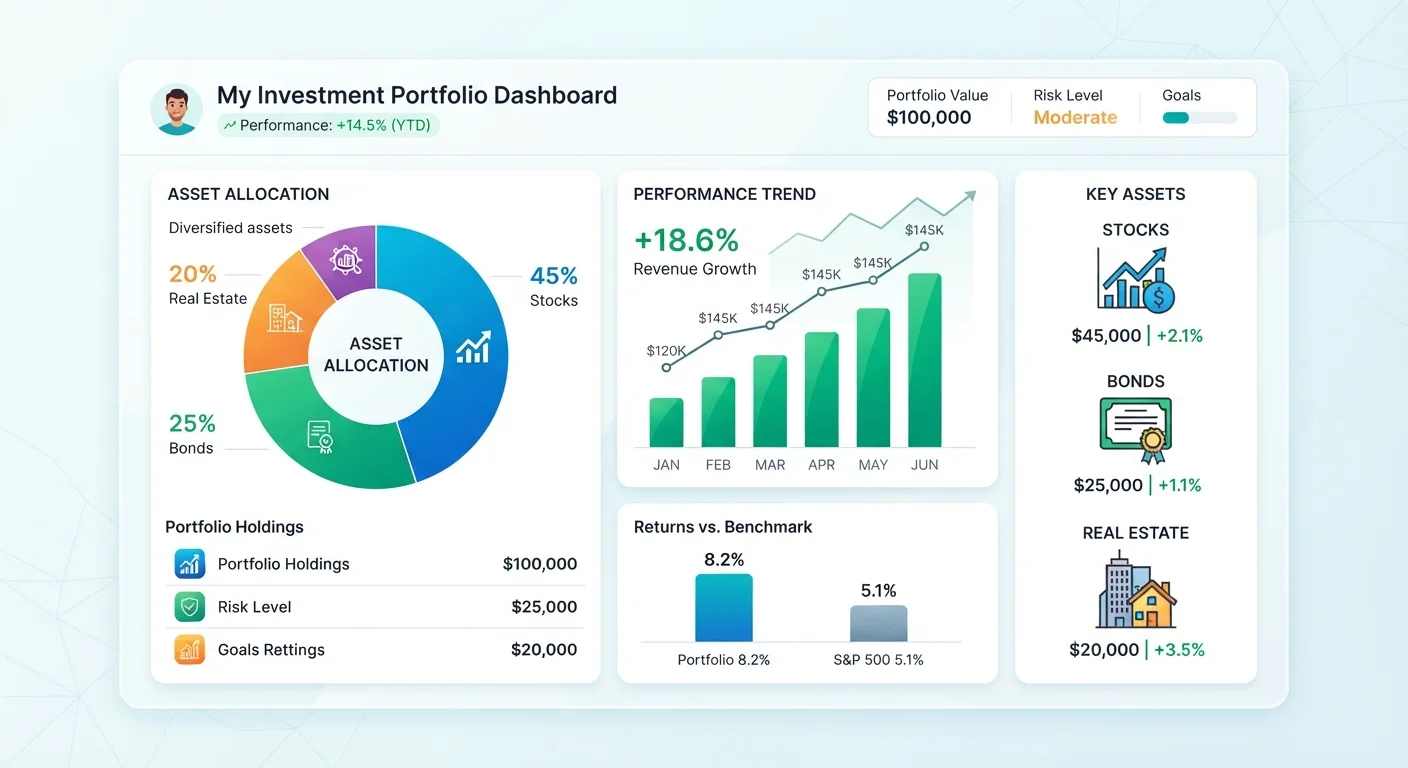
Photo credit: NewBizBuzz.net | Financial Insights For All
In this article
A step-by-step walkthrough of constructing a starter investment portfolio, from choosing asset classes to setting your initial allocation.
Key Takeaways
- Asset allocation — how you divide money across stocks, bonds, and other classes — is the single most consequential portfolio decision.
- Your time horizon and risk tolerance should anchor every allocation choice you make.
- Broad diversification reduces exposure to any single investment's failure without eliminating growth potential.
- Rebalancing periodically restores your intended allocation as markets shift asset values.
- Starting simple with low-cost index funds is a well-established approach for first-time investors.
Why Portfolio Construction Matters From Day One
Most new investors focus intensely on what to buy. Research consistently suggests that the more consequential decision is how to structure the overall portfolio — specifically, how capital is divided across asset classes. Academic work on asset allocation, most notably the Brinson, Hood, and Beebower studies from the 1980s and 1990s, found that the broad allocation policy explained the large majority of a portfolio's return variability over time.
Starting with a deliberate structure rather than a collection of random purchases gives you a framework that scales. It also makes it easier to evaluate performance, stay disciplined during downturns, and make purposeful adjustments as your life circumstances change. For a deeper grounding in how these principles connect, see our comprehensive portfolio construction reference.
This article is for general educational purposes only and does not constitute personalized financial, investment, tax, or legal advice. Please consult a qualified financial adviser before making investment decisions suited to your individual situation.
Understanding the Core Asset Classes
Before allocating capital, you need a working understanding of what you are allocating into. The four primary asset classes most US investors encounter are equities (stocks), fixed income (bonds), cash equivalents, and real assets (such as real estate investment trusts). Each carries a distinct risk-return profile and behaves differently across market cycles.
Asset allocation
The percentage breakdown of a portfolio across broad investment categories such as stocks, bonds, and cash. It is the primary driver of a portfolio's overall risk and return profile.
Diversification
The practice of spreading investments across multiple securities, sectors, and asset classes to reduce the impact of any single holding's poor performance on the overall portfolio.
Time horizon
The length of time you plan to keep money invested before needing to use it. A longer horizon generally allows for more exposure to higher-volatility assets.
Rebalancing
The process of buying or selling holdings to restore a portfolio's actual allocation back to its intended target after market movements have caused it to drift.
Index fund
A fund designed to track the performance of a broad market index, offering wide diversification at generally low cost without requiring active security selection.
Risk tolerance
An investor's capacity and willingness to accept fluctuations in portfolio value in exchange for potential long-term growth. It is shaped by both financial situation and personal temperament.
- Equities offer long-term growth potential but carry higher short-term volatility. They represent ownership stakes in companies.
- Fixed income instruments — including government and corporate bonds — provide regular interest payments and generally exhibit lower volatility than stocks, though they are not risk-free.
- Cash equivalents such as money market funds preserve capital and provide liquidity, but their returns often lag inflation over the long run.
- Real assets, particularly REITs, offer exposure to property markets with the liquidity of publicly traded securities.
For a foundational introduction to these categories, our guide to asset classes for newer investors is a useful starting point. You can also explore the broader asset classes hub for deeper coverage of each type.
Setting Your Initial Allocation
Your allocation — the percentage of your portfolio assigned to each asset class — should be driven by three inputs: your time horizon, your risk tolerance, and your financial goals. These are not interchangeable. A 30-year-old saving for retirement has a different structural need than a 55-year-old planning to draw down capital within a decade.
Start Simple, Then Add Complexity
Beginning with just two or three broad index funds — a total stock market fund, an international equity fund, and a bond fund — provides solid diversification without overwhelming complexity. You can introduce additional asset classes as your knowledge and portfolio size grow. Keeping the initial structure simple also makes rebalancing easier to execute and understand.
A common heuristic is to subtract your age from 110 (or 120 for more aggressive profiles) to estimate a starting equity percentage, with the remainder in fixed income. This is a rough guide, not a prescription — individual circumstances vary considerably.
Once you have a target allocation, translating it into holdings is the next step. For many beginners, broad-market index funds in each asset class provide straightforward, low-cost exposure without requiring security-level analysis. To understand how your personal risk tolerance should shape these choices, see our article on building a portfolio around your actual risk tolerance.
Diversification: Spreading Risk Intelligently
Diversification operates at two levels. The first is across asset classes — holding stocks, bonds, and other categories whose returns are not perfectly correlated, so losses in one can be partially offset by stability or gains in another. The second is within asset classes — for equities, this means exposure to different sectors, geographies, and company sizes rather than concentrating in a handful of names.
A portfolio heavily weighted in a single sector — say, technology — may perform well when that sector leads but can suffer disproportionately during sector-specific downturns. A total-market index fund achieves broad within-class diversification automatically.
Diversification Does Not Eliminate Risk
No allocation strategy removes all investment risk. Even a broadly diversified portfolio can experience significant drawdowns during market-wide downturns. Understanding this before you invest helps you stay the course rather than making reactive decisions during periods of volatility. Always invest only what you can afford to leave invested for your intended time horizon.
It is worth noting that diversification manages but does not eliminate investment risk. All portfolios, including well-diversified ones, can lose value. Past performance of any diversified strategy does not guarantee future results.
If you are considering a purely equity-focused portfolio, our guide to building a stock portfolio from the ground up provides additional structure for that approach.
Rebalancing and Reviewing Your Portfolio
Over time, market movements shift the value of each holding, pulling your portfolio away from its intended allocation. Rebalancing — periodically selling overweight positions and adding to underweight ones — restores alignment with your target. Without rebalancing, a portfolio that began at 70% equities could drift to 85% or higher after a sustained equity rally, exposing you to more risk than you originally intended.
Common rebalancing triggers include a fixed schedule (e.g., annually) or a threshold rule (e.g., when any asset class drifts more than 5 percentage points from its target). Threshold-based rebalancing tends to be more responsive to market conditions; calendar-based rebalancing is simpler to execute consistently.
Beyond rebalancing, conduct a full portfolio review whenever a major life event changes your time horizon or risk capacity — a new job, marriage, the birth of a child, or approaching retirement. For investors curious about alternative frameworks, our investing strategies hub covers a range of equity-focused approaches worth exploring as your knowledge deepens.
Frequently Asked Questions

Author
Investing Fundamentals Editorial Team
Investing Fundamentals Editorial Team is the collective byline for our editorial team and contributor network. Articles published under this byline or an editorial pen name are researched, written, and reviewed according to our editorial standards for clarity, consistency, and independence before publication.
View all articles →