
The Language of Insurance Claims: A Plain-English Glossary
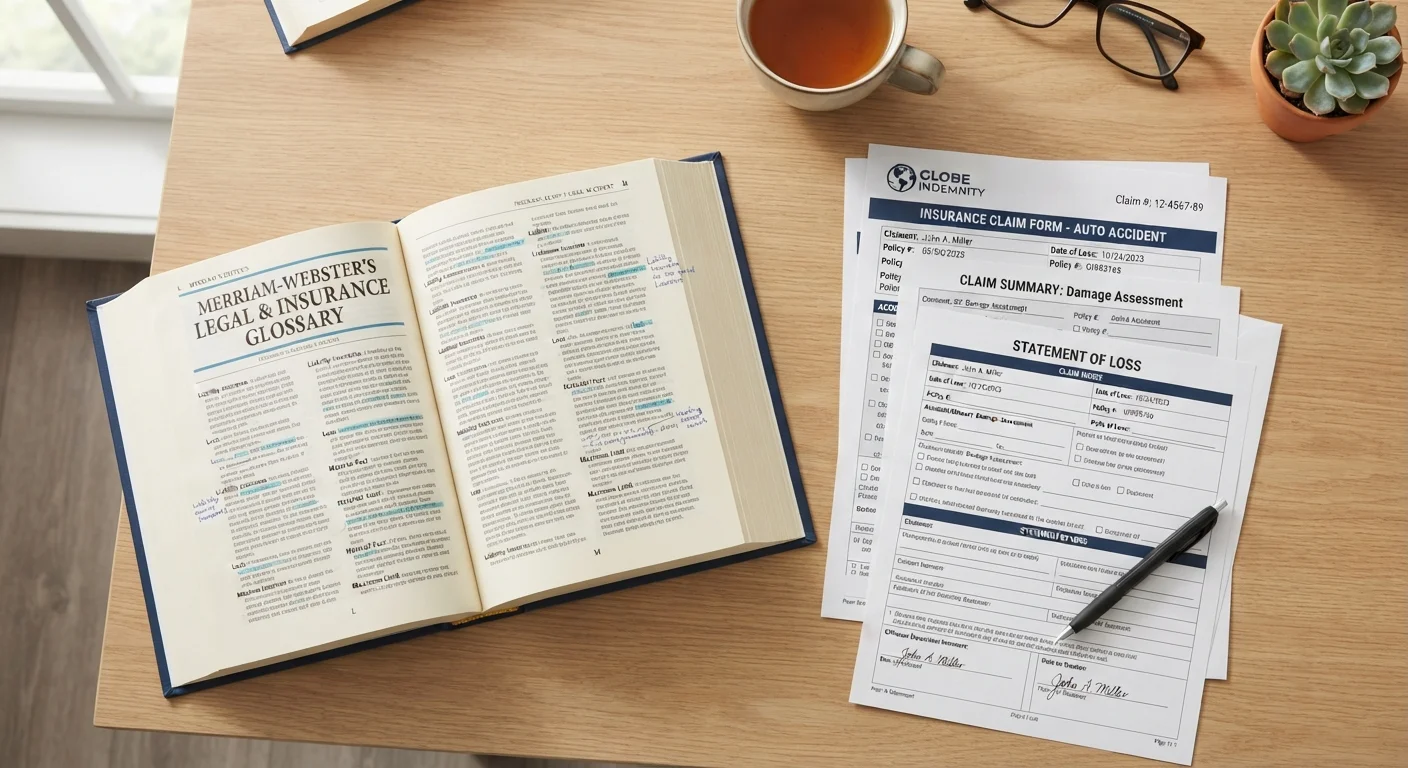
Photo credit: NewBizBuzz.net | Financial Insights For All
From 'subrogation' to 'proof of loss', this reference glossary decodes the terminology you'll encounter during the claims process.
Why Claims Language Matters
When a loss occurs, the last thing you want is to feel lost in translation. Insurance policies are legal contracts, and the claims process comes with its own specialized vocabulary — terms that carry precise meanings that can affect how your claim is evaluated, how quickly it is resolved, and how much you ultimately receive.
This glossary focuses specifically on claims-stage terminology: the words and phrases you are most likely to encounter from the moment you report a loss through final settlement. For foundational policy language — premiums, deductibles, exclusions — see our companion guide to core insurance vocabulary.
Definitions here reflect general industry usage in the United States. Because policy language, coverage terms, and state regulations vary by insurer and jurisdiction, always read your actual policy documents and consult a licensed insurance professional for guidance specific to your situation.
Adjuster
A licensed professional — employed by the insurer or hired independently — who investigates a claim, assesses the extent of a covered loss, and recommends a settlement amount. A public adjuster works on behalf of the policyholder, while a staff or independent adjuster represents the insurer.
Proof of Loss
A formal, signed statement submitted by the policyholder documenting the details of a loss — what was damaged or lost, when, how, and its estimated value. Most policies require proof of loss within a specified time window after the incident; missing that deadline can jeopardize your claim.
Subrogation
The legal right that allows your insurer, after paying your claim, to pursue recovery from a third party who was responsible for the loss. For example, if another driver causes an accident and your insurer covers your repairs, the insurer may then seek reimbursement from the at-fault driver's insurance.
Covered Peril
A specific cause of loss — such as fire, wind, theft, or water damage — that is explicitly covered under a policy. Claims are only eligible for payment if the loss resulted from a covered peril; losses caused by excluded perils are denied.
Actual Cash Value (ACV)
A settlement method that pays the depreciated value of a damaged or lost item at the time of the loss, not what it would cost to replace it new. ACV accounts for age, condition, and wear, which means payouts are often lower than replacement cost.
Replacement Cost Value (RCV)
A settlement method that pays the full cost to repair or replace a damaged item with a comparable new one, without deducting for depreciation. RCV policies typically carry higher premiums than ACV policies but can provide significantly greater recovery after a major loss.
Reservation of Rights
A formal notice from an insurer stating that it will investigate and may pay a claim, while reserving the right to deny coverage later if the investigation reveals a policy exclusion applies. Receiving this notice does not mean your claim is denied — it signals the insurer needs more information.
Appraisal Clause
A policy provision that provides a mechanism to resolve disputes over the dollar amount of a loss when the insurer and policyholder disagree. Each party selects an independent appraiser; if those two cannot agree, they jointly select an umpire whose decision is typically binding.
Depreciation
The reduction in an item's value due to age, use, and wear and tear. Insurers apply depreciation when calculating ACV settlements. On RCV policies, withheld depreciation may be released once repairs or replacement are completed and documented.
Mortgagee Clause
A provision in a property insurance policy that protects a lender's financial interest in the insured property. Claim payments may be made jointly to the policyholder and the lender, and the lender's coverage may remain intact even if the policyholder's coverage is voided.
Excess Clause
A policy provision specifying that coverage only applies to losses above a certain threshold, functioning similarly to a deductible. It determines how costs are shared when multiple insurance policies apply to the same loss.
Loss of Use
Coverage that pays for additional living expenses or lost rental income when a covered loss makes a home or property temporarily uninhabitable or unavailable. Policies cap this benefit by time period, dollar amount, or both.
Key Concepts in the Claims Process
Beyond individual definitions, it helps to understand how these terms connect during a real claim. The sequence typically runs: you report a loss and submit a proof of loss; an adjuster investigates and documents the damage; the insurer determines coverage based on your policy's covered perils and any applicable exclusions; a settlement is offered; and you accept, negotiate, or invoke appraisal or other dispute mechanisms.
| Time limit to file proof of loss | Typically 60–90 days after the loss (Varies by policy and state law; check your specific policy) |
| ACV vs. RCV | ACV deducts depreciation; RCV pays full replacement cost (Standard industry distinction; confirm which applies in your policy) |
| Public adjuster role | Advocates for the policyholder, not the insurer (Licensed at the state level in most US jurisdictions) |
| Subrogation waiver | Can be added by endorsement in some policies (Common in commercial and contractor agreements) |
| Appraisal vs. litigation | Appraisal resolves amount disputes; litigation resolves coverage disputes (General industry practice; policy language governs specifics) |
Understanding where you are in that sequence — and what each party is obligated to do — is central to protecting your interests. For a practical walkthrough of each stage, including documentation strategies and adjuster communication tips, see our guide on navigating the claims process without losing your footing.
If you want to understand the broader landscape of what insurance covers beyond the claims context, our coverage types hub maps the major insurance categories.
This article is for general informational and educational purposes only. It does not constitute personalized insurance, financial, or legal advice. Coverage terms, exclusions, claim procedures, and regulatory requirements vary by insurer, policy, and state. Always read your policy documents carefully and consult a licensed insurance agent or adviser before making decisions about your coverage or claims.

Author
Insurance Explained Editorial Team
Insurance Explained Editorial Team is the collective byline for our editorial team and contributor network. Articles published under this byline or an editorial pen name are researched, written, and reviewed according to our editorial standards for clarity, consistency, and independence before publication.
View all articles →