
High Deductibles and Lower Premiums: A Trade-Off Worth Understanding
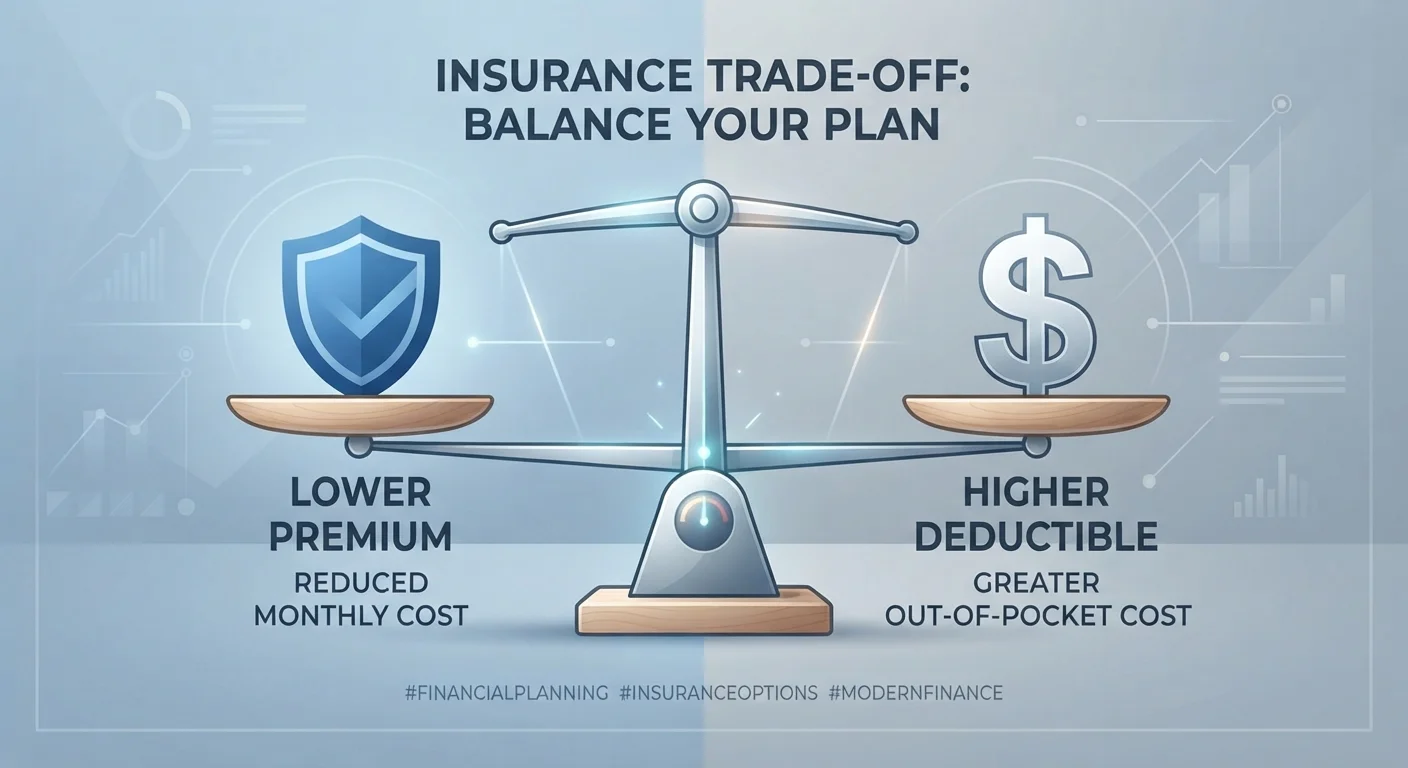
Photo credit: NewBizBuzz.net | Financial Insights For All
In this article
Choosing a higher deductible reduces your premium but shifts more risk onto you. Explore when that trade-off makes financial sense—and when it doesn't.
Key Takeaways
- A higher deductible lowers your monthly premium but increases what you owe before insurance pays.
- This trade-off benefits healthy, financially stable individuals who rarely file claims.
- HDHPs paired with HSAs offer a tax-advantaged way to manage the higher out-of-pocket risk.
- The math only works if your premium savings exceed your realistic claims exposure over time.
- Always verify your ability to cover the full deductible in cash before choosing a high-deductible plan.
Lower monthly or annual premium payments
Premium reductions from a higher deductible can be substantial — sometimes hundreds of dollars per year — freeing cash for other financial priorities or emergency savings.
HSA eligibility unlocks tax advantages
Qualifying high-deductible health plans allow contributions to a Health Savings Account, which offers a triple tax benefit: pre-tax contributions, tax-free growth, and tax-free withdrawals for qualified medical expenses.
Rational choice for low-utilization individuals
Healthy adults who rarely visit a doctor or file claims are statistically unlikely to reach a high deductible in a given year, making lower premiums a net financial gain.
Encourages cost-conscious healthcare decisions
When you're spending your own money before coverage kicks in, you're more likely to compare costs, question necessity, and seek efficient care — behaviors that can reduce overall spending.
Large out-of-pocket cost when claims occur
A single significant medical event, accident, or property claim can trigger a deductible payment of thousands of dollars — a serious financial strain without an adequate emergency fund.
Premium savings may not outpace claim costs
If you file even one modest claim per year, the money saved on premiums can quickly be consumed by your higher deductible, erasing the perceived financial benefit.
Poor fit for chronic conditions or frequent care
Individuals who regularly use prescriptions, specialist visits, or ongoing treatment will typically reach their deductible annually, making a high-deductible plan more expensive in practice.
Risk of delaying necessary care due to cost
Research has shown that high out-of-pocket costs can lead some individuals to defer or avoid medically necessary care, which can worsen health outcomes and ultimately increase costs.
What the Trade-Off Actually Means
Every insurance policy sits on a financial seesaw: as your deductible rises, your premium falls — and vice versa. The deductible is the amount you pay out of pocket before your insurer begins covering eligible claims. The premium is what you pay (monthly or annually) simply to maintain coverage.
When you accept a higher deductible, you're effectively telling the insurer: "I'll absorb more of the initial loss; charge me less for the policy." Insurers reward that promise with lower premiums because your higher threshold reduces how often they must pay out. This is the core mechanics of risk transfer — you retain more risk in exchange for a lower cost of coverage.
For a deeper look at how insurers calculate what you pay, see how insurers assess risk and set premiums. The same logic that governs your rate also determines how much the deductible shift is worth to you financially.
This trade-off isn't unique to insurance. The fundamental relationship between risk and return shapes nearly every financial decision — accepting more exposure in exchange for a potential reward.
The Case For a Higher Deductible
Lower monthly or annual premium payments
Premium reductions from a higher deductible can be substantial — sometimes hundreds of dollars per year — freeing cash for other financial priorities or emergency savings.
HSA eligibility unlocks tax advantages
Qualifying high-deductible health plans allow contributions to a Health Savings Account, which offers a triple tax benefit: pre-tax contributions, tax-free growth, and tax-free withdrawals for qualified medical expenses.
Rational choice for low-utilization individuals
Healthy adults who rarely visit a doctor or file claims are statistically unlikely to reach a high deductible in a given year, making lower premiums a net financial gain.
Encourages cost-conscious healthcare decisions
When you're spending your own money before coverage kicks in, you're more likely to compare costs, question necessity, and seek efficient care — behaviors that can reduce overall spending.
The strongest argument for a high-deductible plan is straightforward: if you rarely use your insurance, you're effectively subsidizing other policyholders with a low-deductible plan's higher premium. Redirecting those savings — especially into a Health Savings Account (HSA) — can build a tax-advantaged reserve that covers future claims and compounds over time.
High-Deductible Health Plans (HDHPs) are the most common formal category. The IRS sets minimum deductible thresholds annually for HDHP qualification, and pairing one with an HSA allows pre-tax contributions that can be invested and withdrawn tax-free for qualified medical expenses.
The Case Against a Higher Deductible
Large out-of-pocket cost when claims occur
A single significant medical event, accident, or property claim can trigger a deductible payment of thousands of dollars — a serious financial strain without an adequate emergency fund.
Premium savings may not outpace claim costs
If you file even one modest claim per year, the money saved on premiums can quickly be consumed by your higher deductible, erasing the perceived financial benefit.
Poor fit for chronic conditions or frequent care
Individuals who regularly use prescriptions, specialist visits, or ongoing treatment will typically reach their deductible annually, making a high-deductible plan more expensive in practice.
Risk of delaying necessary care due to cost
Research has shown that high out-of-pocket costs can lead some individuals to defer or avoid medically necessary care, which can worsen health outcomes and ultimately increase costs.
The trade-off collapses if you can't actually cover the deductible when a claim occurs. A $4,000 deductible on a car accident or hospital visit is a genuine financial emergency for anyone without liquid reserves to match it. Lower premiums feel like savings right up until the moment you need coverage — and then the out-of-pocket cost can wipe out months of premium savings in a single event.
The Liquidity Requirement Is Non-Negotiable
Choosing a high-deductible plan only makes sense if you can pay the full deductible amount in cash without going into debt. Before selecting a plan, confirm that your emergency fund or HSA balance can absorb the maximum out-of-pocket exposure. If it cannot, the premium savings represent a false economy — lower monthly costs paired with hidden financial fragility.
For people with predictable, recurring medical needs, the math rarely favors a high deductible. The coverage gap in health insurance is precisely where high-deductible plans expose policyholders most.
Running the Numbers: A Simple Break-Even Test
Before choosing a plan tier, run a break-even calculation:
- Calculate annual premium savings — subtract the higher-deductible plan's annual premium from the lower-deductible plan's annual premium.
- Calculate your additional exposure — subtract the lower deductible from the higher deductible. This is the extra amount you'd owe if a significant claim occurred.
- Divide exposure by savings — this tells you how many claim-free years it takes to break even.
If the higher-deductible plan saves $600 per year in premiums but exposes you to an additional $2,400 in potential costs, you need four claim-free years just to break even. If your history and health suggest that's realistic, the trade-off may be worthwhile. If not, the apparent savings are illusory.
~58%
U.S. workers enrolled in HDHPs
According to KFF's Employer Health Benefits Survey, high-deductible plans now cover a majority of privately insured American workers, reflecting the broad adoption of this coverage structure.
$1,600+
IRS minimum deductible for individual HDHP
The IRS sets the minimum deductible threshold required for HDHP qualification annually; in recent years the individual minimum has been $1,600 or higher, with family plans set at roughly double.
Those considering an extreme version of this strategy — forgoing insurance almost entirely — should understand the limits. Self-insurance has genuine use cases, but it requires substantial reserves and a clear-eyed assessment of catastrophic risk.
This article is general educational information and does not constitute personalized financial, insurance, or legal advice. Coverage terms, deductible limits, and tax rules vary by plan and state. Consult a licensed insurance agent or financial adviser before making coverage decisions based on your specific circumstances.

Author
Insurance Explained Editorial Team
Insurance Explained Editorial Team is the collective byline for our editorial team and contributor network. Articles published under this byline or an editorial pen name are researched, written, and reviewed according to our editorial standards for clarity, consistency, and independence before publication.
View all articles →